
Science Words That Start With O | List of Scientific Terms and Meanings

The letter “O” introduces a wide range of fascinating scientific terms that help explain how our universe works. Across fields such as physics, chemistry, biology, medicine, and Earth science, words that start with “O” represent important ideas that shape our understanding of nature. Whether it’s studying organisms in biology, exploring optics in physics, or examining oceanography to understand our planet’s oceans, each term reveals a piece of the scientific puzzle. Learning these science words not only strengthens vocabulary but also makes complex concepts easier to understand, helping students and curious minds connect with the discoveries and innovations that define the modern scientific world.
Importance of Science Words Starting With O
Science words that start with the letter “O” play an important role in helping students and researchers understand key scientific concepts across many fields. Terms like orbit, osmosis, oxygen, and organism are fundamental to subjects such as physics, biology, chemistry, and Earth science. Learning these words improves scientific vocabulary, making it easier to read textbooks, understand experiments, and communicate scientific ideas clearly. These terms also help explain natural processes, from how planets move in space to how cells function in living organisms.
Science Words With O For Beginners
- Orbit – The curved path an object follows around another object in space due to gravity.
- Oxygen – A chemical element essential for breathing and combustion.
- Ocean – A vast body of saltwater covering most of Earth’s surface.
- Organism – Any living thing such as a plant, animal, or microbe.
- Observation – The act of carefully watching or measuring something in science.
- Object – Any physical item that can be seen or touched.
- Optics – The study of light and how it behaves.
- Osmosis – The movement of water through a semi-permeable membrane.
- Organ – A body part that performs a specific function.
- Ozone – A gas in Earth’s atmosphere that protects life from harmful UV rays.
- Oar – A tool used to move boats, often studied in physics when learning about force.
- Oil – A liquid substance used as fuel or lubricant.
- Oxygen Cycle – The natural process that circulates oxygen through Earth’s systems.
- Output – The result produced by a system or experiment.
- Origin – The starting point or beginning of something.
- Ovary – The reproductive organ in female animals and plants that produces eggs.
- Optical Lens – A transparent object that focuses light.
- Orbital Path – The route followed by planets or satellites around another body.
- Organic Matter – Material that comes from living organisms.
- Oxide – A compound formed when oxygen combines with another element.
- Ocean Current – Continuous movement of seawater in oceans.
- Orientation – The position or direction of an object in space.
- Observation Tool – Instruments like microscopes used to study objects.
- Outflow – Movement of liquid or gas outward from a source.
- Ozone Layer – A protective region in the atmosphere containing ozone gas.
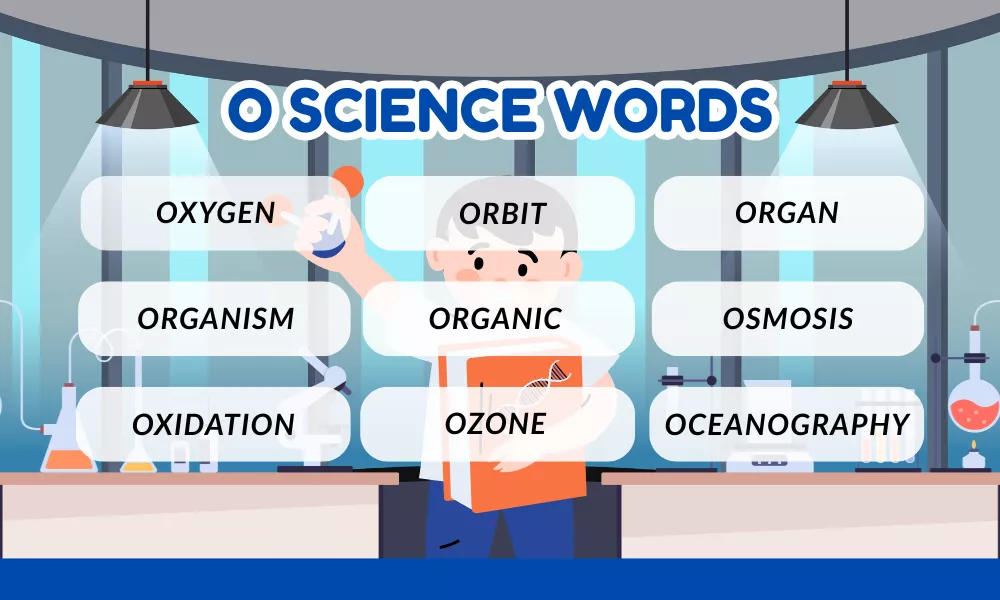
Core Science Terms With Letter O
- Orbit – The gravitational path of one body around another.
- Oxidation – A chemical reaction where a substance loses electrons.
- Osmosis – Diffusion of water across a membrane.
- Organism – A living system capable of growth and reproduction.
- Optics – Branch of physics studying light behavior.
- Observation – Gathering information using senses or instruments.
- Organic Chemistry – Study of carbon-containing compounds.
- Ozone – A molecule made of three oxygen atoms.
- Orbital – Region around an atom’s nucleus where electrons are likely found.
- Oxide – Compound containing oxygen.
- Osmotic Pressure – Pressure required to stop osmosis.
- Oligomer – Molecule made of a few repeating units.
- Outgassing – Release of gases trapped in materials.
- Optical Fiber – Thin glass fiber that transmits light signals.
- Oogenesis – Formation of egg cells in females.
- Oncology – Study of cancer and tumors.
- Oceanography – Study of oceans and marine environments.
- Olfaction – The sense of smell.
- Ozone Depletion – Reduction of ozone concentration in the atmosphere.
- Oxidizing Agent – Substance that causes oxidation in another substance.
- Organic Compound – Carbon-based chemical compound.
- Oscillation – Repeated back-and-forth motion.
- Oviparous – Animals that reproduce by laying eggs.
- Oligotrophic – Environment low in nutrients.
- Outbreak – Sudden increase in disease occurrence.
Physics Science Words That Start With O
- Orbit – The path of an object around another due to gravity.
- Oscillation – Repeated motion back and forth around a point.
- Optics – Study of light and its interaction with matter.
- Ohm – Unit of electrical resistance.
- Ohm’s Law – Relationship between voltage, current, and resistance.
- Orbital Motion – Motion of bodies moving in curved paths around another body.
- Optical Lens – Device that focuses or spreads light rays.
- Optical Reflection – Bouncing of light off a surface.
- Optical Refraction – Bending of light when entering another medium.
- Optical Spectrum – Range of visible light wavelengths.
- Oscillator – Device producing periodic signals.
- Orbital Velocity – Speed required to maintain orbit.
- Optical Fiber – Medium that transmits light signals.
- Output Power – Amount of energy produced by a system.
- Orientation – Direction or alignment of an object.
- Overtone – Higher frequency sound accompanying a fundamental tone.
- Oscillating Wave – Wave showing repeated motion cycles.
- Optical Density – Measure of how much light a material absorbs.
- Open System – System that exchanges energy and matter with surroundings.
- Orbital Period – Time taken for one full orbit.
- Optical Illusion – Visual perception that differs from reality.
- Oscillatory Motion – Motion that repeats regularly.
- Optoelectronics – Study of electronic devices that interact with light.
- Orbital Energy – Energy associated with objects in orbit.
- Optical Instrument – Tools like telescopes and microscopes used to observe light.
Chemistry Science Words That Start With O
| Word | Description |
|---|---|
| Oxidation | Loss of electrons during a chemical reaction. |
| Oxidizing Agent | Substance that gains electrons and causes oxidation. |
| Oxide | Compound formed when oxygen reacts with another element. |
| Organic Chemistry | Study of carbon compounds. |
| Organic Compound | Chemical compound containing carbon. |
| Oxygen | Element essential for combustion and respiration. |
| Ozone | Triatomic oxygen molecule with strong oxidizing ability. |
| Oligomer | Molecule formed from a few repeating units. |
| Organometallic Compound | Compound containing metal-carbon bonds. |
| Octane | Hydrocarbon used in gasoline. |
| Octet Rule | Atoms tend to form bonds to complete eight electrons. |
| Oxalic Acid | Organic acid found in plants. |
| Olefin | Another name for alkenes containing double bonds. |
| Osmotic Pressure | Pressure needed to stop osmosis. |
| Oxonium Ion | Positively charged oxygen ion. |
| Ozone Layer Chemistry | Reactions controlling ozone concentration. |
| Organic Reaction | Chemical reaction involving organic compounds. |
| Oxidation State | Charge assigned to atoms in a compound. |
| Oxidative Reaction | Reaction involving oxygen or electron loss. |
| Organosulfur Compound | Organic compound containing sulfur. |
| Oxyacid | Acid containing oxygen atoms. |
| Oxidative Stress | Chemical imbalance involving reactive oxygen species. |
| Oxyanion | Negatively charged ion containing oxygen. |
| Oxygenation | Addition of oxygen to a compound. |
| Organic Solvent | Carbon-based liquid used to dissolve substances. |
Biology Science Words That Start With O
- Organism – Any living entity capable of life processes.
- Organ – Group of tissues performing a specific function.
- Osmosis – Movement of water across a membrane.
- Ovary – Female reproductive organ producing eggs.
- Ovum – Female reproductive cell or egg.
- Oocyte – Immature egg cell.
- Oogenesis – Process of egg cell formation.
- Olfactory System – System responsible for smell.
- Oncology – Study of tumors and cancer.
- Osteology – Study of bones.
- Osteocyte – Bone cell maintaining bone tissue.
- Osteoblast – Cell responsible for forming bone.
- Osteoclast – Cell that breaks down bone tissue.
- Organ System – Group of organs working together.
- Oviparous – Animals that reproduce by laying eggs.
- Ovulation – Release of an egg from the ovary.
- Oxytocin – Hormone involved in childbirth and bonding.
- Oxygen Transport – Movement of oxygen in blood via hemoglobin.
- Oligotrophic Environment – Habitat with low nutrients.
- Opportunistic Infection – Infection occurring when immunity is weak.
- Osmoregulation – Regulation of water and salt balance in organisms.
- Optic Nerve – Nerve transmitting visual information to the brain.
- Ocular System – Structures related to the eye.
- Oral Cavity – The mouth area involved in digestion.
- Ontogeny – Development of an organism from embryo to adult.
Math Science Words That Start With O
- Obtuse Angle – An angle greater than 90° but less than 180°.
- Octagon – A polygon with eight sides and eight angles.
- Octahedron – A 3D shape with eight triangular faces.
- Ordinal Number – A number that shows position or order (first, second, third).
- Order of Operations – Rules that determine the correct sequence for solving mathematical expressions.
- Origin – The point (0,0) where the x-axis and y-axis intersect on a graph.
- Orthogonal – Lines or vectors that intersect at a 90° angle.
- Odd Number – A number that cannot be evenly divided by two.
- Outcome – A possible result of an experiment or probability event.
- Operation – A mathematical process such as addition, subtraction, multiplication, or division.
- Open Interval – A range of numbers that does not include its endpoints.
- Ordered Pair – A pair of numbers representing coordinates on a graph (x, y).
- Order – The arrangement or sequence of numbers or objects.
- Orthocenter – The intersection point of the altitudes of a triangle.
- One-to-One Function – A function where each input corresponds to exactly one output.
- Oblique Line – A slanted line that is neither vertical nor horizontal.
- Objective Function – A function that needs to be maximized or minimized in optimization problems.
- Octal System – A number system with base 8.
- Orthant – A region in a coordinate system divided by axes.
- Operation Symbol – Mathematical symbols like +, −, ×, ÷.
- Outlier – A value that is significantly different from other values in a dataset.
- Offset – A value added or subtracted to adjust results.
- Optimization – The process of finding the best possible solution to a problem.
- Order Statistic – A value that represents the rank of an element in a dataset.
- Opposite Numbers – Numbers that have the same magnitude but different signs.
Computer Science Words That Start With O
- Object – A data structure that contains data and methods in object-oriented programming.
- Object-Oriented Programming (OOP) – Programming paradigm based on objects and classes.
- Operating System – Software that manages computer hardware and software resources.
- Open Source – Software with publicly available source code that anyone can modify.
- Output – Data produced by a computer system after processing.
- Online – Being connected to a computer network or the internet.
- Offline – Not connected to a network or internet.
- Overclocking – Running a computer processor at a higher speed than its default setting.
- Opcode – A portion of a machine language instruction specifying the operation to perform.
- Object Code – Compiled machine code generated from source code.
- Optical Storage – Data storage using light such as CDs or DVDs.
- Overlay – A programming technique for loading programs into limited memory.
- OpenGL – A graphics library used for rendering 2D and 3D graphics.
- OCR (Optical Character Recognition) – Technology that converts images of text into digital text.
- Operating Memory – Memory used for running programs.
- Object Class – A blueprint for creating objects in programming.
- Overflow Error – Error occurring when a number exceeds the storage capacity of a data type.
- Optimization – Improving code performance or efficiency.
- Out-of-Bounds Error – Error when accessing memory outside an array’s range.
- Open Network – Network accessible to multiple users without strict restrictions.
- Object Model – Framework describing objects, their properties, and relationships.
- On-Premise System – Software installed locally on company hardware.
- Object Database – Database that stores data in object format.
- Operating Environment – Hardware and software setup in which programs run.
- Open Standard – Publicly available specification for software compatibility.
Earth And Space Science Vocabulary With O
- Orbit – The path of a planet, moon, or satellite around another body.
- Oceanography – The scientific study of oceans and marine environments.
- Ozone Layer – Atmospheric layer that absorbs harmful ultraviolet radiation.
- Orogeny – The process of mountain formation.
- Outcrop – Visible rock formations exposed on Earth’s surface.
- Ocean Current – Continuous movement of seawater in a particular direction.
- Ophiolite – Rock formation representing oceanic crust lifted onto land.
- Ozone Depletion – Reduction in the ozone layer caused by pollutants.
- Orbital Period – Time taken by a celestial body to complete one orbit.
- Outer Core – The liquid layer of Earth’s core beneath the mantle.
- Ocean Basin – Large depression in Earth’s surface filled with seawater.
- Oxbow Lake – A curved lake formed when a river meander is cut off.
- Orbital Plane – The flat surface on which an orbit lies.
- Ocean Ridge – Underwater mountain range formed by tectonic activity.
- Outgassing – Release of gases from a planet’s interior.
- Obliquity – The tilt of a planet’s rotational axis.
- Ozone Hole – Area where ozone concentration is significantly reduced.
- Ocean Salinity – Measure of dissolved salts in ocean water.
- Orbital Mechanics – Study of motion of objects in space under gravity.
- Ocean Trenches – Deep underwater valleys formed by tectonic plates.
- Orogenic Belt – Region where mountain-building occurs.
- Oceanic Crust – Thin outer layer of Earth beneath oceans.
- Ozone Photochemistry – Chemical reactions affecting ozone in the atmosphere.
- Orbital Inclination – Angle of a body’s orbit relative to a reference plane.
- Ocean Upwelling – Rising of deep ocean water to the surface.
Engineering And Applied Science Terms With O
- Optimization – Improving efficiency or performance of systems.
- Oscillator – Device producing periodic electrical signals.
- Ohmmeter – Instrument used to measure electrical resistance.
- Operational Amplifier – Electronic amplifier used in circuits.
- Output Power – Amount of power delivered by a system.
- Overload – Condition where equipment operates beyond its capacity.
- Open Circuit – Electrical circuit where current cannot flow.
- Oscillating System – System showing repetitive motion.
- Operating Voltage – Voltage required for proper functioning of equipment.
- Optical Sensor – Device that detects light and converts it into signals.
- Oil Lubrication – Use of oil to reduce friction in machines.
- Offset Error – Deviation from expected measurement values.
- Output Signal – Electrical signal produced by a device.
- Overcurrent Protection – Safety mechanism preventing excessive current.
- Open Loop Control – Control system without feedback.
- Oscillation Frequency – Rate at which oscillation repeats.
- Operational Efficiency – Measure of system performance.
- Optical Engineering – Engineering focused on light-based technologies.
- Oxygen Sensor – Device measuring oxygen levels in systems like engines.
- Overvoltage Protection – Protection against excessive voltage.
- Output Shaft – Rotating shaft delivering mechanical power.
- Operating Temperature – Temperature range for safe equipment use.
- Optical Alignment – Proper positioning of optical components.
- Onboard System – Equipment installed within a machine or vehicle.
- Overrun – When a machine runs beyond its intended limit.
General Scientific Words Starting With O
- Observation – Careful watching and recording of scientific phenomena.
- Objective – A goal or purpose of a scientific study.
- Outcome – The result of an experiment or study.
- Origin – The beginning or source of something.
- Organism – Any living being.
- Osmosis – Movement of water through a semi-permeable membrane.
- Optics – Study of light and its properties.
- Oxidation – Chemical process involving loss of electrons.
- Ozone – Molecule made of three oxygen atoms in the atmosphere.
- Orbit – Path of an object moving around another in space.
- Organic Matter – Material derived from living organisms.
- Outbreak – Sudden increase in occurrence of disease.
- Olfaction – Sense of smell.
- Oncology – Study and treatment of cancer.
- Oceanography – Scientific study of oceans.
- Oscillation – Repetitive movement around a central point.
- Optical Instrument – Tool that uses light for observation.
- Output – Result produced by a system.
- Open System – System exchanging matter and energy with surroundings.
- Organic Chemistry – Study of carbon-based compounds.
- Oviparous – Animals that reproduce by laying eggs.
- Osmoregulation – Regulation of water balance in organisms.
- Orbital – Region around atomic nucleus where electrons exist.
- Oxygenation – Addition of oxygen to a system.
- Ozone Chemistry – Study of ozone reactions in the atmosphere.
How To Learn & Remember O Science Vocabulary Easily
- Group Words by Science Subject
One of the easiest ways to remember science vocabulary is by organizing words into categories such as physics, biology, chemistry, or earth science. For example, words like orbit relate to space science, while osmosis belongs to biology. Grouping similar terms helps your brain create stronger connections and makes studying more structured. - Use Visual Learning Techniques
Many science terms are easier to remember when you visualize them. Draw simple diagrams for concepts like orbit, optics, or organism. Visual learning activates memory and helps you recall definitions quickly during exams or discussions. - Practice With Flashcards
Flashcards are an effective way to review science vocabulary. Write the word on one side and its meaning on the other. Regularly testing yourself with flashcards improves memory retention and helps you master words starting with “O” faster. - Create Real-Life Examples
Connecting science words to everyday life makes them easier to remember. For instance, think about how the ozone layer protects Earth from harmful sunlight or how oxygen is essential for breathing. Real-world connections make scientific terms more meaningful. - Use Mnemonics and Word Associations
Mnemonics are memory tricks that help you remember complex terms. You can associate aReview and Apply the Words Regularly
word like osmosis with “water moving through cells” or link orbit with “objects moving around planets.” These mental shortcuts make vocabulary easier to recall. - Repetition is key to mastering scientific vocabulary. Try writing sentences using the terms, discussing them in study groups, or solving science problems that involve these words. The more you use the vocabulary, the more naturally you will remember it.
FAQs
Conclusion
Science words that start with the letter “O” play an important role in helping us understand the natural world. From fundamental concepts like oxygen, orbit, and organism to advanced scientific terms used in physics, chemistry, biology, and earth science, these words represent essential ideas that shape modern science. Learning and understanding this vocabulary not only improves scientific knowledge but also strengthens communication and critical thinking skills. By organizing terms by subject, using visual learning methods, practicing with flashcards, and connecting concepts to real-life examples, students can easily remember and apply these important science words.