
Science Words That Start With M – Scientific Terms List

Science words that start with M open the door to some of the most meaningful and mind-expanding concepts in every branch of science. From tiny molecules that form all matter to the vast Milky Way stretching across the universe, “M” words help us explore life, energy, space, and transformation. Terms like magnetism, mutation, metabolism, and metamorphosis explain how the world changes, grows, and functions at both microscopic and cosmic levels. Learning these words not only strengthens scientific vocabulary but also makes it easier to understand experiments, textbooks, and real-world discoveries.
Importance of Science Words Starting With M
Science words that begin with M play a major role in building strong foundational knowledge across subjects like chemistry, biology, physics, medicine, and engineering. Key terms such as molecule, mass, magnetism, and metabolism represent core scientific ideas that students encounter early and continue using in advanced studies. Understanding these words improves scientific literacy, making it easier to read textbooks, conduct experiments, and communicate complex ideas clearly. Learning vocabulary by letter also makes study more organized and engaging, especially for young learners.
Science Words With M For Beginners
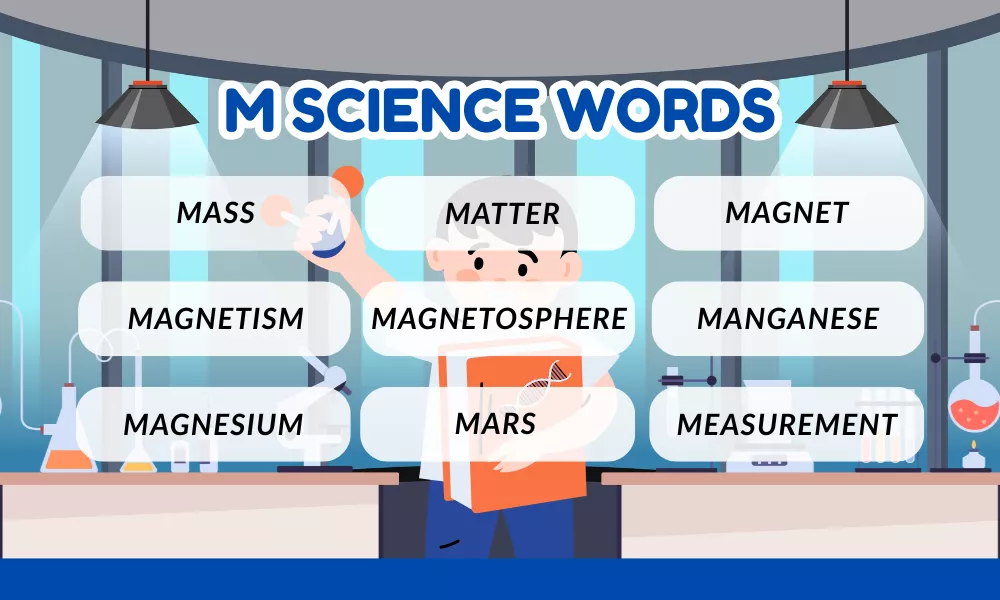
- Matter – Anything that has mass and takes up space.
- Mass – The amount of matter in an object.
- Molecule – A group of atoms bonded together.
- Magnet – An object that attracts iron and certain metals.
- Magnetism – The force that magnets create.
- Metal – A shiny, strong material like iron or copper.
- Mineral – A natural solid found in the Earth.
- Microbe – A tiny living organism seen only with a microscope.
- Microscope – A tool used to see very small objects.
- Motion – Movement from one place to another.
- Mixture – A combination of substances not chemically joined.
- Melting – Changing from solid to liquid.
- Magnetic Field – The area around a magnet where force acts.
- Muscle – Body tissue that helps movement.
- Mutation – A change in genes.
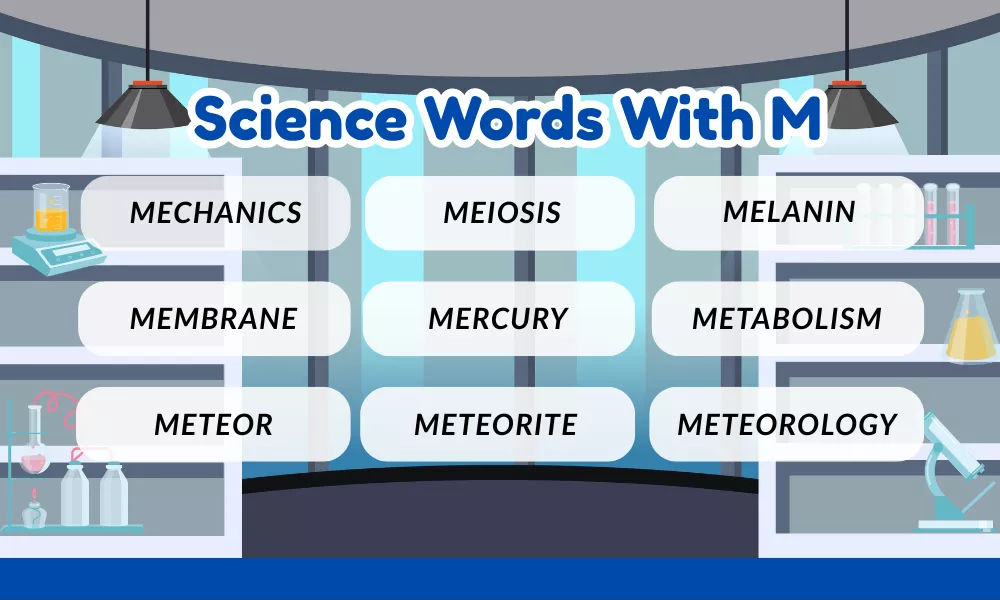
- Meteor – A space rock that burns in Earth’s atmosphere.
- Moon – A natural satellite that orbits a planet.
- Model – A representation used to explain something.
- Measurement – Finding the size or amount of something.
- Magnesium – A chemical element used in science and industry.
- Mammal – An animal that feeds milk to its young.
- Microorganism – A tiny living thing like bacteria.
- Maglev – A train that moves using magnetism.
- Momentum – The strength of motion of an object.
- Milky Way – Our home galaxy.
Core Science Terms With Letter M
- Magnitude – The size or extent of something.
- Mechanism – A system of parts working together.
- Metabolism – Chemical processes in living organisms.
- Matter Cycle – Movement of matter through ecosystems.
- Magnetic Flux – The amount of magnetic field passing through an area.
- Micrometer – A unit of length equal to one-millionth of a meter.
- Momentum Conservation – The law that momentum stays constant in a closed system.
- Mitosis – Cell division for growth and repair.
- Medium – A substance through which waves travel.
- Microgravity – Very weak gravity, like in space.
- Mutation Rate – Frequency of genetic changes.
- Mechanical Energy – Energy of motion or position.
- Magnetic Resonance – A technique used in medical imaging.
- Molarity – Concentration of a solution.
- Morphology – Study of structure and form of organisms.
- Macromolecule – A very large molecule (like proteins).
- Magnetosphere – Region around a planet affected by its magnetic field.
- Metamorphosis – Major change in body form during development.
- Microclimate – Climate of a small specific area.
- Mineralogy – Study of minerals.
- Measurement Error – Difference between measured and true value.
- Magnetic Pole – North or south end of a magnet.
- Magma – Molten rock beneath Earth’s surface.
- Mass Number – Total protons and neutrons in an atom.
- Matter-Energy – Relationship between matter and energy.
Physics Science Words That Start With M
- Mass – Quantity of matter in an object.
- Momentum – Mass in motion.
- Magnetism – Force caused by moving electric charges.
- Magnetic Field – Area where magnetic force exists.
- Magnetic Force – Attraction or repulsion between magnets.
- Mechanical Energy – Energy due to motion or position.
- Motion – Change in position over time.
- Magnitude – Strength or size of a quantity.
- Meter – SI unit of length.
- Microwave – Type of electromagnetic wave.
- Magnetic Flux – Measure of magnetic field through an area.
- Microgravity – Condition of near weightlessness.
- Momentum Conservation – Law stating momentum remains constant.
- Mass-Energy Equivalence – Concept explained by Albert Einstein that mass can convert to energy.
- Magnetic Induction – Creation of magnetic field by electric current.
- Mechanical Work – Force applied over a distance.
- Mach Number – Speed compared to sound speed.
- Magnetic Domain – Region of aligned magnetic atoms.
- Mass Defect – Difference between total mass of parts and nucleus.
- Moment of Inertia – Resistance to rotational motion.
- Magnetic Dipole – Pair of equal opposite magnetic poles.
- Medium – Substance waves travel through.
- Magnetron – Device generating microwaves.
- Measurement – Determining size or quantity.
- Multiverse – Hypothetical multiple universes concept.
Chemistry Science Words That Start With M
| Word | Description |
|---|---|
| Molecule | Group of atoms bonded chemically. |
| Molarity | Concentration of solute in solution. |
| Molality | Moles of solute per kilogram of solvent. |
| Mole | Unit measuring amount of substance. |
| Mixture | Substances combined physically. |
| Metal | Element that conducts heat and electricity. |
| Metalloid | Element with metal and nonmetal properties. |
| Magnesium | Chemical element (Mg). |
| Manganese | Chemical element (Mn). |
| Mercury | Liquid metal element (Hg). |
| Mendeleev | Scientist who created the periodic table. |
| Mass Number | Total protons and neutrons. |
| Molecular Formula | Shows types and number of atoms. |
| Molecular Weight | Mass of a molecule. |
| Melting Point | Temperature when solid becomes liquid. |
| Metallurgy | Study of metals. |
| Monomer | Small molecule forming polymers. |
| Macromolecule | Large molecule like DNA. |
| Molecular Bond | Force holding atoms together. |
| Miscible | Liquids that mix completely. |
| Molten | Melted substance. |
| Mass Spectrometry | Technique to measure atomic mass. |
| Molecular Structure | Arrangement of atoms in molecule. |
| Molar Mass | Mass of one mole of substance. |
| Methyl Group | CH₃ chemical group. |
Biology Science Words That Start With M
- Mitosis – Cell division for growth.
- Meiosis – Cell division producing reproductive cells.
- Mutation – Change in DNA sequence.
- Metabolism – Chemical reactions in cells.
- Mammal – Warm-blooded animal with hair.
- Microorganism – Tiny living organism.
- Membrane – Thin layer covering cells.
- Mitochondria – Cell organelle producing energy.
- Microbiology – Study of microorganisms.
- Morphology – Study of organism structure.
- Microbe – Tiny organism like bacteria.
- Macromolecule – Large biological molecule.
- Mycelium – Fungal root-like structure.
- Myosin – Protein involved in muscle contraction.
- Mucus – Protective body secretion.
- Multicellular – Organism made of many cells.
- Microevolution – Small evolutionary changes.
- Mutagen – Substance causing mutation.
- Microvilli – Small projections increasing absorption.
- Mesoderm – Middle embryonic layer.
- Monocot – Plant with one seed leaf.
- Metastasis – Spread of cancer cells.
- Microhabitat – Small living area for organisms.
- Metamorphosis – Developmental transformation.
- Microtubule – Cell structure maintaining shape.
Math Science Words That Start With M
- Matrix – A rectangular array of numbers arranged in rows and columns.
- Mean – The average of a set of numbers.
- Median – The middle value in an ordered data set.
- Mode – The most frequently occurring number in a data set.
- Multiple – A number obtained by multiplying another number.
- Multiplier – A quantity used to multiply another number.
- Magnitude – The size or absolute value of a number.
- Monomial – An algebraic expression with one term.
- Midpoint – The point exactly halfway between two points.
- Measure – The size, amount, or degree of something.
- Metric System – Decimal-based measurement system.
- Modulo – Operation finding the remainder after division.
- Mean Deviation – Average distance of data from the mean.
- Mapping – A relation assigning elements of one set to another.
- Mathematical Model – Representation of real-world problems using math.
- Multiplication – Arithmetic operation of repeated addition.
- Mantissa – Fractional part of a logarithm.
- Moment (Statistics) – A measure describing shape of a distribution.
- Minimum – The smallest value in a set.
- Maximum – The largest value in a set.
- Measure Theory – Branch of math studying size and probability.
- Modulus – Absolute value of a number.
- Monotonic Function – Function that only increases or decreases.
- Multivariable – Involving more than one variable.
- Mathematics – The study of numbers, patterns, and logic.
Computer Science Words That Start With M
- Machine Learning – AI systems that learn from data.
- Memory – Storage space for data in a computer.
- Microprocessor – The main processing unit on a chip.
- Motherboard – Main circuit board of a computer.
- Malware – Harmful software designed to damage systems.
- Module – Independent section of code or hardware.
- Markup Language – Language for structuring web content (like HTML).
- Multithreading – Running multiple tasks simultaneously.
- Metadata – Data that describes other data.
- Middleware – Software connecting different applications.
- Machine Code – Binary instructions executed by a CPU.
- Microcontroller – Small computer on a single chip.
- Model (AI) – Trained system used for predictions.
- Modem – Device transmitting internet signals.
- Mainframe – Large powerful computer for big organizations.
- Matrix (Computing) – Data structure of rows and columns.
- Monitoring – Tracking system performance.
- Migration (Data) – Transferring data between systems.
- Multimedia – Integration of text, audio, video, and images.
- MapReduce – Programming model for large data processing.
- Microservices – Software architecture of small services.
- Mount (Computing) – Connecting storage to a system.
- MAC Address – Unique network hardware identifier.
- Multiplayer – Multiple users interacting in a system.
- Message Queue – System for communication between processes.
Earth And Space Science Vocabulary With M
- Magma – Molten rock beneath Earth’s surface.
- Mantle – Layer between Earth’s crust and core.
- Meteor – Space rock burning in atmosphere.
- Meteorite – Meteor that reaches Earth’s surface.
- Meteorology – Study of weather.
- Monsoon – Seasonal wind causing heavy rain.
- Magnetosphere – Magnetic field region around Earth.
- Milky Way – Our home galaxy.
- Mars – The red planet in our solar system.
- Moon – Natural satellite orbiting a planet.
- Mid-Ocean Ridge – Underwater mountain range formed by tectonics.
- Metamorphic Rock – Rock changed by heat and pressure.
- Microclimate – Climate of a small area.
- Magnetic Pole – North or south end of Earth’s magnetic field.
- Magnitude (Earthquake) – Measurement of earthquake strength.
- Mass Extinction – Event causing widespread species loss.
- Marine Biology – Study of ocean life.
- Magnetic Field – Area influenced by magnetic force.
- Mesosphere – Atmospheric layer above the stratosphere.
- Mineral – Naturally occurring inorganic solid.
- Mountain – Large landform rising above surroundings.
- Microgravity – Near-weightless condition in space.
- Magnetite – Magnetic mineral.
- Meteoroid – Small rocky object in space.
- Milankovitch Cycles – Variations in Earth’s orbit affecting climate.
Engineering And Applied Science Terms With M
- Mechanics – Study of forces and motion.
- Machine – Device that performs work.
- Manufacturing – Production of goods.
- Material Science – Study of material properties.
- Microfabrication – Manufacturing tiny structures.
- Mechanism – System of moving parts.
- Motor – Device converting energy to motion.
- Measurement System – Tools for precise measurements.
- Modulus of Elasticity – Measure of material stiffness.
- Mechanical Engineering – Engineering field focused on machines.
- Maintenance – Process of keeping systems working.
- Microelectronics – Study of very small electronic circuits.
- Modeling – Creating representations of systems.
- Mechatronics – Integration of mechanics and electronics.
- Metalworking – Process of shaping metal.
- Machining – Cutting material to desired shape.
- Momentum Transfer – Movement of motion between objects.
- Magnetics – Study of magnetic systems.
- Microstructure – Internal structure of materials.
- Mounting – Securing components in place.
- Metrology – Science of measurement.
- Modular Design – System built from separate units.
- Microprocessor System – Embedded computing unit.
- Mechanized System – Automated mechanical setup.
- Microfluidics – Technology controlling small amounts of fluids.
General Scientific Words Starting With M
- Matter – Anything with mass and volume.
- Mass – Amount of matter in an object.
- Measurement – Determining size or quantity.
- Model – Simplified representation of reality.
- Method – Systematic procedure in experiments.
- Mechanism – Process explaining how something works.
- Mutation – Genetic change in DNA.
- Metabolism – Chemical reactions in organisms.
- Microorganism – Tiny living organism.
- Microscope – Instrument to view small objects.
- Magnetism – Physical force from magnetic fields.
- Magnetic Field – Region of magnetic influence.
- Momentum – Quantity of motion.
- Magnitude – Size or extent.
- Medium – Substance through which waves travel.
- Metamorphosis – Biological transformation.
- Microbiology – Study of microscopic life.
- Molecule – Group of bonded atoms.
- Mineral – Naturally occurring solid substance.
- Molarity – Concentration of solution.
- Macromolecule – Large molecule like protein.
- Mitosis – Cell division for growth.
- Magnetic Resonance – Imaging technique used in medicine.
- Multicellular – Made of many cells.
- Microclimate – Local climate conditions.
How To Learn & Remember M Science Vocabulary Easily
- Group Words by Science Branch
Learn M words by category like biology (metabolism, mitosis), chemistry (molecule, molarity), physics (mass, momentum). Grouping builds stronger mental connections and reduces confusion. - Use the “M-Map” Technique
Create a mind map with M in the center, branching out to terms like magnetism, microbe, mutation, and metamorphosis. Visual mapping boosts long-term memory. - Connect Words to Real Life
Relate terms to daily experiences like magnets on a fridge (magnetism), food digestion (metabolism), or insects changing form (metamorphosis). Real-life links make concepts stick. - Learn with Micro-Definitions
Write very short meanings (5–7 words) first, then expand later. For example: Molecule – smallest unit of a compound. This prevents overload while learning. - Say It, Write It, Teach It
Read the word aloud, write it once, and explain it to someone else (or yourself). Teaching activates deeper understanding and recall. - Practice with Spaced Revision
Review M science words after 1 day, 3 days, and 7 days. Spaced repetition strengthens memory far better than cramming.
FAQs
Conclusion
Science words that start with the letter M open the door to essential concepts across physics, chemistry, biology, mathematics, engineering, computer science, and earth science. From foundational ideas like mass and matter to advanced terms such as metabolism and microprocessor, these words help us describe how the world works at every level, from microscopic cells to massive galaxies. Learning “M” science vocabulary strengthens academic performance, builds scientific literacy, and improves communication skills. By using smart learning strategies like concept mapping, real-life connections, and daily revision, students can confidently master and remember these important terms.