Science Words That Start With L – List of Scientific Terms
Long words that start with the letter L open the door to deeper learning and clearer communication, especially in science. From everyday terms like light and lava to specialized words such as lipids, luminescence, and lichen, these terms help explain how nature and technology work around us. Learning science words that begin with L not only strengthens vocabulary but also makes complex ideas easier to understand across biology, physics, earth science, chemistry, and engineering. Exploring these words encourages curiosity, improves language skills, and helps learners describe scientific concepts with confidence and clarity.
Importance of Science Words Starting With L
Science words starting with L play an important role in helping learners understand key concepts across many scientific fields. These terms describe natural processes, materials, and phenomena that shape our world, making scientific discussions clearer and more precise. Building vocabulary with L science words also improves reading comprehension, academic writing, and overall communication skills, supporting both classroom learning and everyday understanding of science.
Science Words With L For Beginners
- Light – Energy that allows us to see objects.
- Leaf – The green part of plants that makes food.
- Lava – Melted rock flowing from a volcano.
- Liquid – A state of matter that flows but has a fixed volume.
- Lens – A curved piece of glass that focuses light.
- Life – The condition that separates living things from non-living things.
- Lung – An organ that helps animals breathe.
- Lab – A place where scientific experiments are done.
- Length – Measurement of how long something is.
- Layer – A sheet or level of material.
- Lightning – A natural electric spark in the sky.
- Lunar – Related to the Moon.
- Lichen – A living partnership of fungi and algae.
- Load – Weight or force carried by an object.
- Litter – Waste materials affecting the environment.
- Lizard – A reptile studied in zoology.
- Level – Measurement of height or amount.
- Loop – A circular or repeating pattern.
- Lightyear – Distance light travels in one year.
- Limestone – A sedimentary rock made mostly of calcium carbonate.
- Lake – A large body of inland water.
- Landform – Natural features like mountains and valleys.
- Larva – Early stage of insects and some animals.
- Labouratory Glassware – Tools like beakers and flasks.
- Living – Anything that grows and reproduces.
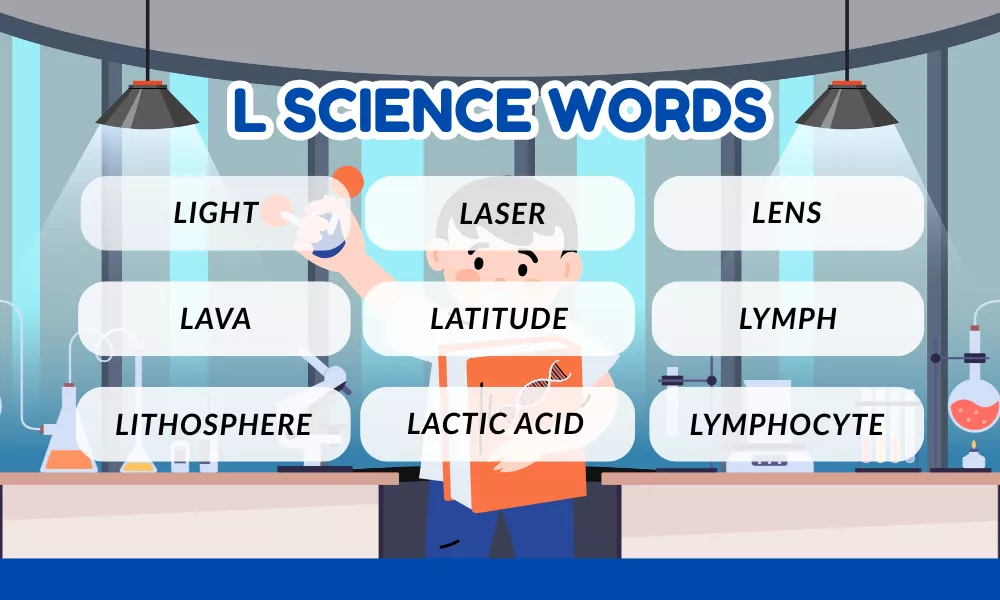
Core Science Terms With Letter L
- Law – A scientific rule proven through experiments.
- Luminescence – Emission of light without heat.
- Latitude – Distance north or south of the equator.
- Longitude – Distance east or west on Earth.
- Laser – Device producing concentrated light beams.
- Lithosphere – Earth’s outer rocky layer.
- Lipids – Fats important for energy and cell structure.
- Lysis – Breaking down of a cell.
- Locus – Specific location of a gene.
- Load Force – Force acting on structures or objects.
- Linear Motion – Movement in a straight line.
- Luminosity – Brightness of a star or object.
- Lethal Dose – Amount of substance causing death.
- Lattice – Ordered structure of atoms in solids.
- Ligament – Tissue connecting bones.
- Leverage – Mechanical advantage using a lever.
- Liquid Pressure – Force exerted by liquids.
- Luminary – A natural source of light.
- Low Pressure – Area with less atmospheric pressure.
- Load Capacity – Maximum load something can hold.
- Lipid Bilayer – Structure forming cell membranes.
- Lumen – Unit measuring brightness.
- Laboratory Safety – Rules ensuring safe experiments.
- Local Environment – Surroundings of organisms.
- Life Cycle – Stages of growth of living organisms.
Physics Science Words That Start With L
- Light – Electromagnetic radiation visible to humans.
- Laser – Focused beam of light energy.
- Luminosity – Brightness of stars.
- Linear Motion – Movement in a straight line.
- Lever – Simple machine used to lift loads.
- Load – Force applied to an object.
- Lens – Device that bends light rays.
- Luminous – Emitting light.
- Lightyear – Distance measurement in space.
- Longitudinal Wave – Wave where particles move parallel.
- Light Spectrum – Range of light wavelengths.
- Lagrangian – Mathematical function in mechanics.
- Lorentz Force – Force on charged particles in fields.
- Light Speed – Fastest speed in the universe.
- Luminous Intensity – Light power per direction.
- Line of Action – Direction of force application.
- Load Resistance – Opposition to force or motion.
- Light Reflection – Bouncing of light from surfaces.
- Light Refraction – Bending of light in materials.
- Low Frequency – Waves with fewer vibrations.
- Lift Force – Force lifting objects upward.
- Lenz’s Law – Rule about induced current direction.
- Linear Acceleration – Change in speed along a line.
- Light Amplification – Principle behind lasers.
- Light Absorption – Capture of light energy.
Chemistry Science Words That Start With L
| Word | Description |
|---|---|
| Lithium | Light metal element. |
| Ligand | Molecule attached to a metal atom. |
| Lime | Calcium compound used in chemistry. |
| Lye | Strong alkaline solution. |
| Liquid State | Matter with fixed volume. |
| Leaching | Removal of substances by liquid. |
| Labile | Easily changed compound. |
| Latent Heat | Heat absorbed during phase change. |
| Lewis Acid | Electron pair acceptor. |
| Lewis Base | Electron pair donor. |
| Lattice Energy | Energy holding ionic solids. |
| Litmus | Indicator for acids and bases. |
| Liquid Crystal | Material with properties of liquids and solids. |
| Liquefaction | Gas turning into liquid. |
| Lipid | Fat molecules important biologically. |
| Luminol | Chemical used in forensic detection. |
| Le Chatelier’s Principle | Predicts reaction shifts. |
| Lone Pair | Non-bonded electrons in atoms. |
| Liquid Solution | Mixture with liquid solvent. |
| Laboratory Reagent | Chemical used in experiments. |
| Lactate | Compound formed from lactic acid. |
| Liquid Nitrogen | Extremely cold nitrogen in liquid form. |
| Limewater | Solution detecting carbon dioxide. |
| Ligature | Bonding interaction in complexes. |
| Lipid Hydrolysis | Breakdown of fats by water. |
Biology Science Words That Start With L
- Liver – Organ that detoxifies blood.
- Lung – Organ used for breathing.
- Leaf – Plant structure for photosynthesis.
- Larva – Early developmental stage of animals.
- Lichen – Partnership of fungi and algae.
- Lymph – Fluid in the immune system.
- Lymphocyte – White blood cell.
- Lipid – Fat molecule in cells.
- Ligament – Tissue connecting bones.
- Lobe – Section of an organ.
- Lactation – Production of milk in mammals.
- Life Cycle – Growth stages of organisms.
- Leaf Vein – Transport system in leaves.
- Lysosome – Organelle that digests waste.
- Locomotion – Movement of organisms.
- Larynx – Voice box in animals.
- Leaf Stomata – Pores for gas exchange.
- Leukocyte – White blood cell.
- Lineage – Genetic ancestry line.
- Limb – Appendage of animals.
- Lipid Bilayer – Structure of cell membrane.
- Lactose – Sugar in milk.
- Living Organism – Any life form.
- Lymph Node – Immune system structure.
- Lichenology – Study of lichens.
Math Science Words That Start With L
- Line – A straight path extending infinitely in both directions.
- Length – Measurement of distance from end to end.
- Limit – Value a function approaches.
- Linear Equation – Equation forming a straight-line graph.
- Linear Function – Function with constant rate of change.
- Logarithm – Power to which a base number is raised.
- Locus – Set of points satisfying conditions.
- Line Segment – Part of a line between two points.
- Less Than (<) – Comparison showing smaller value.
- Least Common Multiple (LCM) – Smallest shared multiple of numbers.
- Lowest Term – Fraction in simplest form.
- Lateral Surface Area – Surface area excluding bases.
- Linear Pair – Adjacent angles forming a straight line.
- Leading Coefficient – First coefficient in a polynomial.
- Limit Point – Point approached by sequence values.
- Log Function – Function based on logarithms.
- Line of Symmetry – Line dividing shapes equally.
- Linear Inequality – Inequality with linear expressions.
- Least Squares Method – Data fitting technique.
- Level Curve – Curve showing equal values.
- Lattice Point – Point with integer coordinates.
- Log Scale – Scale using logarithmic growth.
- Length Unit – Measurement unit for distance.
- Linear Programming – Optimization technique.
- Limit Law – Rules for solving limits.
Computer Science Words That Start With L
- Loop – Repeated execution of instructions.
- Language (Programming) – System for writing programs.
- Logic Gate – Basic building block of digital circuits.
- Library – Collection of reusable code.
- Login – Process of accessing a system.
- Local Network – Network covering a small area.
- Link – Connection between resources.
- Load – Process of bringing data into memory.
- Latency – Delay in data transmission.
- Linux – Open-source operating system.
- Loop Counter – Variable controlling loops.
- Low-Level Language – Programming close to hardware.
- Load Balancing – Distribution of network workload.
- List – Data structure storing ordered items.
- Linked List – Data structure with connected nodes.
- Login Credentials – Information used to authenticate users.
- Logic Programming – Programming based on logic rules.
- Local Storage – Browser storage for data.
- Layered Architecture – System divided into layers.
- Lexer – Program component that breaks input into tokens.
- Lookup Table – Data structure for fast retrieval.
- Looping Statement – Instruction repeating code blocks.
- Load Time – Time needed to load data.
- Log File – File recording system events.
- Library Function – Prewritten function in code libraries.
Earth And Space Science Vocabulary With L
- Lava – Molten rock from volcanoes.
- Lithosphere – Earth’s outer rocky shell.
- Lunar – Related to the Moon.
- Latitude – Distance north or south of the equator.
- Longitude – Distance east or west of prime meridian.
- Lagoon – Shallow body of water near coasts.
- Landslide – Movement of rock and soil downhill.
- Limestone – Rock mainly made of calcium carbonate.
- Low Pressure – Atmospheric region with low pressure.
- Lightyear – Distance light travels in one year.
- Lava Flow – Movement of molten rock.
- Lunar Eclipse – Earth blocks sunlight to the Moon.
- Lunar Phase – Different appearances of the Moon.
- Lava Dome – Rounded mound formed by lava.
- Lake – Large inland water body.
- Lahar – Volcanic mudflow.
- Lenticular Cloud – Lens-shaped cloud formation.
- Landform – Natural land feature.
- Local Time – Time based on longitude.
- Libration – Apparent wobble of the Moon.
- Low Tide – Lowest sea level during tide cycle.
- Lunar Surface – Outer layer of the Moon.
- Littoral Zone – Nearshore aquatic zone.
- Light Pollution – Excess artificial light affecting skies.
- Lava Tube – Tunnel formed by flowing lava.
Engineering And Applied Science Terms With L
- Load – Force acting on structures.
- Lever – Simple machine for lifting loads.
- Lubrication – Reducing friction between parts.
- Load Capacity – Maximum supported weight.
- Lathe – Machine tool for shaping materials.
- Linear Actuator – Device creating straight motion.
- Leveling – Process of making surfaces even.
- Lifting Mechanism – System raising heavy objects.
- Load Bearing – Supporting structural weight.
- Laser Cutting – Material cutting using lasers.
- Layout Design – Arrangement of components.
- Low Voltage – Reduced electrical potential.
- Load Distribution – Spreading forces across structures.
- Leakage Current – Unwanted electrical current flow.
- Linear Motor – Motor producing straight-line motion.
- Load Testing – Testing under weight or stress.
- Lamination – Layer bonding technique.
- Lifting Force – Force raising objects.
- Level Sensor – Device measuring liquid level.
- Logic Controller – Industrial automation controller.
- Load Path – Path force travels in structures.
- Low Friction – Reduced resistance between surfaces.
- Lightweight Material – Material with low mass.
- Line Shaft – Rotating shaft distributing power.
- Lapping – Finishing process improving surface smoothness.
General Scientific Words Starting With L
- Laboratory – Place for scientific experiments.
- Law – Proven scientific principle.
- Layer – Level or sheet of material.
- Liquid – State of matter that flows.
- Luminescence – Light emission without heat.
- Luminous – Giving off light.
- Life – Condition of living organisms.
- Light – Form of energy enabling vision.
- Lipid – Fat molecules in organisms.
- Lens – Device focusing light.
- Lung – Organ for breathing.
- Lysis – Breakdown of cells.
- Locus – Gene position on chromosome.
- Ligament – Tissue connecting bones.
- Lichen – Algae-fungi partnership organism.
- Lactose – Sugar in milk.
- Lethal – Capable of causing death.
- Lattice – Regular atomic arrangement.
- Latitude – Geographic coordinate measurement.
- Luminary – Natural light source.
- Local Environment – Surrounding ecosystem.
- Life Form – Any living organism.
- Lung Capacity – Volume lungs can hold.
- Light Energy – Energy from light.
- Living System – System containing life processes.
How To Learn & Remember L Science Vocabulary Easily
- Learn Words in Real-Life Context
Connect each word to real examples. For instance, relate lava to volcano videos or light to everyday lighting. Real-life connections make words easier to remember. - Group Words by Science Subject
Organize L-words into categories like biology, chemistry, physics, or earth science. Group learning helps your brain store information logically. - Use Visual Memory Techniques
Draw diagrams or look at pictures when learning terms like lithosphere or luminescence. Visual learning improves long-term recall. - Practice Using Words in Sentences
Write or speak sentences using new words. Example: “Luminescence occurs in fireflies.” Usage strengthens memory. - Make Flashcards or Digital Quizzes
Write the word on one side and its meaning on the other. Quick daily review builds strong vocabulary memory. - Revise Regularly with Mini Tests
Test yourself weekly on learned words. Repetition helps transfer words from short-term to long-term memory.
FAQs
Conclusion
Science words beginning with the letter L open a gateway to understanding many important concepts across biology, chemistry, physics, mathematics, earth science, computer science, and engineering. From everyday terms like light and liquid to advanced vocabulary such as luminescence and lithosphere, these words help learners describe scientific ideas more clearly. Building vocabulary not only improves academic performance but also boosts communication and curiosity about how the world works. Regular practice, categorization, and real-life application make learning science vocabulary both easier and more enjoyable.