
Science Words That Start With R – Scientific Terms and Meanings

The letter “R” plays a remarkable role in the language of science, representing a wide range of concepts that shape our understanding of the natural world. From powerful physical phenomena like radiation and refraction to essential biological processes such as ribosomes and reproduction, science words that begin with “R” span multiple disciplines including physics, chemistry, biology, and environmental science. These terms reflect the depth of research, reasoning, and discovery that drive scientific progress and help explain everything from microscopic cellular reactions to the vast mechanics of the universe.
Importance of Science Words Starting With R
Science words that start with “R” play an important role in understanding key concepts across many scientific fields. Terms like reaction, radiation, refraction, ribosome, and reproduction help explain how matter behaves, how energy moves, and how living organisms grow and function. These words are commonly used in subjects such as chemistry, physics, biology, and environmental science, making them essential for students, teachers, and researchers. Learning science vocabulary that begins with R also strengthens scientific communication and critical thinking. It allows learners to describe experiments, understand research, and interpret scientific discoveries more clearly.
Science Words With R For Beginners
- Reaction – A process in which substances interact to form new substances with different properties.
- Radiation – Energy that travels through space in the form of waves or particles, such as light or heat.
- Refraction – The bending of light when it passes from one medium to another, like from air to water.
- Rotation – The spinning of an object around its own axis, such as Earth rotating on its axis.
- Reflection – The bouncing back of light or sound waves from a surface.
- Respiration – The process by which living organisms convert oxygen and nutrients into energy.
- Reproduction – The biological process by which living organisms produce new individuals.
- Root – The part of a plant that grows underground and absorbs water and nutrients.
- Rainfall – The amount of rain that falls in a particular place over a certain period.
- River – A natural stream of flowing water that moves toward oceans, seas, or lakes.
- Rock – A naturally occurring solid made of minerals that forms part of Earth’s crust.
- Resource – A natural material or energy source that humans use for survival and development.
- Range – The difference between the highest and lowest values in data or measurements.
- Rate – The speed at which something happens or changes over time.
- Resistance – The ability of a material to oppose the flow of electricity or other forces.
- Radar – A system that uses radio waves to detect objects and determine their distance or speed.
- Renewable – A type of resource that can naturally replenish over time, like solar or wind energy.
- Reservoir – A natural or artificial place where water is stored.
- Ray – A narrow beam of light or energy traveling in a straight line.
- Region – A specific area that shares common physical or environmental characteristics.
- Radius – The distance from the center of a circle to its outer edge.
- Rotation Period – The amount of time an object takes to complete one full spin.
- Rocket – A vehicle that moves by expelling gases at high speed and is used in space exploration.
- Ridge – A long, narrow elevated landform often found in mountains.
- Recycle – The process of converting waste materials into reusable resources.
Core Science Terms With Letter R
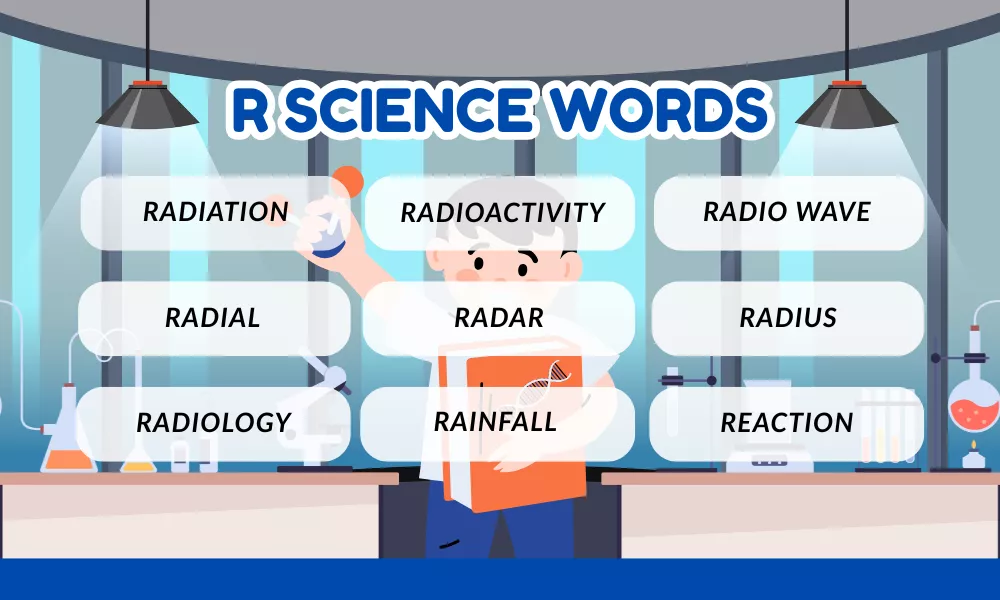
- Relativity – A theory explaining how space, time, and gravity interact, developed by Albert Einstein.
- Radiation – The emission and transmission of energy through space or matter.
- Reactivity – A measure of how easily a substance undergoes a chemical reaction.
- Refraction – The change in direction of light or waves when they enter a new medium.
- Resonance – The amplification of vibrations when an object is exposed to specific frequencies.
- Resistance – The opposition to electric current in a material.
- Radioactivity – The spontaneous release of energy or particles from unstable atomic nuclei.
- Receptor – A specialized structure that detects stimuli such as light, sound, or chemicals.
- Replication – The biological process where DNA makes an identical copy of itself.
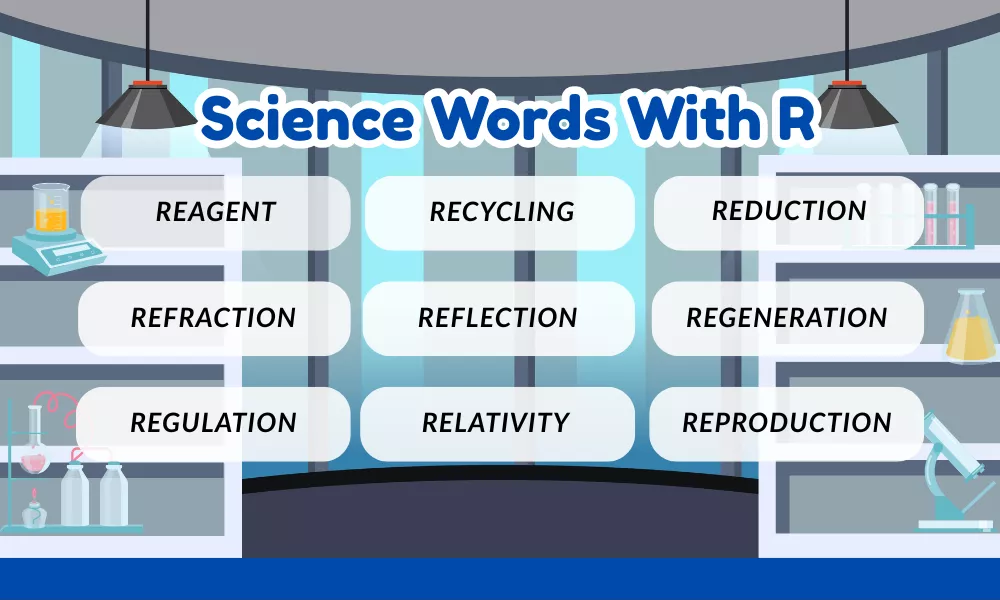
- Regulation – The control of processes within organisms to maintain balance.
- Recombination – The rearrangement of genetic material during reproduction.
- Reaction Rate – The speed at which a chemical reaction occurs.
- Reduction – A chemical reaction involving the gain of electrons.
- Respiration – The biochemical process that releases energy from food molecules.
- Ribosome – A cellular structure responsible for protein synthesis.
- Radiant Energy – Energy transmitted through electromagnetic waves.
- Reflection – The return of light or sound waves from a surface.
- Rotation – Circular movement of an object around an axis.
- Revolution – The movement of one object around another in space.
- Range – The spread between the smallest and largest values in data.
- Reservoir – A storage location for fluids such as water or chemicals.
- Radiometer – An instrument used to measure radiation intensity.
- Raman Spectroscopy – A technique used to study molecular vibrations.
- Redshift – A shift of light toward longer wavelengths due to the expansion of the universe.
- Radial Velocity – The speed of an object moving toward or away from an observer.
Physics Science Words That Start With R
- Radiation – The transfer of energy through waves or particles in space.
- Refraction – The bending of light when it changes mediums.
- Reflection – The bouncing back of waves when they hit a surface.
- Resistance – A material’s opposition to electric current.
- Resonance – The increase in vibration when objects respond to matching frequencies.
- Relativity – A theory describing how time, space, and gravity interact.
- Radio Waves – Electromagnetic waves used in communication systems.
- Radial Acceleration – Acceleration directed toward the center of circular motion.
- Rotational Motion – Motion of an object around a fixed axis.
- Rocket Propulsion – Movement produced by the expulsion of gases from a rocket engine.
- Radiant Heat – Heat transferred through electromagnetic waves.
- Reflected Light – Light that bounces off surfaces instead of passing through them.
- Radiometer – A device that measures radiant energy.
- Rigid Body – An object that does not deform when forces are applied.
- Rest Mass – The mass of an object measured when it is not moving.
- Refractive Index – A measure of how much light slows down in a medium.
- Resistivity – A property describing how strongly a material resists electrical current.
- Radiation Pressure – Pressure exerted by electromagnetic radiation on surfaces.
- Rotational Energy – Energy possessed by objects due to their rotation.
- Reaction Force – The force that occurs as a response to another force.
- Ray Optics – A model describing light as rays traveling in straight lines.
- Radioactivity – Emission of radiation from unstable atomic nuclei.
- Range – The maximum distance an object can travel or be detected.
- Radiant Flux – The total power of radiation emitted by a source.
- Reference Frame – A coordinate system used to measure motion.
Chemistry Science Words That Start With R
| Word | Description |
|---|---|
| Reaction | A process where substances transform into new chemical products. |
| Reactant | A substance that participates in a chemical reaction. |
| Reagent | A chemical used to detect or cause a reaction. |
| Reduction | A reaction involving the gain of electrons. |
| Redox Reaction | A chemical reaction involving both reduction and oxidation. |
| Rate of Reaction | The speed at which reactants convert into products. |
| Reactivity | The tendency of a substance to undergo chemical change. |
| Radical | An atom or molecule with an unpaired electron. |
| Resonance | A concept describing multiple bonding structures in molecules. |
| Recrystallization | A purification technique used to obtain pure crystals. |
| Racemization | The process that converts an optically active compound into a mixture. |
| Reversible Reaction | A reaction that can proceed in both forward and backward directions. |
| Reactant Concentration | The amount of reactant present in a reaction mixture. |
| Reaction Mechanism | The step-by-step sequence of events during a reaction. |
| Radionuclide | A radioactive form of an element. |
| Reaction Intermediate | A temporary substance formed during a reaction. |
| Resin | A polymer substance often used in chemical processes. |
| Refining | The purification of chemicals or metals. |
| Reagent Bottle | A container used for storing chemicals. |
| Reduction Potential | The tendency of a chemical species to gain electrons. |
| Reactivity Series | A list ranking metals based on their reactivity. |
| Reaction Energy | Energy released or absorbed during a reaction. |
| Rutherfordium | A synthetic chemical element with atomic number 104. |
| Rare Earth Elements | A group of metallic elements with special chemical properties. |
| Reaction Equilibrium | The state where forward and reverse reactions occur at equal rates. |
Biology Science Words That Start With R
- Ribosome – A cellular structure responsible for protein production.
- RNA – Ribonucleic acid, a molecule involved in protein synthesis.
- Reproduction – The biological process of producing offspring.
- Respiration – The cellular process that releases energy from food.
- Root – The plant structure that absorbs water and nutrients.
- Regeneration – The ability of organisms to regrow lost body parts.
- Receptor – A cell structure that detects chemical or physical signals.
- Reflex – An automatic response to stimuli.
- Reptile – A class of cold-blooded vertebrates including snakes and lizards.
- Retina – The light-sensitive layer of tissue at the back of the eye.
- Ribose – A sugar molecule found in RNA.
- Rumen – A stomach compartment in ruminant animals like cows.
- Regulation – The maintenance of internal balance within organisms.
- Respiratory System – The system responsible for breathing and gas exchange.
- Recombinant DNA – DNA formed by combining genetic material from different sources.
- Reproductive System – Organs responsible for producing offspring.
- Rhizome – An underground plant stem that produces roots and shoots.
- Rod Cells – Light-sensitive cells in the retina used for night vision.
- RNA Polymerase – An enzyme that synthesizes RNA from DNA templates.
- Reabsorption – The process where substances are absorbed again in the kidneys.
- Rigor Mortis – Stiffening of muscles after death due to chemical changes.
- Respiratory Rate – The number of breaths taken per minute.
- Random Mutation – A spontaneous change in genetic material.
- Reproductive Isolation – A mechanism preventing species from interbreeding.
- Ribosomal RNA (rRNA) – A type of RNA that forms part of ribosomes and aids protein synthesis.
Math Science Words That Start With R
- Radius – The distance from the center of a circle to any point on its boundary.
- Range – The difference between the highest and lowest values in a data set.
- Ratio – A comparison between two quantities showing their relative sizes.
- Radian – A unit used to measure angles based on the radius of a circle.
- Radical – A mathematical symbol (√) used to indicate a root of a number.
- Rational Number – A number that can be expressed as a fraction of two integers.
- Real Number – Any number that can exist on the number line, including integers and decimals.
- Reciprocal – A number obtained by dividing 1 by another number.
- Rectangle – A four-sided polygon with opposite sides equal and all angles 90°.
- Rectangular Coordinates – A coordinate system used to locate points using x and y values.
- Recursion – A process where a function repeatedly applies itself to solve problems.
- Regression – A statistical method used to analyze relationships between variables.
- Regular Polygon – A polygon with equal sides and equal angles.
- Relation – A connection between elements of two sets in mathematics.
- Remainder – The amount left after performing division.
- Root – A value that satisfies a given equation.
- Rotation – A transformation where a figure turns around a fixed point.
- Reflection – A transformation creating a mirror image across a line.
- Rounding – Approximating a number to a specified place value.
- Row – A horizontal arrangement of numbers or elements in a table or matrix.
- Random Variable – A variable whose value depends on the outcome of a random event.
- Random Sampling – A statistical method where each member of a population has an equal chance of selection.
- Rate of Change – The speed at which one variable changes relative to another.
- Radial Symmetry – Symmetry around a central point or axis.
- Regression Line – A line that best fits data points in a scatter plot.
Computer Science Words That Start With R
- RAM (Random Access Memory) – A computer’s short-term memory used to store data temporarily.
- Router – A device that directs data packets between computer networks.
- Runtime – The period during which a computer program is running.
- Repository – A storage location where code and data are maintained.
- Recursion – A programming technique where a function calls itself.
- Rendering – The process of generating images or graphics from data.
- Responsive Design – A design approach that adapts websites to different screen sizes.
- Refactoring – Improving code structure without changing its functionality.
- Request – A message sent by a client to ask a server for information.
- Response – The data returned by a server after receiving a request.
- Root Directory – The top-level directory in a file system hierarchy.
- Remote Access – The ability to connect to a computer or network from another location.
- Relational Database – A database organized using tables linked by relationships.
- Robotics Software – Programs used to control robotic systems.
- Rollback – Reverting a system or database to a previous state.
- Raster Graphics – Images made up of pixels arranged in a grid.
- Resource Allocation – Assigning computing resources such as CPU or memory to processes.
- Replication – Copying data across multiple systems for reliability.
- Redundancy – Extra components used to improve system reliability.
- Runtime Error – An error that occurs while a program is executing.
- Read Operation – Retrieving data from memory or storage.
- Register – A small, high-speed storage location inside a CPU.
- Reboot – Restarting a computer system.
- Root Access – Administrative privileges allowing full system control.
- Random Number Generator – An algorithm that produces unpredictable numbers.
Earth And Space Science Vocabulary With R
- Rock Cycle – The natural process by which rocks form, break down, and reform.
- River Basin – The land area drained by a river and its tributaries.
- Rainfall – The amount of rain that falls in a specific area over time.
- Ridge – A long, narrow elevated landform often found in mountain ranges.
- Reservoir – A natural or artificial lake used to store water.
- Radiation – Energy emitted from the Sun and other celestial objects.
- Rotation – The spinning motion of Earth on its axis.
- Revolution – The movement of Earth around the Sun.
- Regolith – A layer of loose rock and dust covering solid rock on planets or moons.
- Rain Shadow – A dry area on the leeward side of mountains where rainfall is reduced.
- Rift Valley – A valley formed when Earth’s crust pulls apart.
- Ring System – Bands of ice and rock orbiting around a planet.
- Radiant Energy – Energy emitted from the Sun that reaches Earth.
- Red Giant – A stage in a star’s life cycle where it expands and cools.
- Roche Limit – The minimum distance a satellite can orbit a planet without breaking apart.
- Radiometric Dating – A technique used to determine the age of rocks using radioactive decay.
- Runoff – Water that flows across land surfaces into rivers and oceans.
- Rock Formation – Natural arrangements of rock created by geological processes.
- Retrograde Motion – The apparent backward motion of planets as seen from Earth.
- Reef – A ridge of coral, rock, or sand near the surface of the ocean.
- Rain Gauge – An instrument used to measure rainfall.
- Ridge Push – A force that drives tectonic plates away from mid-ocean ridges.
- Radiation Belt – Regions of charged particles trapped by a planet’s magnetic field.
- Redshift – The stretching of light waves as objects move away in space.
- Rotation Axis – An imaginary line around which a planet spins.
Engineering And Applied Science Terms With R
- Resistance – Opposition to the flow of electric current in a circuit.
- Resistor – A component used to control electrical current.
- Reinforcement – Strengthening materials like concrete using steel bars.
- Reliability – The ability of a system to perform consistently over time.
- Robotics – The field involving the design and use of robots.
- Regulator – A device that maintains constant voltage or pressure.
- Rotor – The rotating part of a machine or motor.
- Reducer – A mechanism used to decrease speed or pressure in systems.
- Reactive Power – Power stored and released by electrical components in AC circuits.
- Radiator – A device used to transfer heat away from a system.
- Reinforced Concrete – Concrete strengthened with embedded steel bars.
- Retrofitting – Updating older structures or machines with new technology.
- Redundancy – Using extra components to improve system reliability.
- Robotic Arm – A mechanical arm used in automation and manufacturing.
- Reciprocating Motion – Back-and-forth motion used in engines and pumps.
- Regenerative Braking – A system that converts motion into stored energy.
- Resilience – The ability of materials to recover after deformation.
- Reactor – A vessel used to carry out chemical or nuclear reactions.
- Rotational Speed – The rate at which an object spins around an axis.
- Resistance Welding – A process that joins metals using heat from electrical resistance.
- Radiography – Imaging technique using radiation for inspection.
- Rigid Structure – A structure designed to resist deformation.
- Reinforcement Bar (Rebar) – Steel bars used to strengthen concrete structures.
- Resource Efficiency – Using materials and energy in the most effective way.
- Response Time – The time taken for a system to react to inputs.
General Scientific Words Starting With R
- Research – The systematic study conducted to discover new knowledge.
- Result – The outcome obtained after conducting an experiment or study.
- Record – Documented observations or measurements during research.
- Replicate – To repeat an experiment to confirm results.
- Reasoning – Logical thinking used to interpret scientific data.
- Review – The process of evaluating scientific work or studies.
- Reference – A source of information used in research.
- Revision – Improving scientific work based on feedback.
- Response – A reaction to a stimulus or experimental condition.
- Risk – The possibility of harm or uncertainty in scientific activities.
- Rate – A measure of how quickly something happens.
- Range – The spread of data values in a study.
- Randomization – Assigning subjects randomly in experiments to reduce bias.
- Replication Study – A study repeated to verify previous results.
- Research Method – A systematic approach used to conduct investigations.
- Resource – Materials or tools used for scientific work.
- Regulation – Rules or controls governing scientific processes.
- Reliability – The consistency of results across repeated experiments.
- Rationale – The reasoning behind a scientific experiment or theory.
- Reaction – A response to a stimulus or chemical interaction.
- Result Analysis – Examining experimental data to draw conclusions.
- Reproducibility – The ability to achieve the same results in repeated experiments.
- Researcher – A person who conducts scientific investigations.
- Report – A document summarizing scientific findings.
- Revision Process – Updating scientific work after evaluation or peer review.
How To Learn & Remember R Science Vocabulary Easily
- Learn Words Through Real-Life Examples
Connecting scientific terms with everyday experiences makes them easier to remember. For example, you can observe refraction when a straw appears bent in a glass of water or see radiation from sunlight warming your skin. Real-world connections strengthen memory and understanding. - Group Words by Science Subject
Organizing “R” words into categories such as physics, chemistry, biology, and earth science helps your brain process them more efficiently. Learning related terms together builds stronger conceptual connections. - Use Visual Learning Techniques
Diagrams, charts, and flashcards can significantly improve retention. Visualizing structures like ribosomes, the rock cycle, or a radius in geometry helps reinforce meaning and recall. - Practice With Short Quizzes or Games
Self-testing is one of the most effective ways to remember new vocabulary. Create small quizzes, word puzzles, or matching games using science words starting with R to reinforce learning in a fun way. - Create Memory Associations
Link each word with a simple phrase or mental image. For example, you might remember rotation by thinking of the Earth spinning like a top, or reproduction as living organisms creating new life. - Use the Words in Sentences or Discussions
Applying vocabulary in sentences, explanations, or classroom discussions helps move the words from short-term memory into long-term understanding. Teaching a concept like resonance or respiration to someone else can also strengthen your knowledge.
FAQs
Conclusion
Science words that start with R represent an important part of scientific language across many disciplines, including physics, chemistry, biology, mathematics, computer science, and earth science. From fundamental concepts like reaction, radiation, and radius to complex ideas such as relativity, resonance, and ribosome, these terms help explain how the natural world and technological systems function. Learning and understanding these “R” science words not only expands vocabulary but also strengthens scientific thinking and communication skills. Whether you are a student, a teacher, or simply a curious learner, exploring scientific vocabulary beginning with R opens the door to deeper knowledge and discovery.