
Science Words That Start With V: Definitions and Scientific Guide

Venturing into the vast world of science, the letter “V” introduces a vibrant collection of terms that help explain the natural and physical universe. From fundamental concepts like velocity and vacuum to specialized fields such as virology, vaccinology, and volcanology, “V” words play an important role in scientific communication across disciplines including chemistry, biology, physics, and Earth science. These terms describe everything from microscopic viruses to powerful volcanic forces, highlighting the diversity and depth of scientific exploration. Learning science words that start with “V” not only strengthens vocabulary but also enhances our ability to understand complex ideas.
Importance of Science Words Starting With V
Science words that start with “V” play an important role in helping scientists and students describe and understand key concepts across many scientific fields. Terms such as velocity, vacuum, variation, virus, and volcano explain essential processes in physics, chemistry, biology, and Earth science. These words provide precise language that improves scientific communication, supports learning, and helps explain complex phenomena more clearly. By understanding “V” science terms, learners can expand their vocabulary, grasp important scientific principles, and better connect ideas that describe how the natural world works.
Science Words With V For Beginners
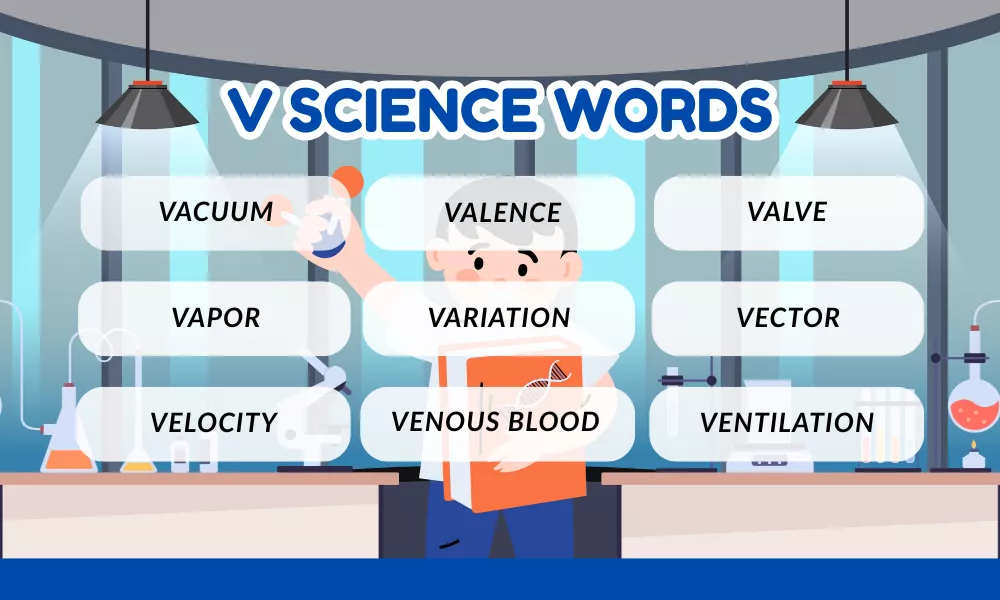
- Vacuum – A space with very little or no matter, including almost no air.
- Vaccine – A substance that helps the body develop protection against diseases.
- Valence – The ability of an atom to combine with other atoms.
- Variation – Differences that occur among individuals of the same species.
- Vector – A quantity that has both magnitude and direction, or an organism that spreads disease.
- Velocity – The speed of an object in a particular direction.
- Venom – A poisonous substance produced by animals like snakes or spiders.
- Ventilation – The movement of air in and out of a space or system.
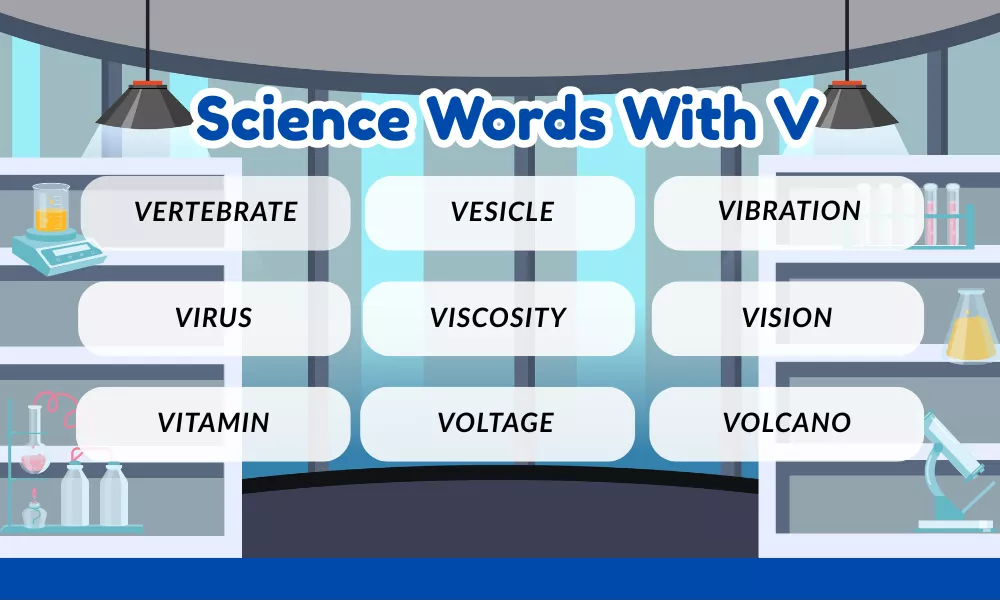
- Vertebrate – An animal that has a backbone or spinal column.
- Vibration – Rapid back-and-forth movement of an object.
- Virus – A microscopic infectious agent that can reproduce only inside living cells.
- Viscosity – The thickness or resistance of a liquid to flow.
- Vision – The ability of organisms to see using eyes.
- Vitamin – Organic compounds that organisms need in small amounts for health.
- Voltage – The electrical force that pushes electric current through a circuit.
- Volcano – An opening in Earth’s crust where lava, ash, and gases escape.
- Volume – The amount of space an object or substance occupies.
- Vapor – The gaseous form of a substance that is usually liquid or solid.
- Vent – An opening through which gas, liquid, or air escapes.
- Vacancy – An empty space within a material or structure.
- Vascular – Related to vessels that carry fluids, such as blood vessels in animals or water vessels in plants.
- Vesicle – A small sac or bubble within a cell used to store or transport substances.
- Volatility – The tendency of a substance to evaporate easily.
- Virology – The scientific study of viruses.
- Vortex – A spinning flow of fluid such as water or air.
Core Science Terms With Letter V
- Vacuum – A region without matter or with extremely low pressure.
- Valence Electron – An electron in the outer shell of an atom involved in bonding.
- Variation – Genetic or physical differences within species.
- Vector – A quantity with magnitude and direction.
- Velocity – Rate of change of position in a given direction.
- Venom – Toxic chemical produced by animals for defense or hunting.
- Vibration – Oscillating motion around an equilibrium position.
- Virus – Tiny infectious particle that replicates inside host cells.
- Viscosity – Measure of resistance to fluid flow.
- Voltage – Electric potential difference between two points.
- Volume – Three-dimensional space occupied by matter.
- Vaporization – Process in which liquid changes into gas.
- Volcano – Geological structure releasing magma and gases.
- Vortex – Rotating fluid flow forming a spiral pattern.
- Vacancy Defect – Missing atom in a crystal structure.
- Vascular Tissue – Plant tissue that transports water and nutrients.
- Vesicle – Membrane-bound sac within a cell.
- Virulence – Degree of harmfulness of a pathogen.
- Viral Infection – Disease caused by viruses entering host cells.
- Ventilation – Circulation of air or gases.
- Vacuum Pressure – Pressure lower than atmospheric pressure.
- Volatility – Tendency of substances to evaporate.
- Vibration Frequency – Number of vibrations per second.
- Vector Quantity – Physical quantity having magnitude and direction.
- Visible Spectrum – The portion of electromagnetic radiation visible to the human eye.
Physics Science Words That Start With V
- Velocity – Speed of an object in a specific direction.
- Vector – Quantity with magnitude and direction such as velocity or force.
- Voltage – Electrical potential difference that drives current.
- Vacuum – Space without matter where light and radiation can travel.
- Vibration – Oscillating motion of particles or objects.
- Vortex – Rotating motion of fluid or air.
- Vertical Motion – Movement upward or downward due to gravity.
- Virtual Image – Image formed where light rays appear to meet but do not actually meet.
- Viscosity – Internal resistance of fluids to flow.
- Velocity Vector – Vector showing both speed and direction of motion.
- Variable – A quantity that can change in an experiment.
- Vacuum Tube – Device that controls electric current in a vacuum.
- Vibrational Energy – Energy due to vibration of particles.
- Velocity-Time Graph – Graph showing how velocity changes with time.
- Volume – Space occupied by matter.
- Vacuum Energy – Energy that exists even in empty space.
- Velocity Change – Difference in speed or direction over time.
- Vorticity – Measure of rotation in fluid flow.
- Vector Addition – Combining vectors using mathematical rules.
- Vertical Acceleration – Acceleration due to gravity in vertical motion.
- Vibration Frequency – Number of vibrations per second.
- Vacuum Chamber – Enclosed space from which air is removed.
- Vector Field – Region where each point has a vector value.
- Velocity Ratio – Ratio of input velocity to output velocity in machines.
- Viscous Force – Force resisting motion in fluids.
Chemistry Science Words That Start With V
| Words | Description |
|---|---|
| Valence | Combining capacity of an atom. |
| Valence Electron | Outer shell electron involved in bonding. |
| Valency | Number of chemical bonds an atom can form. |
| Vapor | Gas form of a substance normally liquid or solid. |
| Vaporization | Conversion of liquid into gas. |
| Volatility | Tendency of substances to evaporate quickly. |
| Viscosity | Thickness or resistance of liquids to flow. |
| Volumetric Analysis | Determining concentration by measuring volume. |
| Volumetric Flask | Laboratory glassware used to prepare solutions. |
| Van der Waals Forces | Weak attractions between molecules. |
| Vacuum Distillation | Distillation under reduced pressure. |
| Valence Shell | Outer electron shell of an atom. |
| Volatile Compound | Chemical that evaporates easily. |
| Vapor Pressure | Pressure exerted by vapor above a liquid. |
| Vitrification | Transformation of materials into glass-like solids. |
| Viscous Liquid | Thick liquid with high resistance to flow. |
| Vanadium | Chemical element with atomic number 23. |
| Vinyl Group | Functional group used in polymer chemistry. |
| Volumetric Pipette | Tool for measuring precise liquid volumes. |
| Vacuum Filtration | Filtration process using reduced pressure. |
| Valence Bond Theory | Theory explaining chemical bonding. |
| Volatile Solvent | Solvent that evaporates quickly. |
| Vapor Density | Density of a vapor compared with air or hydrogen. |
| Viscosimeter | Instrument used to measure viscosity. |
| Vapor Phase | Gas phase of a substance in chemical reactions. |
Biology Science Words That Start With V
- Virus – Microscopic infectious agent that replicates inside living cells.
- Vaccine – Biological preparation that provides immunity against disease.
- Variation – Differences in traits among organisms of the same species.
- Vertebrate – Animal with a backbone.
- Vascular Tissue – Plant tissue that transports water and nutrients.
- Vein – Blood vessel that carries blood toward the heart.
- Venom – Poison produced by animals for defense or hunting.
- Vector – Organism that spreads pathogens between hosts.
- Vesicle – Small membrane-bound sac inside a cell.
- Vitamin – Essential nutrients needed in small amounts for body functions.
- Villi – Tiny finger-like projections in the small intestine that absorb nutrients.
- Virulence – Ability of a pathogen to cause disease.
- Ventral – The underside or belly side of an organism.
- Viviparous – Animals that give birth to live young.
- Vacuole – Storage organelle in plant and some animal cells.
- Vascular Plant – Plant that has xylem and phloem tissues.
- Virology – Study of viruses.
- Vertebra – Individual bone that forms the spinal column.
- Vascular System – Network of vessels that transport fluids in organisms.
- Viral Infection – Disease caused by viruses entering body cells.
- Venule – Small blood vessel that connects capillaries to veins.
- Vitreous Body – Gel-like substance filling the eye.
- Vagus Nerve – Important nerve controlling organs like the heart and lungs.
- Vivarium – Enclosed space for keeping animals or plants for study.
- Vegetative Reproduction – Asexual reproduction in plants.
Math Science Words That Start With V
- Variable – A symbol (usually a letter) that represents a number that can change.
- Value – The numerical result of a mathematical expression or variable.
- Vector – A mathematical quantity that has both magnitude and direction.
- Vertex – The point where two or more lines, edges, or curves meet.
- Vertical Line – A straight line that runs up and down on a graph.
- Venn Diagram – A diagram using overlapping circles to show relationships between sets.
- Volume – The amount of three-dimensional space occupied by an object.
- Variance – A statistical measure showing how far numbers spread from the mean.
- Vector Space – A mathematical structure formed by vectors that follow certain rules.
- Valid Argument – A logical argument where the conclusion follows from the premises.
- Vertex Form – A way of writing a quadratic equation showing its vertex.
- Variable Expression – A mathematical expression that includes variables.
- Vector Addition – The process of combining two or more vectors.
- Value Set – The set of all possible values a variable can take.
- Volume Formula – A mathematical equation used to calculate the volume of shapes.
- Vector Magnitude – The length or size of a vector.
- Vertical Angles – Opposite angles formed by two intersecting lines.
- Variation – A relationship where one variable changes in relation to another.
- Vinculum – A horizontal line used in mathematical notation, such as in fractions.
- Vector Component – A part of a vector in a specific direction.
- Variable Rate – A rate that changes over time or conditions.
- Value Function – A function that assigns values to variables.
- Volume Unit – Measurement units used for volume such as cubic meters.
- Vector Equation – An equation involving vectors.
- Variance Analysis – A statistical technique used to analyze differences in data.
Computer Science Words That Start With V
- Variable – A storage location in a program used to hold data.
- Virtual Memory – A memory management technique that uses disk space as extra RAM.
- Virtual Machine – Software that acts like a physical computer system.
- Version Control – A system that tracks changes to files or code over time.
- Vector Graphics – Images created using mathematical formulas instead of pixels.
- Validation – The process of checking if data is correct and acceptable.
- Virtualization – Technology that allows multiple virtual systems to run on one physical machine.
- Video Codec – Software used to compress and decompress video files.
- Viewport – The visible area of a digital interface or graphics display.
- Variable Scope – The area of a program where a variable can be accessed.
- Visual Programming – Programming using graphical elements instead of text-based code.
- Virtual Network – A network created within another network using software.
- Versioning – Assigning numbers to different versions of software or files.
- Vulnerability – A weakness in software that can be exploited by attackers.
- Virtual Disk – A file that behaves like a physical storage device.
- Video Processing – The manipulation and analysis of digital video data.
- Voice Recognition – Technology that converts spoken words into text or commands.
- Vector Processing – A computing technique that performs operations on entire arrays of data.
- Visual Interface – A graphical interface used to interact with a computer system.
- Virtual Environment – A simulated computing space for running programs.
- Verification – The process of ensuring software works as intended.
- Variable Declaration – The process of defining a variable in programming.
- Virtual Router – A software-based network routing system.
- Video Rendering – The process of generating images from digital models or animations.
- Virtual Assistant – AI-based software that performs tasks based on user commands.
Earth And Space Science Vocabulary With V
- Volcano – An opening in Earth’s crust where magma erupts.
- Volcanology – The scientific study of volcanoes and volcanic activity.
- Valley – A low area between hills or mountains.
- Vapor – The gaseous form of water or other substances.
- Vent – An opening in Earth’s crust where gases or lava escape.
- Volcanic Ash – Fine particles of rock released during volcanic eruptions.
- Volcanic Rock – Rock formed from cooled lava or magma.
- Vortex – A spinning motion of air or water, such as in storms.
- Vernal Equinox – The time in spring when day and night are nearly equal.
- Vacuum of Space – The nearly empty environment of outer space.
- Volcanic Crater – Bowl-shaped depression at the top of a volcano.
- Volcanic Eruption – The release of lava, gases, and ash from a volcano.
- Volcanic Gas – Gases like sulfur dioxide released during eruptions.
- Vapor Condensation – The process where water vapor turns into liquid droplets.
- Volcanic Island – An island formed from volcanic activity.
- Volcanic Belt – A chain of volcanoes along tectonic plate boundaries.
- Volcanic Cone – A mountain-shaped structure formed by volcanic material.
- Vent System – Channels through which magma travels to the surface.
- Vapor Pressure – Pressure exerted by vapor in the atmosphere.
- Volcanic Plateau – Large flat land formed by lava flows.
- Volcanic Soil – Fertile soil formed from volcanic materials.
- Volcanic Activity – Processes related to eruptions and magma movement.
- Volcanic Bomb – Large rock fragment ejected during eruptions.
- Volcanic Rift – Crack in Earth’s crust where magma rises.
- Volcanic Field – Area with many volcanoes or volcanic vents.
Engineering And Applied Science Terms With V
- Voltage – Electrical potential difference that drives electric current.
- Valve – A device that controls the flow of liquids or gases.
- Vibration Analysis – Study of vibrations to detect mechanical problems.
- Ventilation System – Equipment that circulates fresh air in buildings.
- Vacuum Pump – Device used to remove air or gas from a container.
- Variable Speed Drive – Device used to control motor speed.
- Viscosity Measurement – Determining the thickness of fluids.
- Voltage Regulator – Device that maintains a constant voltage level.
- Vibration Isolation – Technique used to reduce vibrations in machines.
- Vacuum Chamber – Sealed container from which air is removed.
- Valve Control System – System that regulates fluid flow in pipelines.
- Vertical Shaft – Upright rotating shaft used in machines.
- Variable Resistor – Electrical component used to adjust resistance.
- Venturi Tube – Device used to measure fluid flow speed.
- Vibration Sensor – Device that detects vibrations in machinery.
- Vacuum Sealing – Removing air from packaging to preserve contents.
- Voltage Divider – Circuit that reduces voltage.
- Variable Frequency Drive – Device controlling AC motor speed.
- Vane Pump – Pump that moves fluids using rotating vanes.
- Vacuum Insulation – Insulation that reduces heat transfer using vacuum.
- Vertical Milling Machine – Machine tool used for cutting materials.
- Valve Actuator – Device used to control valve movement.
- Viscoelastic Material – Material that shows both viscous and elastic behavior.
- Vibration Damping – Reducing vibration energy in structures.
- Voltage Sensor – Device used to measure electrical voltage.
General Scientific Words Starting With V
- Vacuum – Space with extremely low pressure and little matter.
- Vaccine – Biological preparation that protects against diseases.
- Valence – The bonding capacity of an atom.
- Variation – Differences among individuals of the same species.
- Vector – Quantity with both magnitude and direction.
- Velocity – Speed of an object in a given direction.
- Venom – Poison produced by animals for defense or hunting.
- Vibration – Rapid back-and-forth movement of particles.
- Virus – Tiny infectious agent that reproduces inside host cells.
- Viscosity – Resistance of liquids to flow.
- Voltage – Electric potential difference in a circuit.
- Volume – Amount of space occupied by matter.
- Vapor – Gas phase of a substance normally liquid or solid.
- Ventilation – Circulation of air in a system.
- Vertebrate – Animal with a spinal column.
- Vesicle – Small membrane-bound structure inside cells.
- Virulence – Degree of harmfulness of a microorganism.
- Vortex – Spinning flow of fluid or air.
- Vascular System – Network of vessels transporting fluids in organisms.
- Villi – Tiny projections that increase absorption in the intestine.
- Volcano – Geological structure that releases magma and gases.
- Vaporization – Process of liquid turning into gas.
- Volatility – Tendency of a substance to evaporate quickly.
- Viral Infection – Disease caused by viruses invading cells.
- Vacuole – Storage organelle found in many cells.
How To Learn & Remember V Science Vocabulary Easily
- Use Word Association
Connect new “V” science words with familiar ideas or images. For example, link velocity with a moving car or volcano with erupting lava. Associating words with visuals or real-life examples makes them easier to remember. - Create Flashcards
Write the vocabulary word on one side of a card and its definition on the other. Reviewing flashcards regularly helps reinforce memory and makes learning science terms faster and more effective. - Practice with Examples
Try using each word in a simple sentence or example. For instance, “The rocket increased its velocity during launch.” Using words in context helps you understand and retain them better. - Group Words by Category
Organize vocabulary into subjects like physics, chemistry, biology, or Earth science. Learning related words together improves comprehension and makes studying more structured. - Use Visual Learning Tools
Diagrams, charts, and videos can make scientific terms clearer. For example, watching a video about volcanic eruptions or vector diagrams helps connect vocabulary with real scientific processes. - Review and Repeat Regularly
Consistent revision is key to remembering vocabulary. Spend a few minutes each day reviewing the terms and definitions to strengthen long-term memory.
FAQs
Conclusion
Science words that start with “V” reveal a vibrant and valuable part of scientific vocabulary, covering concepts across mathematics, physics, chemistry, biology, computer science, engineering, and Earth science. From fundamental ideas like velocity, vector, volume, and vacuum to specialized terms such as virology, volcanology, virtualization, and viscosity, these words help explain the mechanisms that shape our world and the universe beyond. Learning and understanding these terms not only strengthens scientific knowledge but also improves communication, critical thinking, and academic success.