
Science Words That Start With T: Scientific Terms and Meanings
The letter “T” opens the door to a remarkable collection of scientific terms that help explain how our world and universe function. Across disciplines such as biology, chemistry, physics, earth science, and engineering, many key concepts begin with this single letter. These words are more than vocabulary; they represent the principles, processes, and discoveries that shape scientific understanding and technological progress. Exploring science terms that start with T not only expands a learner’s scientific language but also strengthens conceptual clarity, making complex ideas easier to grasp.
Importance of Science Words Starting With T
Science words that begin with the letter “T” play an important role in understanding many fundamental concepts across scientific disciplines. Terms such as thermodynamics, taxonomy, transpiration, and tectonics help scientists describe natural processes, classify living organisms, and explain physical and chemical changes in the environment. Learning these terms not only expands scientific vocabulary but also improves comprehension of complex ideas in biology, chemistry, physics, and earth science.
Science Words With T For Beginners
- Temperature – A measure of how hot or cold a substance or environment is.
- Tissue – A group of similar cells that perform a specific function in living organisms.
- Thermometer – An instrument used to measure temperature.
- Transformation – A change in form, structure, or appearance.
- Turbine – A machine that converts energy from moving fluids into mechanical power.
- Thermal Energy – Energy that comes from heat.
- Trajectory – The curved path an object follows through space.
- Transpiration – The process by which plants release water vapor from their leaves.
- Toxin – A poisonous substance produced by living organisms.
- Tectonics – The study of the movement of Earth’s crust and plates.
- Telescope – An instrument used to observe distant objects in space.
- Tide – The rise and fall of sea levels caused by the gravitational pull of the Moon and Sun.
- Transfer – The movement of energy, heat, or matter from one place to another.
- Theory – A well-supported explanation of natural phenomena.
- Therapy – Treatment used to heal or manage diseases.
- Tropism – Growth movement of plants toward or away from a stimulus.
- Turbulence – Irregular or chaotic flow of fluids like air or water.
- Tension – The pulling force transmitted through a rope, string, or cable.
- Terminal Velocity – The maximum speed reached by a falling object.
- Transmission – The passing of energy, waves, or signals from one place to another.
- Thermal Expansion – The increase in size of a substance when heated.
- Titration – A chemical technique used to determine concentration of a solution.
- Transgenic – An organism whose DNA has been altered by genetic engineering.
- Troposphere – The lowest layer of Earth’s atmosphere.
- Topology – The study of spatial properties and shapes.
Core Science Terms With Letter T
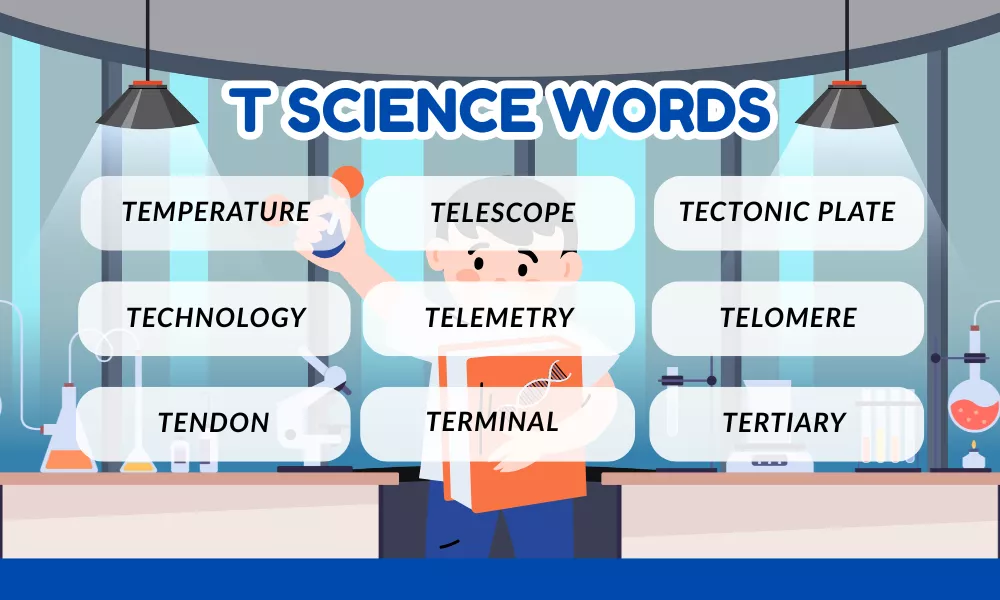
- Thermodynamics – The study of heat, energy, and their transformations.
- Taxonomy – The classification of organisms into groups based on shared traits.
- Tensor – A mathematical object used in physics to describe physical properties.
- Tectonic Plates – Large sections of Earth’s crust that move slowly.
- Thermal Conductivity – The ability of a material to conduct heat.
- Tissue Culture – A technique of growing cells in a controlled laboratory environment.
- Tonicity – The ability of a solution to cause cells to gain or lose water.
- Transcription – The process of copying DNA into RNA.
- Translation – The process by which proteins are synthesized from RNA.
- Thermochemistry – The study of heat changes in chemical reactions.
- Turbidity – The cloudiness of a liquid caused by particles.
- Tensile Strength – The resistance of a material to breaking under tension.
- Trophic Level – The position an organism occupies in a food chain.
- Tunneling (Quantum) – A phenomenon where particles pass through barriers.
- Tidal Force – Gravitational force that causes tides.
- Tracer – A substance used to track chemical or biological processes.
- Thermoplastic – A material that becomes soft when heated.
- Toxinology – The study of toxins and poisons.
- Tectonophysics – Study of the physical processes in Earth’s crust.
- Thermal Radiation – Energy emitted as electromagnetic waves due to heat.
- Tachyon – A hypothetical particle that travels faster than light.
- Template Strand – The DNA strand used during transcription.
- Taphonomy – The study of how organisms decay and become fossils.
- Thermoregulation – The process of maintaining body temperature.
- Topography – The study of Earth’s surface features.
Physics Science Words That Start With T
- Torque – A force that causes rotation around an axis.
- Tension – Force transmitted through a string or rope.
- Thermodynamics – Study of heat and energy transfer.
- Terminal Velocity – Maximum speed of a falling object.
- Trajectory – The path followed by a moving object.
- Turbulence – Chaotic motion of fluids.
- Thermal Energy – Energy due to the motion of particles.
- Thermal Expansion – Increase in size due to heat.
- Transformer – A device that changes electrical voltage.
- Transverse Wave – A wave where motion is perpendicular to the direction of travel.
- Time Dilation – Slowing of time due to high speed or gravity.
- Thermal Conductivity – Ability of a material to conduct heat.
- Tunneling – Quantum particles passing through barriers.
- Torsion – Twisting force on an object.
- Tesla – Unit of magnetic field strength.
- Thermal Radiation – Heat energy emitted as electromagnetic waves.
- Tidal Force – Gravitational effect causing tides.
- Translational Motion – Movement in a straight line.
- Total Internal Reflection – Complete reflection of light inside a medium.
- Thermal Equilibrium – State where temperatures become equal.
- Torque Arm – Distance between force and pivot point.
- Tachyon – Hypothetical faster-than-light particle.
- Thermistor – Resistor whose resistance changes with temperature.
- Turbogenerator – Device producing electricity from turbine motion.
- Top Quark – A fundamental particle in physics.
Chemistry Science Words That Start With T
| Words | Description |
|---|---|
| Titration | Method used to determine concentration of a solution. |
| Toluene | An aromatic hydrocarbon used as a solvent. |
| Thermochemistry | Study of heat in chemical reactions. |
| Transition Metal | Elements in the central block of the periodic table. |
| Tautomerism | Chemical equilibrium between structural isomers. |
| Thermoplastic | Plastic that softens when heated. |
| Thermosetting Polymer | Plastic that permanently hardens when heated. |
| Toxicology | Study of poisons and toxic substances. |
| Tritium | A radioactive isotope of hydrogen. |
| Tungsten | A dense metal with a high melting point. |
| Turbidity | Cloudiness in a liquid due to suspended particles. |
| Tetrahedron | Molecular shape with four triangular faces. |
| Thermal Decomposition | Breakdown of compounds due to heat. |
| Tertiary Carbon | Carbon atom bonded to three other carbons. |
| Thin Layer Chromatography | Technique for separating mixtures. |
| Thermodynamic System | A region studied for energy changes. |
| Transition State | High-energy state during a reaction. |
| Tartaric Acid | Organic acid found in grapes. |
| Teflon | A polymer known for its non-stick properties. |
| Toluate | Salt or ester of toluic acid. |
| Titrant | Solution of known concentration used in titration. |
| Thermite Reaction | Exothermic reaction producing molten metal. |
| Tungstate | A salt containing tungsten and oxygen. |
| Thermochemical Equation | Chemical equation showing heat changes. |
| Trimer | Molecule formed from three monomers. |
Biology Science Words That Start With T
- Taxonomy – Classification of living organisms.
- Tissue – Group of similar cells working together.
- Transpiration – Water loss from plant leaves.
- Tropism – Growth response to stimuli.
- Toxin – Poison produced by organisms.
- Tendon – Tissue connecting muscle to bone.
- Thymus – Gland involved in immune system development.
- Thyroid – Hormone-producing gland controlling metabolism.
- Transcription – DNA copied into RNA.
- Translation – RNA used to build proteins.
- Trophic Level – Position in a food chain.
- Tumor – Abnormal growth of cells.
- Transgenic – Organism genetically modified.
- Taproot – Main central root of a plant.
- Telomere – Protective end of chromosomes.
- Turgor Pressure – Pressure of water inside plant cells.
- Tadpole – Larval stage of frogs and toads.
- Thermoregulation – Maintaining stable body temperature.
- Taxis – Movement of organisms toward or away from stimuli.
- Testis – Male reproductive organ producing sperm.
- Tissue Culture – Growing cells in a laboratory.
- Transduction – Transfer of DNA via viruses.
- Trophoblast – Outer cell layer of early embryo.
- Thylakoid – Membrane structure in chloroplasts where photosynthesis occurs.
- Trematode – Parasitic flatworm species.
Math Science Words That Start With T
- Tangent – A line that touches a curve at exactly one point without crossing it.
- Theorem – A mathematical statement proven to be true using logical reasoning.
- Tensor – A mathematical object used to represent relationships between sets of numbers in multiple dimensions.
- Topology – The study of geometric properties that remain unchanged through stretching or bending.
- Transformation – A mathematical operation that changes the position or size of a shape.
- Term – A single number, variable, or product of numbers and variables in an expression.
- Trigonometry – The branch of mathematics dealing with angles and triangles.
- Triangular Number – A number that can form an equilateral triangular pattern.
- Translation – A transformation that slides a shape without rotating or resizing it.
- Transversal – A line that intersects two or more lines.
- Tessellation – A repeating pattern of shapes that fit together without gaps.
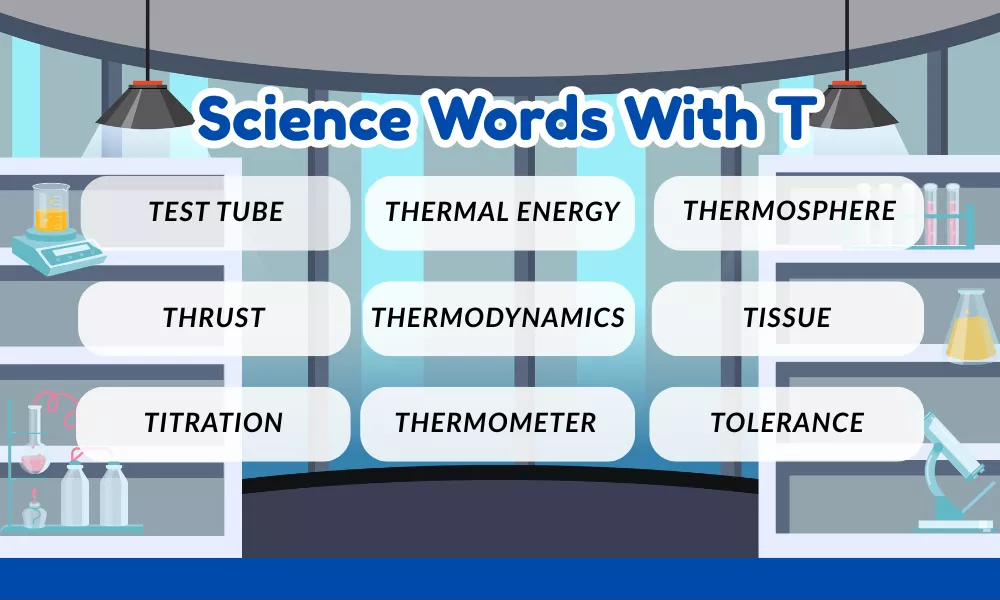
- Tolerance – The acceptable limit of variation in measurement or calculation.
- Total – The sum of all values in a dataset or calculation.
- Trapezoid – A quadrilateral with at least one pair of parallel sides.
- Triangle – A three-sided polygon.
- Trig Function – Mathematical functions like sine, cosine, and tangent.
- Transpose – To interchange rows and columns in a matrix.
- Taylor Series – A representation of a function as an infinite sum of terms.
- Trend Line – A line used in statistics to show the general direction of data.
- Truncation – Shortening a number by removing digits after a certain point.
- Triangulation – Determining position by measuring angles from known points.
- Test Statistic – A value used in hypothesis testing.
- Type I Error – Rejecting a true hypothesis in statistics.
- Type II Error – Failing to reject a false hypothesis.
- Threshold Value – A value where a mathematical function changes behavior.
Computer Science Words That Start With T
- Thread – The smallest unit of processing executed by a CPU.
- Token – A basic unit of code used during programming language parsing.
- Topology (Network) – The physical or logical layout of a computer network.
- Terminal – A device or interface used to communicate with a computer system.
- Transistor – A semiconductor device used to amplify or switch electronic signals.
- Throughput – The amount of data processed in a given time.
- Task – A specific job executed by a computer program.
- Table – A structured set of data arranged in rows and columns.
- Turing Machine – A theoretical computing machine used to study algorithms.
- Tokenization – Breaking text or code into smaller units called tokens.
- Technology Stack (Tech Stack) – The set of technologies used to build an application.
- Thread Pool – A collection of worker threads used for efficient program execution.
- Transmission Control Protocol (TCP) – A communication protocol used in networking.
- Template – A reusable structure or layout used in programming.
- Tunneling – Encapsulating one network protocol inside another.
- Type System – Rules that define how data types interact in programming.
- Tag – A label used in markup languages like HTML.
- Tree Structure – A hierarchical data structure consisting of nodes.
- Transaction – A sequence of operations performed as a single logical unit in databases.
- Test Case – A set of conditions used to test software functionality.
- Trace – A method used to track program execution.
- Throughput Optimization – Improving system performance for higher data processing rates.
- Task Scheduler – Software that manages the execution timing of tasks.
- Thin Client – A lightweight computer that depends on a central server.
- Toolkit – A collection of software tools for development.
Earth And Space Science Vocabulary With T
- Tectonic Plates – Large pieces of Earth’s crust that move slowly.
- Tsunami – A large ocean wave caused by underwater earthquakes or eruptions.
- Troposphere – The lowest layer of Earth’s atmosphere.
- Topography – The physical features of Earth’s surface.
- Tundra – A cold biome with little vegetation.
- Tidal Force – Gravitational forces causing ocean tides.
- Tidal Range – The difference between high and low tide levels.
- Tornado – A violently rotating column of air extending from a thunderstorm.
- Thermosphere – Upper layer of the atmosphere where temperatures rise sharply.
- Tectonics – The study of Earth’s structural movements.
- Turbidity – Cloudiness of water caused by particles.
- Terrestrial Planet – A rocky planet like Earth or Mars.
- Transit – The passage of a celestial body across another body.
- Terminator (Astronomy) – The boundary between day and night on a planet.
- Tidal Energy – Energy produced from ocean tides.
- Tektite – Glassy material formed from meteor impacts.
- Tidal Basin – Coastal area affected by tidal movement.
- Thermal Vent – Opening in the ocean floor releasing heated water.
- Tropopause – Boundary between troposphere and stratosphere.
- Tropical Cyclone – A powerful rotating storm system.
- Terrane – A block of crust with a unique geological history.
- Tachylite – A volcanic glass formed by rapid cooling of lava.
- Tidal Current – Water flow caused by tides.
- Tidal Flat – Coastal land exposed at low tide.
- Tephra – Rock fragments ejected during volcanic eruptions.
Engineering And Applied Science Terms With T
- Torque – Rotational force applied to an object.
- Tolerance – Permissible limits of variation in a manufactured part.
- Turbine – A rotating machine that converts fluid energy into mechanical energy.
- Thermodynamics – Study of energy, heat, and work.
- Thermal Conductivity – Ability of a material to conduct heat.
- Tensile Strength – Maximum stress a material can withstand while being stretched.
- Thermocouple – Device used to measure temperature.
- Thermal Expansion – Expansion of materials due to heat.
- Transmission System – Mechanism that transfers power from one part to another.
- Truss – Structural framework made of interconnected triangles.
- Torque Converter – Device transferring rotating power in vehicles.
- Thermal Insulation – Material used to reduce heat transfer.
- Toolpath – Path followed by a cutting tool in manufacturing.
- Thermal Stress – Stress caused by temperature changes.
- Testing Protocol – Standard procedure for evaluating systems.
- Turbomachinery – Machines using rotating blades to move fluids.
- Thermal Efficiency – Measure of how well a system converts heat to work.
- Technical Drawing – Detailed diagram used in engineering design.
- Threading (Mechanical) – Process of creating screw threads.
- Thermostat – Device that regulates temperature.
- Torque Wrench – Tool used to apply precise torque.
- Thermal Barrier – Layer that reduces heat transfer.
- Tracking System – Mechanism that follows movement or position.
- Turbidity Sensor – Device measuring cloudiness in fluids.
- Tuning – Adjusting system parameters for optimal performance.
General Scientific Words Starting With T
- Theory – A well-supported explanation of natural phenomena.
- Technology – Application of scientific knowledge for practical use.
- Test – A procedure to evaluate a hypothesis or system.
- Technique – A specific scientific method used in research.
- Transfer – Movement of energy, matter, or information.
- Transformation – A change in structure or form.
- Threshold – A limit where a change occurs.
- Trend – A general direction in data over time.
- Tool – An instrument used in scientific work.
- Tracking – Monitoring movement or changes.
- Trial – An experimental attempt to test a hypothesis.
- Toxin – A poisonous biological substance.
- Therapy – Treatment used to cure diseases.
- Template – A model or pattern used for replication.
- Trace Element – A chemical element required in very small amounts.
- Transmitter – Device that sends signals or energy.
- Trigger – An event that initiates a process.
- Thermal – Related to heat energy.
- Transition – Change from one state or condition to another.
- Trajectory – Path followed by a moving object.
- Turbulence – Chaotic fluid motion.
- Topology – Study of spatial relationships.
- Thermometer – Instrument used to measure temperature.
- Target Variable – The outcome measured in an experiment.
- Trend Analysis – Method of analyzing patterns in data.
How To Learn & Remember T Science Vocabulary Easily
- Learn Words in Scientific Categories
Instead of memorizing random terms, group “T” science words by subject such as physics, chemistry, biology, or mathematics. For example, learning torque, tension, and thermodynamics together in physics makes it easier to understand their relationships and remember them longer. - Connect Words to Real-Life Examples
Relating scientific terms to everyday experiences helps reinforce memory. For instance, think of temperature when checking weather, turbine when learning about electricity generation, or transpiration when observing how plants release water vapor. - Use Visual Learning Techniques
Diagrams, charts, and concept maps make complex scientific vocabulary easier to understand. Visualizing things like tectonic plates, triangles, or transverse waves helps your brain associate the word with an image. - Practice With Flashcards or Vocabulary Lists
Create flashcards with the term on one side and its definition on the other. Regularly reviewing them improves memory retention and allows quick revision of important science vocabulary. - Apply the Words in Sentences or Short Notes
Writing short explanations or examples using the words strengthens understanding. For example: “Torque is the force that causes an object to rotate.” Using terms in context helps your brain remember them more effectively. - Review Frequently and Teach Others
One of the best ways to remember scientific terms is by explaining them to someone else. Teaching classmates or discussing concepts strengthens understanding and improves long-term memory.
FAQs
Conclusion
Science words that begin with the letter “T” form an essential part of the scientific vocabulary used across many fields, including physics, chemistry, biology, mathematics, computer science, engineering, and earth science. From fundamental concepts like temperature and triangle to more advanced terms such as thermodynamics, tectonics, and tensors, these words help describe important natural processes, scientific principles, and technological systems. Learning these terms not only expands your vocabulary but also improves your understanding of how the world works. By organizing words into categories, using visual learning strategies, and practicing them regularly, students and learners can easily master and remember science words starting with “T.”