Science Words That Start With P – Physics, Biology & Chemistry Terms
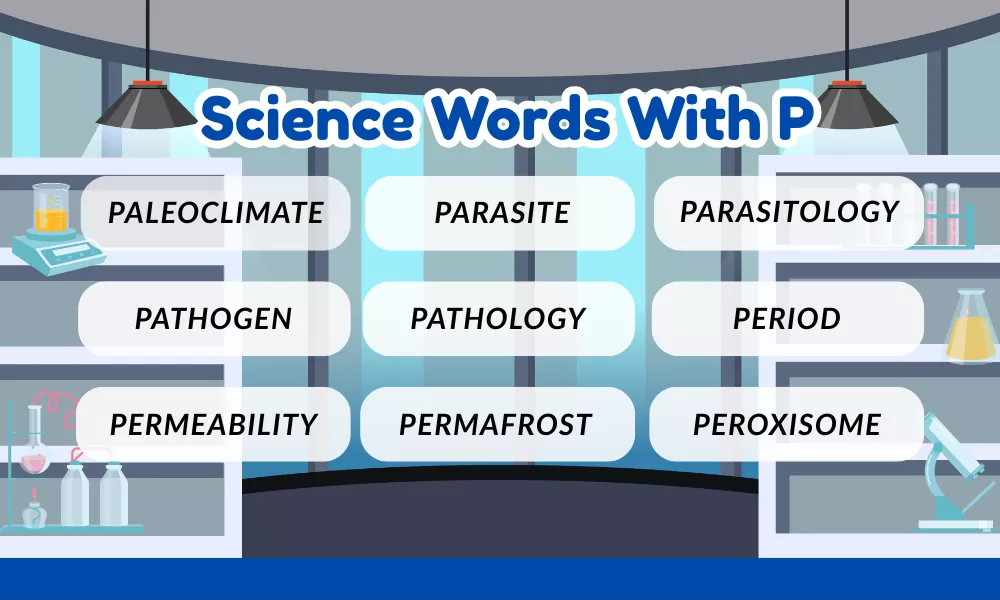
The letter “P” holds a powerful place in the language of science, introducing many terms that explain how the universe and life itself function. From photosynthesis, the process that fuels plant life, to protons, the tiny particles at the center of atoms, “P” words represent some of the most important ideas across scientific fields. These terms appear in disciplines such as physics, chemistry, biology, Earth science, and even astronomy, helping scientists describe the principles, processes, and phenomena that shape our natural world. Exploring science words that start with “P” is more than just learning vocabulary but it is a gateway to understanding how nature works.
Importance of Science Words Starting With P
Science words that start with “P” play an important role in helping us understand many key concepts across different scientific fields. Terms like photosynthesis, proton, plasma, and phylogeny explain essential processes related to life, matter, energy, and evolution. These words help scientists describe complex ideas clearly and accurately, making communication in research, education, and scientific discussions more effective. Learning these terms also strengthens scientific vocabulary for students, researchers, and science enthusiasts.
Science Words With P For Beginners
- Planet – A large celestial body that orbits a star and does not produce its own light.
- Plant – A living organism that usually grows in soil and makes its own food through photosynthesis.
- Particle – A very small piece of matter, such as atoms, electrons, or molecules.
- Power – The rate at which energy is used or transferred in a system.
- Pressure – The force applied on a surface divided by the area of that surface.
- Pulse – A rhythmic movement or wave, often used to describe heartbeats or signals.
- Phase – A stage in a process or a physical state of matter such as solid, liquid, or gas.
- Population – A group of organisms of the same species living in the same area.
- Pollution – Harmful substances introduced into the environment.
- Photosynthesis – The process by which plants use sunlight to produce food.
- Protein – A large molecule in living organisms that helps build and repair body tissues.
- Predator – An animal that hunts and eats other animals for food.
- Prey – An animal that is hunted and eaten by another animal.
- Pulse Rate – The number of heartbeats per minute.
- Property – A characteristic or quality of a substance, such as color or density.
- Process – A series of actions or steps that lead to a particular result.
- Plasma – A state of matter made of charged particles, often found in stars.
- Pathogen – A microorganism that causes disease.
- Pigment – A substance that gives color to plants, animals, or materials.
- Potential Energy – Stored energy due to an object’s position or condition.
- Producer – An organism, such as a plant, that makes its own food.
- Perimeter – The outer boundary of a shape or area.
- Pattern – A repeated or predictable arrangement in nature or data.
- Pulse Wave – A wave that travels through a medium carrying energy.
- Point Source – A single identifiable source of pollution.
Core Science Terms With Letter P
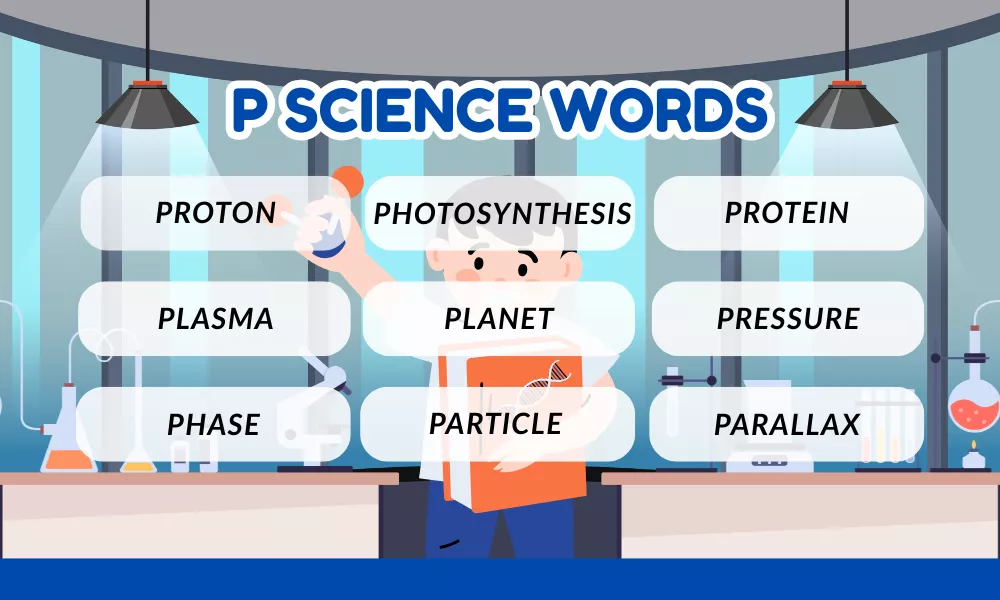
- Proton – A positively charged particle found in the nucleus of an atom.
- Photon – A tiny packet of light energy.
- Plasma – The fourth state of matter consisting of ionized gas.
- Pressure – The force exerted per unit area.
- Power – The rate at which work is done or energy is transferred.
- Photosynthesis – The process plants use to convert sunlight into chemical energy.
- Protein – Essential biological molecules that perform many functions in cells.
- Population – A group of organisms of the same species in a specific area.
- Pathogen – A biological agent that causes disease.
- Polymer – A large molecule made from repeating smaller units.
- Precipitation – Water that falls from clouds as rain, snow, or hail.
- Plate Tectonics – The theory describing movement of Earth’s outer crust.
- Potential Energy – Energy stored in an object because of its position.
- Pulse – A periodic signal or rhythmic movement.
- Pigment – A molecule that absorbs certain wavelengths of light.
- pH – A scale used to measure how acidic or basic a substance is.
- Parasite – An organism that lives on or inside another organism and benefits from it.
- Permeability – The ability of a substance to allow liquids or gases to pass through it.
- Protein Synthesis – The cellular process of making proteins.
- Phototropism – Growth of plants toward light.
- Polarity – A separation of electric charge in a molecule.
- Pressure Gradient – The change in pressure across a distance.
- Plankton – Tiny organisms floating in water bodies.
- Population Density – The number of individuals per unit area.
- Periodic Table – A chart that organizes chemical elements.
Physics Science Words That Start With P
- Photon – A particle that represents a quantum of light or electromagnetic radiation.
- Proton – A positively charged particle in the nucleus of an atom.
- Power – The rate of energy transfer or work done.
- Pressure – Force exerted over a given area.
- Potential Energy – Stored energy based on position or configuration.
- Plasma – Ionized gas with free-moving charged particles.
- Pulse – A sudden burst or wave of energy.
- Period – The time it takes for one complete cycle of motion or wave.
- Pendulum – A weight suspended from a pivot that swings freely.
- Parallax – The apparent shift of an object when viewed from different positions.
- Polarization – Restriction of wave vibrations to a single direction.
- Path Length – The distance traveled by an object or wave.
- Projectile – An object thrown or projected through the air.
- Phase – A specific point in a cycle of motion or wave.
- Particle Physics – The study of fundamental particles of matter.
- Planck Constant – A physical constant used in quantum mechanics.
- Potential Difference – The voltage between two points in a circuit.
- Photon Energy – Energy carried by a photon.
- Pressure Wave – A wave created by compression in a medium.
- Power Output – The amount of power produced by a system.
- Position – The location of an object in space.
- Path – The trajectory followed by a moving object.
- Power Density – Power per unit area or volume.
- Physical Quantity – A measurable property such as mass or speed.
- Point Mass – An object treated as having mass but no size in calculations.
Chemistry Science Words That Start With P
| Word | Description |
|---|---|
| pH | A scale that measures acidity or alkalinity. |
| Polymer | A large molecule made of repeating units. |
| Precipitate | A solid that forms during a chemical reaction in a solution. |
| Periodic Table | A chart organizing elements based on atomic structure. |
| Proton | A positively charged particle in the atomic nucleus. |
| Product | A substance formed as the result of a chemical reaction. |
| Pure Substance | A material with a fixed composition and properties. |
| Polar Molecule | A molecule with uneven distribution of electric charge. |
| Polarity | The presence of positive and negative ends in a molecule. |
| Photochemical Reaction | A chemical reaction triggered by light. |
| Phosphorus | A chemical element essential for life. |
| Platinum | A dense, valuable metal element used in catalysts. |
| Pressure | Force applied per unit area in chemical systems. |
| Partial Pressure | The pressure contributed by a single gas in a mixture. |
| Phase Change | Transition between states of matter. |
| Peroxide | A compound containing an oxygen-oxygen single bond. |
| Protein | Large biomolecules composed of amino acids. |
| Phosphate | A chemical compound containing phosphorus and oxygen. |
| Propane | A hydrocarbon gas used as fuel. |
| Polyethylene | A common plastic polymer. |
| Photolysis | Chemical decomposition caused by light. |
| Pyrolysis | Chemical breakdown caused by heat. |
| Protonation | The addition of a proton to a molecule. |
| Potassium | An essential chemical element and alkali metal. |
| Precursor | A substance from which another compound forms. |
Biology Science Words That Start With P
- Photosynthesis – The process plants use to convert sunlight into energy.
- Protein – Biological molecules essential for structure and function of cells.
- Parasite – An organism that lives on or inside another organism.
- Pathogen – A microorganism that causes disease.
- Population – A group of organisms of the same species in an area.
- Predator – An animal that hunts other animals.
- Prey – An organism that is hunted and eaten.
- Plasma (Blood Plasma) – The liquid component of blood.
- Plant Cell – A cell type found in plants with a cell wall and chloroplasts.
- Pigment – A molecule that produces color in living organisms.
- Phloem – Tissue in plants that transports nutrients.
- Photosystem – A protein complex involved in photosynthesis.
- Phylogeny – The evolutionary history of organisms.
- Plankton – Small organisms drifting in oceans or freshwater.
- Pollination – Transfer of pollen for plant reproduction.
- Pollen – Powder containing male reproductive cells of plants.
- Prokaryote – A cell without a nucleus, like bacteria.
- Phenotype – Observable characteristics of an organism.
- Peptide – A short chain of amino acids.
- Proteome – The full set of proteins produced by a cell.
- Photosphere – The visible surface layer of the sun.
- Parasitism – A relationship where one organism benefits and the other is harmed.
- Plant Hormone – Chemicals that regulate plant growth.
- Peroxisome – A cell organelle that breaks down fatty acids.
- Protoplasm – The living substance inside a cell.
Math Science Words That Start With P
- Parallel – Lines that never intersect and remain the same distance apart.
- Parabola – A curved shape formed by a quadratic equation.
- Parameter – A variable that defines certain characteristics of a system or equation.
- Perimeter – The total distance around a geometric shape.
- Pi (π) – A mathematical constant representing the ratio of a circle’s circumference to its diameter.
- Probability – The measure of how likely an event is to occur.
- Polynomial – An algebraic expression consisting of variables and coefficients.
- Power – An exponent indicating how many times a number is multiplied by itself.
- Prime Number – A number greater than 1 that has only two factors: 1 and itself.
- Proportion – An equation stating that two ratios are equal.
- Permutation – An arrangement of objects in a specific order.
- Pattern – A repeated sequence or design in numbers or shapes.
- Plane Geometry – The study of shapes on a flat surface.
- Percent – A ratio expressed as a fraction of 100.
- Point – An exact location in space with no size or dimension.
- Projection – The representation of a shape or object onto a surface.
- Product – The result obtained from multiplication.
- Place Value – The value of a digit based on its position in a number.
- Pythagorean Theorem – A rule relating the sides of a right triangle.
- Positive Number – A number greater than zero.
- Polygon – A closed shape with straight sides.
- Prism – A 3D geometric shape with two parallel faces.
- Partial Sum – The sum of the first several terms in a sequence.
- Piecewise Function – A function defined by different formulas in different intervals.
- Parameterization – Expressing a mathematical object using parameters.
Computer Science Words That Start With P
- Program – A set of instructions that a computer follows to perform a task.
- Programming – The process of writing and designing computer programs.
- Processor – The main component of a computer that performs calculations and instructions.
- Python – A popular programming language known for simplicity and versatility.
- Protocol – A set of rules governing communication between devices on a network.
- Packet – A small unit of data transmitted over a network.
- Pixel – The smallest unit of a digital image or display.
- Platform – The environment or system where software runs.
- Pointer – A variable that stores the memory address of another variable.
- Parallel Computing – Processing multiple calculations simultaneously.
- Pipeline – A sequence of processing stages where output from one stage feeds the next.
- Port – A communication endpoint used in networking.
- Password – A secret word or phrase used for authentication.
- Phishing – A cyberattack attempting to steal sensitive information.
- Plugin – Software that adds new features to an existing program.
- Patch – A software update that fixes bugs or security issues.
- Process – A running instance of a program.
- Programming Language – A formal language used to write software.
- Parse – Analyzing a sequence of symbols in programming code.
- Package – A collection of related software modules.
- Permission – Access rights assigned to users or programs.
- Proxy Server – An intermediary server between a user and the internet.
- Persistence – The ability of data to remain stored after a program ends.
- Profiling – Analyzing program performance to optimize efficiency.
- Predictive Algorithm – An algorithm that predicts outcomes using data.
Earth And Space Science Vocabulary With P
- Planet – A celestial body that orbits a star and does not produce its own light.
- Plate Tectonics – The movement of Earth’s crustal plates.
- Precipitation – Water that falls from clouds as rain, snow, sleet, or hail.
- Permafrost – Ground that remains frozen for two or more years.
- Peninsula – Land surrounded by water on three sides.
- Plain – A large area of flat land.
- Plate Boundary – The area where two tectonic plates meet.
- Polar Region – Areas around the North and South Poles.
- Pressure System – A region where atmospheric pressure differs from surrounding areas.
- Plume – A column of hot material rising from Earth’s mantle.
- Photosphere – The visible surface layer of the Sun.
- Perigee – The point in the Moon’s orbit closest to Earth.
- Planetary Orbit – The path a planet follows around a star.
- Protoplanet – A large body that can develop into a planet.
- Planetary Nebula – A glowing shell of gas ejected by a dying star.
- Polar Ice Cap – A mass of ice covering the polar regions of a planet.
- Paleoclimate – The study of past climates of Earth.
- Pangaea – An ancient supercontinent that existed millions of years ago.
- Pyroclastic Flow – A fast-moving current of hot gas and volcanic material.
- Planetary Ring – Rings made of dust and ice particles orbiting a planet.
- Plate Movement – The slow shifting of Earth’s tectonic plates.
- Polar Wind – Strong winds blowing from polar regions.
- Pressure Gradient – The difference in atmospheric pressure between locations.
- Planetary Atmosphere – The layer of gases surrounding a planet.
- Perihelion – The point in a planet’s orbit closest to the Sun.
Engineering And Applied Science Terms With P
- Prototype – An early model used to test and improve a design.
- Process Engineering – Designing and optimizing industrial processes.
- Power System – A network that generates and distributes electrical energy.
- Pressure Vessel – A container designed to hold gases or liquids under pressure.
- Pump – A mechanical device used to move fluids.
- Pulley – A wheel with a groove used to lift or move loads.
- Pipeline – A system of pipes used to transport liquids or gases.
- Propulsion – The mechanism that moves vehicles such as rockets or aircraft.
- Power Plant – A facility where electricity is generated.
- Precision Engineering – Designing machines with extremely high accuracy.
- Programmable Logic Controller (PLC) – A digital device used for industrial automation.
- Printed Circuit Board (PCB) – A board used to connect electronic components.
- Product Design – The process of creating and developing new products.
- Pressure Sensor – A device that measures pressure in systems.
- Power Transmission – The transfer of mechanical or electrical power.
- Protective Coating – A layer applied to prevent corrosion or damage.
- Photovoltaic Cell – A device that converts sunlight into electricity.
- Process Control – Monitoring and adjusting industrial processes.
- Prototype Testing – Evaluating a design before mass production.
- Pneumatics – Technology using compressed air for mechanical movement.
- Performance Analysis – Evaluating system efficiency and reliability.
- Power Converter – A device that changes electrical energy from one form to another.
- Precision Measurement – Accurate measurement used in engineering design.
- Product Lifecycle – The stages a product goes through from design to disposal.
- Pressure Regulation – Controlling pressure levels within systems.
General Scientific Words Starting With P
- Phenomenon – An observable event or occurrence in nature.
- Principle – A fundamental scientific rule or law.
- Process – A series of actions leading to a particular result.
- Property – A characteristic of a substance or system.
- Particle – A tiny unit of matter.
- Pattern – A regular or repeated arrangement in nature or data.
- Prediction – A statement about what is expected to happen based on evidence.
- Parameter – A measurable factor in an experiment or system.
- Proof – Evidence supporting a scientific conclusion.
- Procedure – The steps followed during an experiment.
- Precision – The closeness of repeated measurements to each other.
- Product – A substance produced by a chemical reaction.
- Population – A group of organisms of the same species.
- Pathway – A sequence of reactions or processes in science.
- Potential – The capacity to produce a particular effect.
- Phase – A distinct form or state of matter.
- Propagation – The spreading of waves or organisms.
- Perception – The interpretation of sensory information.
- Particle Model – A model explaining matter as tiny particles.
- Photosphere – The visible surface of the Sun.
- Periodic – Occurring at regular intervals.
- Phenotype – Observable characteristics of an organism.
- Parameter Space – The range of possible values in a model.
- Process Variable – A measurable factor in a scientific process.
- Physical Law – A rule describing a consistent natural phenomenon.
How To Learn & Remember P Science Vocabulary Easily
- Group Words by Scientific Field
Organize “P” science words based on subjects like physics, chemistry, biology, or mathematics. Learning related terms together helps your brain connect concepts and remember them more easily. - Use Word Associations and Mnemonics
Create simple memory tricks or associations for each term. For example, you can remember photosynthesis by thinking of “photo = light” and “synthesis = making,” which reminds you that plants make food using light. - Practice With Real-World Examples
Relate scientific terms to everyday life. For instance, connect pressure to the air pressure in a bicycle tire or pollination to bees visiting flowers. Real examples make vocabulary easier to understand and recall. - Make Flashcards or Digital Quizzes
Write the science word on one side and its meaning on the other. Regularly testing yourself with flashcards or apps helps reinforce memory and improves long-term retention. - Use Visual Learning Techniques
Many science terms become clearer when paired with diagrams, charts, or images. Seeing a picture of a planet, parabola, or protein structure helps you remember the term faster. - Review and Use the Words Regularly
Practice writing sentences or short explanations using the new vocabulary. Repetition and usage help move the words from short-term memory to long-term knowledge.
FAQs
Conclusion
Science words that start with “P” cover a wide range of fascinating ideas across fields like physics, chemistry, biology, mathematics and computer science. From essential concepts such as photosynthesis and proton to specialized terms used in technology, these words help explain the processes and principles that shape our world and the universe. Learning this vocabulary is not only useful for students and researchers but also for anyone curious about science. By understanding these terms, readers can better grasp scientific discussions, textbooks, and discoveries. With the help of simple learning strategies, mastering science vocabulary that begins with P becomes much easier and more enjoyable.