
Science Words That Start With N – Scientific Terms & Meanings

Science words that start with “N” introduce some of the most important ideas across physics, chemistry, biology, astronomy, and technology. From neutrons that form the core of atoms to neurons that transmit signals in the human brain, and from glowing nebulae in deep space to essential elements like nitrogen, these terms explain how both the microscopic and cosmic worlds function. Exploring science vocabulary beginning with N not only expands scientific knowledge but also helps learners understand the connections between natural processes, living systems, and modern technology.
Importance of Science Words Starting With N
Science words that start with “N” play an important role in helping students and researchers understand key scientific concepts across different fields. Terms like neutron, nucleus, neuron, nitrogen, and nebula represent fundamental ideas in physics, chemistry, biology, and astronomy. Learning these words strengthens scientific vocabulary, making it easier to study complex topics and communicate scientific information clearly. By understanding science words beginning with N, learners can improve their comprehension of scientific theories, support academic learning, and develop curiosity about the discoveries that shape modern science.
Science Words With N For Beginners
- Nature – The physical world and everything in it, including plants, animals, land, and natural processes.
- Neuron – A specialized nerve cell that sends and receives signals in the brain and nervous system.
- Nerve – A bundle of fibers that carries signals between the brain, spinal cord, and other parts of the body.
- Nutrient – A substance in food that helps living organisms grow, repair tissues, and produce energy.
- Nitrogen – A colorless gas that makes up most of Earth’s atmosphere and is essential for living organisms.
- Nucleus – The central part of an atom or cell that contains important materials like protons or genetic information.
- Nebula – A large cloud of gas and dust in space where new stars are often formed.
- Natural Resource – Materials found in nature such as water, air, minerals, and forests that humans use.
- Nutrition – The process by which organisms obtain and use food for growth and energy.
- Nocturnal – Describes animals that are active mainly during the night.
- Niche – The specific role or position an organism has within its environment.
- Nanometer – A very small unit of length equal to one billionth of a meter.
- Navigation – The process of determining direction or position, used by animals and technology.
- Neutral – A condition where there is no electric charge or chemical reaction.
- Network – A connected system, such as the network of nerves in the human body.
- Nerve Impulse – An electrical signal that travels through neurons to transmit information.
- Natural Selection – The process where organisms better suited to their environment survive and reproduce.
- Nitrogen Cycle – The natural process by which nitrogen moves through soil, water, air, and living organisms.
- Nutritional Energy – Energy obtained from food that powers the body.
- Nerve Cell – Another term for neuron, responsible for sending signals in the nervous system.
- Natural Habitat – The environment where a plant or animal normally lives.
- Nanotechnology – The science of working with extremely small materials at the atomic or molecular level.
- Neural Network – A system of interconnected neurons or computer models designed like the brain.
- Nonliving Factor – Environmental elements like sunlight, air, or water that are not alive but affect ecosystems.
- Natural Phenomenon – An event or process that occurs in nature, such as earthquakes or rainfall.
Core Science Terms With Letter N
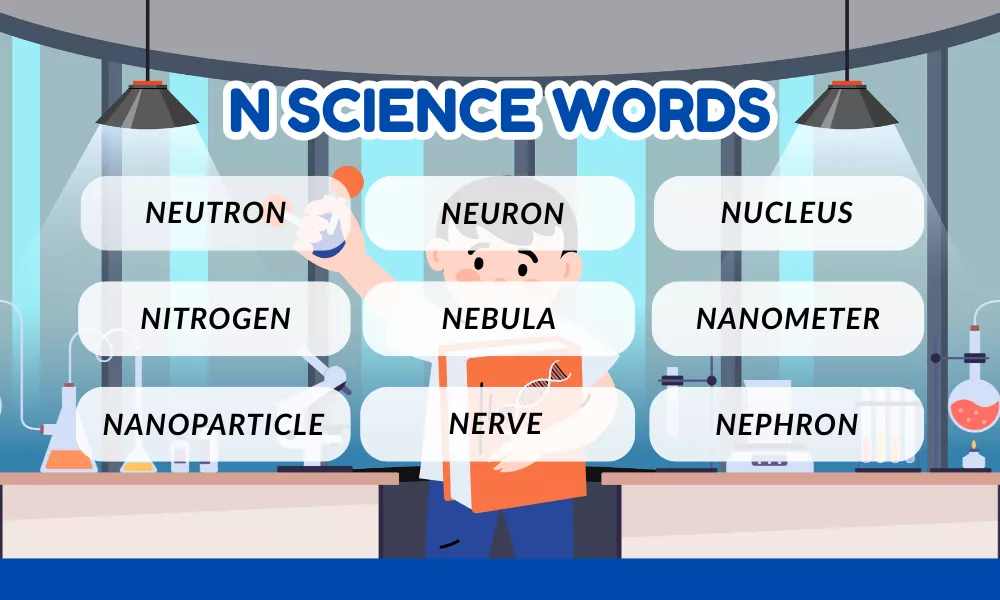
- Neutron – A neutral particle found in the nucleus of an atom.
- Nucleus – The dense center of an atom containing protons and neutrons.
- Nitrogen – A chemical element (symbol N) essential for life and proteins.
- Nebula – A giant cloud of gas and dust in space.
- Neuron – A cell that carries electrical signals in the nervous system.
- Natural Selection – The evolutionary process where favorable traits become more common over generations.
- Nucleic Acid – Biological molecules such as DNA and RNA that carry genetic information.
- Nerve – Tissue that transmits signals through the nervous system.
- Nanotechnology – Technology that manipulates matter at the nanoscale.
- Nuclear Energy – Energy released from the nucleus of an atom during nuclear reactions.
- Neutralization – A chemical reaction where an acid and a base form salt and water.
- Nitric Acid – A strong acid used in chemical reactions and industrial processes.
- Nuclear Fusion – The process where light atomic nuclei combine to form a heavier nucleus.
- Nuclear Fission – The splitting of a heavy atomic nucleus into smaller nuclei with energy release.
- Nerve Impulse – An electrical signal transmitted along a neuron.
- Nutrient Cycle – The movement of nutrients through ecosystems.
- Neural System – The body system responsible for communication and coordination.
- Nanoparticle – A particle extremely small in size, measured in nanometers.
- Nonmetal – A chemical element that lacks metallic properties.
- Nucleolus – A structure inside the cell nucleus where ribosomes are produced.
- Nuclear Reactor – A device used to control nuclear reactions to produce energy.
- Natural Resource – Materials obtained from nature for human use.
- Nitrogen Fixation – The process of converting nitrogen gas into usable compounds.
- Nuclear Radiation – Energy emitted from unstable atomic nuclei.
- Neurotransmitter – Chemical substances that transmit signals between neurons.
Physics Science Words That Start With N
- Newton – The SI unit of force.
- Newton’s First Law – The law stating that an object remains at rest or in motion unless acted upon by a force.
- Newton’s Second Law – A law explaining that force equals mass multiplied by acceleration.
- Newton’s Third Law – The law stating that every action has an equal and opposite reaction.
- Neutron – A neutral subatomic particle found in atomic nuclei.
- Nuclear Energy – Energy released during nuclear reactions.
- Nuclear Fission – The splitting of heavy atomic nuclei to release energy.
- Nuclear Fusion – The joining of light atomic nuclei to form heavier ones.
- Normal Force – The support force exerted by a surface on an object.
- Node – A point in a standing wave where there is no movement.
- Natural Frequency – The frequency at which an object naturally vibrates.
- Neutrino – A very small, nearly massless particle that rarely interacts with matter.
- Nuclear Reaction – A reaction involving changes in an atom’s nucleus.
- Noncontact Force – A force that acts without physical contact, such as gravity.
- Nanoscale – A size range between 1 and 100 nanometers.
- Newtonian Mechanics – The study of motion based on Newton’s laws.
- Negative Charge – The electric charge carried by electrons.
- Nuclear Radiation – Energy emitted from unstable atomic nuclei.
- Neutron Star – A dense star composed mainly of neutrons.
- Nuclear Decay – The process where unstable atomic nuclei lose energy.
- Net Force – The total force acting on an object.
- Normal Acceleration – Acceleration directed toward the center of circular motion.
- Nuclear Binding Energy – The energy holding protons and neutrons together in a nucleus.
- Nonlinear Motion – Motion that does not follow a straight line.
- Neutron Flux – The number of neutrons passing through a surface in a given time.
Chemistry Science Words That Start With N
| Word | Description |
|---|---|
| Nitrogen | A chemical element essential for amino acids and proteins. |
| Nitrate | A chemical compound containing nitrogen and oxygen. |
| Nitrite | A compound containing nitrogen and two oxygen atoms. |
| Neutralization | A reaction between an acid and a base producing salt and water. |
| Noble Gas | A group of stable, nonreactive gases like neon and argon. |
| Nonmetal | Elements that generally lack metallic properties. |
| Nucleus | The central part of an atom containing protons and neutrons. |
| Nucleophile | A chemical species that donates electrons to form bonds. |
| Nanochemistry | The study of chemical processes at the nanoscale. |
| Naphthalene | An organic compound used in mothballs. |
| Nickel | A metallic chemical element used in alloys and batteries. |
| Neon | A noble gas used in lighting and advertising signs. |
| Nitric Acid | A strong acid used in fertilizers and explosives. |
| Nitrogen Oxide | Compounds formed from nitrogen and oxygen. |
| Neutral Molecule | A molecule with no overall electric charge. |
| Nucleation | The initial process in crystal or phase formation. |
| Nonpolar Molecule | A molecule with evenly distributed electric charge. |
| Nucleic Acid | DNA or RNA molecules containing genetic information. |
| Naphtha | A flammable liquid mixture used in fuels and solvents. |
| Nitrate Ion | A negatively charged nitrogen–oxygen ion. |
| Nitrogen Fixation | The conversion of nitrogen gas into useful compounds. |
| Nuclear Chemistry | The study of chemical reactions involving atomic nuclei. |
| Nitro Compound | Organic molecules containing the nitro group (-NO₂). |
| Neutral Solution | A solution with a pH of 7. |
| Nanoparticle | Extremely small particles used in modern chemical technology. |
Biology Science Words That Start With N
- Neuron – A nerve cell that transmits signals in the nervous system.
- Nucleus – The control center of a cell containing genetic material.
- Nerve – Fibers that carry signals between the brain and body.
- Nucleic Acid – DNA and RNA molecules responsible for genetic information.
- Natural Selection – The evolutionary process where organisms adapt to survive.
- Niche – The role or function of an organism in its ecosystem.
- Nutrient – A substance required for growth and energy in organisms.
- Nutrition – The process of obtaining and using food.
- Nervous System – The system controlling body communication and coordination.
- Neurotransmitter – Chemical messengers that transmit signals between neurons.
- Nitrogen Cycle – The movement of nitrogen through living organisms and the environment.
- Nocturnal – Active mainly at night.
- Nodule – A small swelling or structure in plants or tissues.
- Nerve Impulse – Electrical signals transmitted through neurons.
- Nucleolus – A structure inside the cell nucleus that produces ribosomes.
- Neural Network – Interconnected neurons working together.
- Natality – The birth rate within a population.
- Neurobiology – The study of the nervous system.
- Nematode – A type of roundworm found in many environments.
- Nymph – An immature stage of some insects.
- Nitrogen Fixation – The process of converting nitrogen gas into usable compounds by bacteria.
- Nerve Tissue – Tissue specialized for transmitting electrical signals.
- Nephron – The functional unit of the kidney responsible for filtering blood.
- Neurogenesis – The formation of new neurons in the brain.
- Nonvascular Plant – Plants that lack specialized tissues for transporting water and nutrients.
Math Science Words That Start With N
- Natural Number – A positive counting number such as 1, 2, 3, and so on.
- Negative Number – A number less than zero, usually written with a minus sign.
- Nonlinear Equation – An equation where the variables are not raised only to the first power.
- Normal Distribution – A bell-shaped probability distribution common in statistics.
- Numerator – The top number in a fraction that shows how many parts are taken.
- Number Line – A visual representation of numbers arranged in order on a straight line.
- Numeric Value – The numerical representation or quantity of a number or variable.
- Nth Term – A formula used to find any term in a sequence.
- Nonnegative Number – A number that is either positive or zero.
- Nonzero Number – Any number that is not equal to zero.
- Norm – A mathematical function used to measure the size or length of a vector.
- Normal Vector – A vector that is perpendicular to a surface or line.
- Nonlinear Function – A function whose graph is not a straight line.
- Number Theory – A branch of mathematics that studies properties of integers.
- Numerical Method – Techniques used to find approximate solutions to mathematical problems.
- Noncollinear Points – Points that do not lie on the same straight line.
- Noncoplanar Points – Points that do not lie on the same plane.
- Numerical Analysis – The study of algorithms for solving mathematical problems numerically.
- Nonnegative Integer – A whole number that is zero or positive.
- Nth Root – A value that, when multiplied by itself a certain number of times, gives the original number.
- Number Pattern – A sequence of numbers that follows a specific rule.
- Null Set – A set that contains no elements.
- Notation – Symbols and signs used to represent mathematical ideas.
- Numeric Expression – A mathematical phrase containing numbers and operations.
- Number System – A way of representing numbers such as binary or decimal systems.
Computer Science Words That Start With N
- Network – A group of interconnected computers that share resources and data.
- Node – A connection point in a network where data can be transmitted or received.
- Namespace – A container that organizes identifiers to avoid name conflicts in programming.
- Neural Network – A computing model inspired by the structure of the human brain.
- Natural Language Processing – A field of AI that enables computers to understand human language.
- Nanosecond – A unit of time equal to one billionth of a second used in computing speed measurements.
- Null Value – A value that represents missing or undefined data in programming.
- Nested Loop – A loop placed inside another loop in programming code.
- Network Protocol – A set of rules that control how data is transmitted over a network.
- Node.js – A runtime environment used to run JavaScript applications on servers.
- Neural Computing – Computing methods based on artificial neural networks.
- Network Topology – The physical or logical layout of devices in a network.
- NAND Gate – A digital logic gate that outputs false only when all inputs are true.
- NAT (Network Address Translation) – A technique that allows multiple devices to share a single IP address.
- Network Security – Measures used to protect computer networks from threats.
- Nonvolatile Memory – Memory that retains data even when power is turned off.
- Numeric Data Type – A type of data used to store numbers in programming languages.
- Network Interface Card (NIC) – Hardware that allows a computer to connect to a network.
- Network Packet – A small unit of data transmitted across a network.
- Neural Algorithm – Algorithms designed based on artificial neural network models.
- Network Bandwidth – The maximum rate of data transfer in a network.
- NoSQL Database – A database system designed for flexible data storage and large datasets.
- Node Processing – Data processing performed at a specific network node.
- Network Latency – The delay before data transfer begins following a request.
- Namespace Collision – A conflict that occurs when two identifiers share the same name.
Earth And Space Science Vocabulary With N
- Nebula – A large cloud of gas and dust in space where stars often form.
- Neutron Star – An extremely dense star made mostly of neutrons.
- Nadir – The point in the sky directly below an observer.
- Natural Satellite – A celestial body that orbits a planet, such as the Moon.
- Nutation – A small irregular motion in the rotation axis of a planet.
- Northern Hemisphere – The half of Earth located north of the equator.
- Nucleosynthesis – The process of creating new atomic nuclei inside stars.
- Near-Earth Object (NEO) – An asteroid or comet whose orbit comes close to Earth.
- Neap Tide – A tide with a small difference between high and low water levels.
- Nitrate – A compound containing nitrogen often found in soil and water.
- Nitrogen Cycle – The movement of nitrogen through the atmosphere, soil, and living organisms.
- Natural Hazard – A natural event such as earthquakes, floods, or volcanic eruptions.
- Nimbostratus Cloud – A thick cloud layer that produces steady precipitation.
- Nodule – A small mineral deposit found in rocks or ocean floors.
- Nuclear Fusion (in Stars) – The process by which stars produce energy by fusing hydrogen nuclei.
- Nappe – A large sheet of rock that has moved over another rock layer.
- Nivation – A process where snow and ice cause erosion and landform changes.
- Neogene Period – A geological period that began about 23 million years ago.
- Normal Fault – A fracture in Earth’s crust where one block moves downward.
- Natural Gas – A fossil fuel mainly composed of methane found underground.
- Neodymium – A rare earth element used in powerful magnets.
- Nuclear Radiation – Energy released during radioactive decay.
- North Magnetic Pole – The point where Earth’s magnetic field points vertically downward.
- Night Sky – The appearance of the sky after sunset with visible stars and planets.
- Nova – A sudden brightening of a star caused by an explosion on its surface.
Engineering And Applied Science Terms With N
- Nanotechnology – The engineering of materials at extremely small scales measured in nanometers.
- Nanosensor – A sensor designed to detect substances at the nanoscale.
- Network Engineering – The design and management of computer networks.
- Numerical Simulation – The use of computer models to simulate real-world systems.
- Nonlinear System – A system where outputs are not directly proportional to inputs.
- Nondestructive Testing – Methods used to test materials without damaging them.
- Noise Reduction – Techniques used to minimize unwanted signals in systems.
- Neutral Axis – A line in a beam where no tension or compression occurs during bending.
- Nuclear Engineering – The field that focuses on nuclear energy and radiation technologies.
- Nanomaterial – Materials designed at the nanoscale with unique properties.
- Network Infrastructure – The hardware and software that support network operations.
- Node Control – Management of nodes within a networked system.
- Nonconductive Material – Materials that do not allow electricity to pass easily.
- Noise Filter – A device that removes unwanted electrical signals.
- Nonlinear Control System – A system used to control processes with nonlinear behavior.
- Nanofabrication – The process of manufacturing devices at the nanoscale.
- Neutral Grounding – A safety technique used in electrical engineering systems.
- Network Optimization – Improving network efficiency and performance.
- Numerical Control (NC) – Automated control of machines using programmed instructions.
- Nodal Analysis – A method used in electrical engineering to analyze circuits.
- Natural Ventilation – The use of natural airflow to cool or ventilate buildings.
- Nanocoating – A thin nanoscale layer applied to surfaces for protection or performance.
- Noise Signal – Random unwanted disturbance in electronic communication.
- Nonlinear Dynamics – The study of systems with complex and unpredictable behavior.
- Network Automation – The automatic configuration and management of networks.
General Scientific Words Starting With N
- Nature – The physical world and everything that exists naturally.
- Nucleus – The central part of an atom or cell.
- Neutron – A neutral particle found inside atomic nuclei.
- Nitrogen – A chemical element essential for life and a major part of Earth’s atmosphere.
- Neuron – A nerve cell responsible for transmitting signals in the body.
- Nucleic Acid – DNA and RNA molecules that carry genetic information.
- Nerve – Tissue that carries signals throughout the body.
- Natural Selection – The evolutionary process where organisms adapt to their environment.
- Nutrient – A substance that provides nourishment for growth and survival.
- Nebula – A cosmic cloud of gas and dust in space.
- Nanometer – A unit of length equal to one billionth of a meter.
- Nanoscale – A size range between 1 and 100 nanometers.
- Neutralization – A chemical reaction between an acid and a base.
- Neurotransmitter – Chemical messengers that transmit signals between neurons.
- Nonmetal – A chemical element that lacks metallic properties.
- Network – A connected system of elements or structures.
- Natural Resource – Materials obtained from nature for human use.
- Nerve Impulse – An electrical signal transmitted through nerve cells.
- Nuclear Energy – Energy released from atomic nuclei.
- Nuclear Reaction – A reaction that involves changes in the nucleus of an atom.
- Nucleolus – A structure within the cell nucleus involved in ribosome production.
- Nanoparticle – Extremely small particles used in advanced technologies.
- Nitrogen Fixation – The conversion of nitrogen gas into usable compounds by organisms.
- Natural Phenomenon – Events that occur naturally such as rain or earthquakes.
- Neurobiology – The study of the nervous system and brain.
How To Learn & Remember N Science Vocabulary Easily
- Create Word Associations
Connect new science words with familiar ideas or images. For example, link nebula with colorful space clouds or neuron with brain signals. Associating words with visual or real-life concepts helps the brain remember them more easily. - Use Flashcards for Quick Review
Write the science word on one side and its definition on the other side. Reviewing flashcards regularly helps reinforce memory and allows quick revision before exams or quizzes. - Group Words by Science Field
Organize vocabulary into categories such as physics, chemistry, biology, math, or astronomy. Learning related words together helps you understand how concepts connect within each scientific discipline. - Practice with Real Examples
Try using the words in simple sentences or examples. For instance, “Nitrogen makes up most of Earth’s atmosphere.” Using words in context improves comprehension and long-term memory. - Visualize Concepts with Diagrams
Many science terms become easier to remember when paired with visuals. Drawing simple diagrams of a neuron, nucleus, or nebula can help you recall their meanings faster. - Review Regularly with Short Quizzes
Test yourself by writing down definitions or asking questions about the terms. Regular practice strengthens memory and helps ensure you truly understand the vocabulary.
FAQs
Conclusion
Science words that start with N cover a wide range of fascinating concepts across physics, chemistry, biology, mathematics, computer science, engineering, and earth science. From essential terms like neutron, nucleus, and nitrogen to advanced ideas such as nanotechnology, neural networks, and nucleosynthesis, these words help explain how the universe, living organisms, and modern technologies function. Learning and understanding this vocabulary not only improves scientific knowledge but also strengthens communication in academic and professional settings. By practicing regularly and exploring these terms in context, learners can build a strong scientific foundation and develop a deeper curiosity about the natural world and its many discoveries.