Science Words That Start With W – Scientific Vocabulary List
Science words that start with “W” open the door to a wide and fascinating world of discovery. From fundamental natural processes like the water cycle and weather to powerful scientific concepts such as waves, wavelength, and watt, these terms appear across many branches of science including physics, chemistry, biology, and earth science. The letter W, often called “double U,” may seem simple, but it introduces ideas that help explain how energy moves, how ecosystems function, and how the universe behaves. Exploring these words not only expands scientific vocabulary but also deepens our understanding of the natural and technological world around us.
Importance of Science Words Starting With W
Science words that start with “W” play an important role in helping us understand many natural and scientific processes. Terms like wave, wavelength, weather, water cycle, and watt explain key concepts in physics, earth science, biology, and chemistry. Learning these words expands scientific vocabulary and helps students describe how energy moves, how ecosystems work, and how natural systems interact. Understanding “W” science terms also improves communication in scientific studies, making it easier to read textbooks, follow experiments, and discuss scientific ideas clearly.
Science Words With W For Beginners
- Water – A chemical substance (H₂O) essential for life on Earth.
- Wave – A movement that transfers energy through a medium or space.
- Weather – The day-to-day condition of the atmosphere such as rain, wind, and temperature.
- Wind – The movement of air from high pressure to low pressure areas.
- Weight – The force of gravity acting on an object.
- Warmth – The presence or transfer of heat energy.
- Wax – A natural or synthetic substance used in coatings and chemical studies.
- Water Vapor – The gaseous form of water in the atmosphere.
- Water Cycle – The continuous movement of water through evaporation, condensation, and precipitation.
- Wildlife – Animals and plants that live in natural environments.
- Wetland – Land areas saturated with water, supporting unique ecosystems.
- Wood – Plant tissue commonly studied in botany and environmental science.
- Worm – A simple invertebrate animal often studied in biology.
- Wing – A body part that enables animals like birds and insects to fly.
- Waste – Unwanted materials produced from biological or industrial processes.
- Wind Energy – Energy generated by harnessing the power of moving air.
- Wave Energy – Energy produced from the movement of ocean waves.
- Water Pressure – The force exerted by water in motion or stored systems.
- Wildfire – An uncontrolled fire that spreads through vegetation.
- Weathering – The breakdown of rocks by natural forces like wind and water.
- Water Table – The underground level where soil is fully saturated with water.
- Wind Turbine – A machine that converts wind energy into electricity.
- Wavelength – The distance between two identical points in a wave.
- Warm-Blooded – Animals that maintain a constant internal body temperature.
- Water Pollution – Contamination of water bodies by harmful substances.
Core Science Terms With Letter W
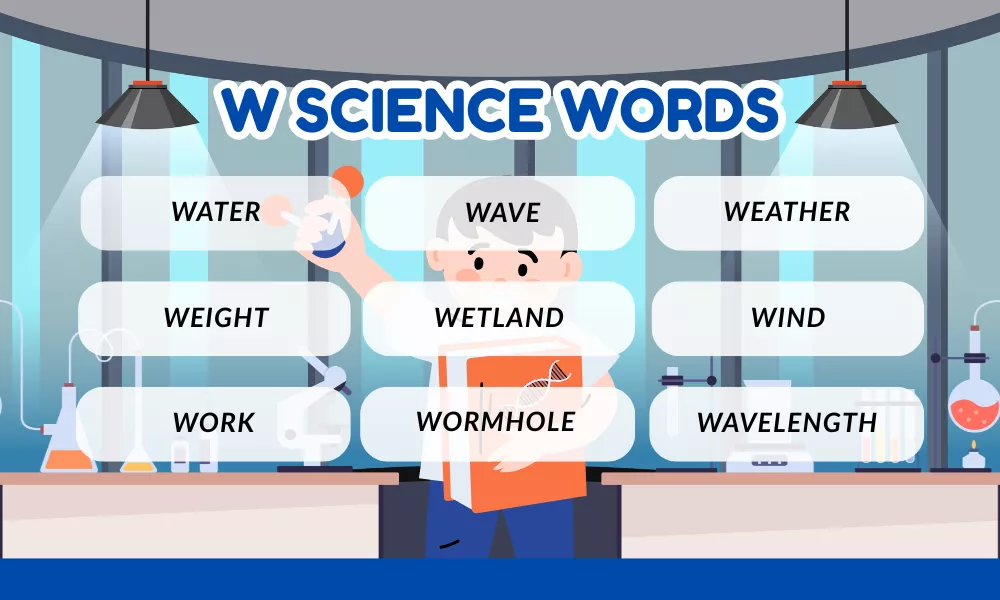
- Watt – The SI unit used to measure power.
- Work – Energy transferred when a force moves an object.
- Wave Motion – The movement of waves transferring energy.
- Wavelength – The length between repeating points of a wave.
- Wave Frequency – The number of wave cycles passing a point per second.
- Wave Speed – The speed at which a wave travels through a medium.
- Water Density – The mass per unit volume of water.
- Wind Speed – The rate at which air moves in the atmosphere.
- Water Potential – The measure of potential energy of water in plants.
- Weather System – Large atmospheric patterns influencing weather.
- Wave Reflection – The bouncing back of waves from a surface.
- Wave Refraction – The bending of waves when they enter a different medium.
- Wave Interference – Interaction of waves producing new wave patterns.
- Wind Chill – The cooling effect of wind on exposed surfaces.
- Water Hardness – The concentration of dissolved minerals in water.
- Water Solubility – The ability of a substance to dissolve in water.
- Water Treatment – Processes used to make water safe for use.
- Wind Direction – The direction from which the wind originates.
- Water Storage – The accumulation of water in natural or artificial systems.
- Wave Propagation – The movement of waves through space or a medium.
- Water Filtration – The removal of particles from water.
- Water Balance – The equilibrium between water input and output in a system.
- Wind Pattern – Regular movement patterns of atmospheric air.
- Wave Amplitude – The height of a wave from its equilibrium position.
- Water Absorption – The process of taking in water by materials or organisms.
Physics Science Words That Start With W
- Watt – Unit of power equal to one joule per second.
- Work – Energy transferred by force acting through a distance.
- Wave – A disturbance that transfers energy without moving matter permanently.
- Wavelength – Distance between repeating points of a wave.
- Wave Frequency – Number of waves passing a point in one second.
- Wave Speed – The rate at which waves travel through space or a medium.
- Wave Reflection – The return of a wave after hitting a surface.
- Wave Refraction – Bending of waves when entering a different medium.
- Wave Interference – Interaction of two or more waves.
- Wave Diffraction – The spreading of waves around obstacles.
- Wavefront – A surface representing points of equal wave phase.
- Wave Mechanics – The study of wave-like behavior in physics.
- Wave Energy – Energy carried and transferred by waves.
- Wave Pulse – A single disturbance traveling through a medium.
- Wave Equation – A mathematical description of wave motion.
- Wave Packet – A localized group of waves traveling together.
- Wave Theory – A theory explaining light and other phenomena as waves.
- Wave Polarization – Restriction of wave vibrations to one direction.
- Wave Intensity – Power transmitted per unit area by a wave.
- Wave Crest – The highest point of a wave.
- Wave Trough – The lowest point of a wave.
- Wave Period – Time required for one full wave cycle.
- Wave Medium – The material through which a wave travels.
- Wave Propagation – The movement of waves through space.
- Wave Oscillation – Repeated back-and-forth motion in a wave system.
Chemistry Science Words That Start With W
| Words | Description |
|---|---|
| Water (H₂O) | A universal solvent important in many chemical reactions. |
| Water Molecule | A molecule consisting of two hydrogen atoms and one oxygen atom. |
| Water Vapor | Water in its gaseous state. |
| Water Hardness | The amount of dissolved calcium and magnesium salts in water. |
| Water Softening | The process of removing hardness from water. |
| Water Solubility | Ability of substances to dissolve in water. |
| Water Electrolysis | Decomposition of water into hydrogen and oxygen using electricity. |
| Water of Hydration | Water molecules chemically bound in a compound. |
| Wet Chemistry | Chemical analysis using liquids and solutions. |
| Wax Compound | Organic substances used in chemistry and materials science. |
| Weak Acid | An acid that partially ionizes in solution. |
| Weak Base | A base that does not fully dissociate in water. |
| Wetting Agent | A substance that reduces surface tension of liquids. |
| Water Purification | Removal of contaminants from water. |
| Water Treatment | Chemical processes used to clean water. |
| Water Contamination | Presence of harmful chemicals in water. |
| Water Sample | A collected portion of water for chemical testing. |
| Water Ionization | The process where water molecules form ions. |
| Water Solvent | Water acting as a medium to dissolve substances. |
| Water Reactivity | How substances react with water. |
| Water Distillation | Purification of water through boiling and condensation. |
| Water Neutralization | Balancing acids and bases in water solutions. |
| Water Alkalinity | The ability of water to neutralize acids. |
| Water Acidity | The level of acid concentration in water. |
| Water Chemistry | Study of chemical properties and reactions in water. |
Biology Science Words That Start With W
- Wildlife – Animals and plants living in natural habitats.
- Worm – A soft-bodied invertebrate animal.
- Wing – A structure enabling animals to fly.
- Warm-Blooded – Animals that maintain stable body temperature.
- Wetland – A water-rich ecosystem supporting diverse life.
- Wood Tissue – Plant tissue responsible for structural support.
- Water Balance – Regulation of water within organisms.
- Water Transport – Movement of water through plant tissues.
- Water Loss – Loss of water through processes like transpiration.
- Water Absorption – Uptake of water by roots or cells.
- Water Regulation – Biological control of internal water levels.
- Wound Healing – The biological process of repairing tissue damage.
- Waxy Cuticle – Protective layer on plant leaves preventing water loss.
- Wheat Plant – A cereal plant studied in agriculture and botany.
- Wild Population – A group of organisms living naturally in the wild.
- Water Ecosystem – Biological communities living in aquatic environments.
- Water Conservation – Biological adaptation to reduce water loss.
- Water Habitat – Natural environment where aquatic organisms live.
- Water Nutrient Cycle – Movement of nutrients through aquatic systems.
- Waterborne Disease – Diseases transmitted through contaminated water.
- Wolffian Duct – Embryonic structure involved in reproductive development.
- White Blood Cells – Immune cells that fight infections.
- Wool Fiber – Natural protein fiber produced by animals like sheep.
- Water Filtration in Plants – Natural purification through plant roots.
- Wildlife Conservation – Protection and management of wild species.
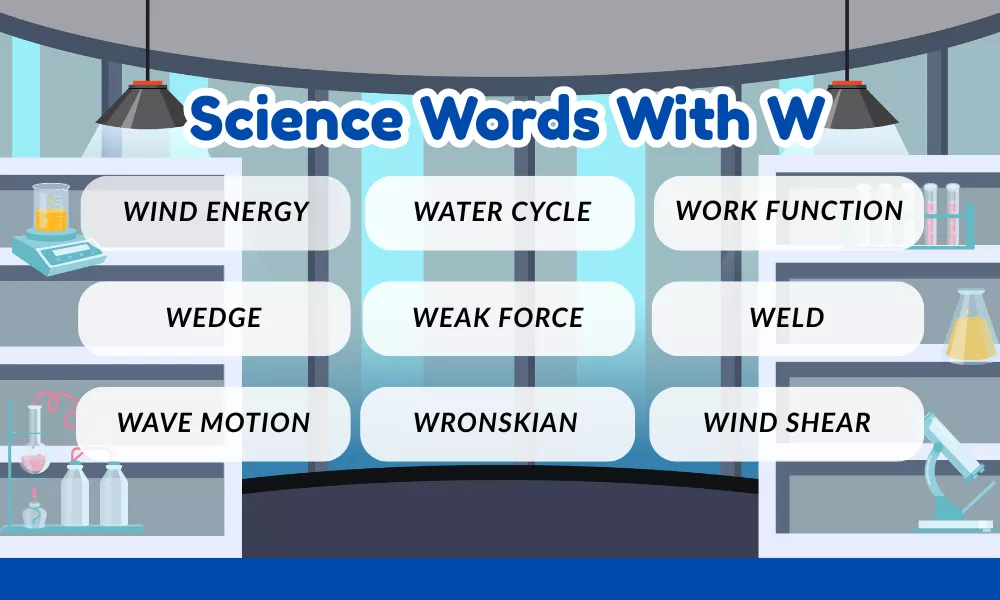
Math Science Words That Start With W
- Whole Number – A number without fractions or decimals, such as 0, 1, 2, and 3.
- Width – The measurement of how wide an object or shape is.
- Weighted Average – An average where some values contribute more than others.
- Weight Function – A function used in mathematics to assign importance to values.
- Wedge Product – A mathematical operation used in geometry and algebra.
- Well-Defined Function – A function that gives a unique output for each input.
- Wave Function – A mathematical function describing a quantum system.
- Winding Number – A number representing how many times a curve wraps around a point.
- Weak Solution – A type of solution used in advanced differential equations.
- Weighted Graph – A graph where edges have numerical values or weights.
- Walsh Function – Mathematical functions used in signal processing.
- Wigner Distribution – A mathematical representation used in quantum mechanics.
- Wronskian – A determinant used to determine independence of functions.
- Weierstrass Function – A function known for being continuous but nowhere differentiable.
- Well-Ordering Principle – A principle stating every set of positive integers has a smallest element.
- Wave Equation – A mathematical equation describing wave motion.
- Weighted Sum – The sum of values multiplied by assigned weights.
- Window Function – A mathematical function used in signal analysis.
- Weak Convergence – A concept in probability and functional analysis.
- Weight Vector – A vector used in mathematical modeling and statistics.
- Wolfram Function – Mathematical functions used in computational models.
- Wavelet – A mathematical function used in signal processing and analysis.
- Wavelet Transform – A method for analyzing signals at different scales.
- Weighted Median – A statistical measure considering weighted data.
- Working Variable – A variable used during intermediate steps of calculations.
Computer Science Words That Start With W
- Web – A system of interlinked digital documents accessed through the internet.
- Website – A collection of related web pages available online.
- Web Browser – Software used to access websites on the internet.
- Web Server – A server that stores and delivers web pages.
- Web Application – A program that runs on a web browser.
- Wi-Fi – Wireless technology used to connect devices to the internet.
- Wireless Network – A network that connects devices without cables.
- Web Development – The process of creating and maintaining websites.
- Webpage – A single page of information on a website.
- Web Protocol – Rules used for transferring information over the web.
- Web API – A programming interface that allows software to interact with web services.
- Web Hosting – A service that stores websites on internet servers.
- Workflow – A sequence of tasks in a computing process.
- Wrapper Function – A function that adds additional functionality to another function.
- Web Framework – A software framework used for building web applications.
- Web Crawler – A program that automatically scans web pages.
- Write Operation – The process of saving data to a storage device.
- Write Buffer – Temporary storage used before writing data permanently.
- Web Security – Protection of websites from cyber threats.
- White Hat Hacker – A security expert who ethically tests computer systems.
- Web Token – A digital token used for authentication in web applications.
- Windows OS – An operating system developed for computers.
- Web Socket – A protocol enabling real-time communication on the web.
- Workstation – A high-performance computer used for technical tasks.
- Wide Area Network (WAN) – A network that covers large geographic areas.
Earth And Space Science Vocabulary With W
- Weather – The short-term condition of the atmosphere.
- Wind – The movement of air in the atmosphere.
- Water Cycle – The continuous movement of water on Earth.
- Watershed – Land area that drains water into a river or lake.
- Water Table – The upper level of underground water.
- Wave – Movement of energy through water or other mediums.
- Weathering – The breakdown of rocks over time.
- Wind Erosion – The wearing away of land by wind.
- Wind Current – Large-scale movement of air in the atmosphere.
- Warm Front – A boundary where warm air replaces cold air.
- Water Vapor – The gaseous form of water in the atmosphere.
- Wind Storm – A storm with extremely strong winds.
- Winter Solstice – The shortest day and longest night of the year.
- World Ocean – The combined ocean system covering Earth.
- Wave Energy – Energy produced by ocean waves.
- Wind Energy – Energy generated from wind movement.
- Water Resources – Natural sources of water used by humans.
- Weather Satellite – A satellite used to observe Earth’s atmosphere.
- Water Basin – A region drained by a river system.
- Water Erosion – The removal of soil by flowing water.
- Wind Pattern – Regular movement patterns of atmospheric air.
- Water Reservoir – A natural or artificial lake storing water.
- Water Salinity – The amount of salt dissolved in water.
- Water Depth – Measurement of how deep a body of water is.
- White Dwarf – A small dense star formed after a star exhausts its fuel.
Engineering And Applied Science Terms With W
- Watt – The standard unit of power in engineering.
- Welding – A process of joining materials using heat or pressure.
- Wire – A thin metal conductor used in electrical systems.
- Wind Turbine – A machine that converts wind energy into electricity.
- Water Pump – A device used to move water from one place to another.
- Water Treatment Plant – A facility used to purify water.
- Waste Management – The process of handling and disposing waste materials.
- Water Filtration System – A system designed to clean water.
- Wind Load – The force exerted by wind on structures.
- Work Efficiency – Measurement of how effectively energy is used.
- Workpiece – A material being shaped or processed in manufacturing.
- Wrench – A tool used to tighten or loosen bolts.
- Water Cooling System – A cooling system using water to remove heat.
- Wave Generator – A device used to create controlled waves.
- Wire Gauge – Measurement of wire thickness.
- Water Pressure System – Equipment used to control water pressure.
- Wind Tunnel – A tool used to test aerodynamic designs.
- Wiper System – Mechanical system used to clear surfaces like windshields.
- Water Jet Cutter – A machine that cuts materials using high-pressure water.
- Wastewater Treatment – The process of cleaning used water.
- Wiring Diagram – A visual representation of electrical connections.
- Wheel Mechanism – A circular device used in mechanical systems.
- Water Heater – A device used to heat water.
- Weight Distribution – How weight is spread across a structure.
- Work Output – The useful energy produced by a machine.
General Scientific Words Starting With W
- Water – A vital compound necessary for life.
- Wave – A pattern of motion that transfers energy.
- Weight – The force caused by gravity acting on an object.
- Watt – A unit used to measure power.
- Weather – Atmospheric conditions at a specific time and place.
- Wind – Moving air caused by pressure differences.
- Wavelength – The distance between repeating points of a wave.
- Water Vapor – Water in its gaseous form.
- Water Cycle – Natural circulation of water on Earth.
- Work – Energy transferred by applying force over distance.
- Wildlife – Animals and plants living in natural habitats.
- Wetland – Land saturated with water supporting ecosystems.
- Weathering – Natural breakdown of rocks and minerals.
- Wind Energy – Energy generated from wind movement.
- Wave Energy – Energy produced by ocean waves.
- Water Pollution – Contamination of water by harmful substances.
- Water Pressure – Force exerted by water.
- Wind Speed – Rate at which air moves.
- Water Absorption – The process of taking in water.
- Water Storage – Accumulation of water in natural or artificial systems.
- Wave Motion – Movement of waves transferring energy.
- Water Resources – Natural water sources used by living organisms.
- Wind Direction – The direction from which wind originates.
- Water Balance – The balance between water input and output.
- Water Ecosystem – Biological community living in aquatic environments.
How To Learn & Remember W Science Vocabulary Easily
- Use Word Associations
Connect each “W” science word with a real-life example. For instance, think of waves in the ocean when learning about wave motion or wind when studying energy. - Create Visual Flashcards
Write the word on one side and the definition with a small diagram on the other. Visual learning helps the brain remember scientific terms more easily. - Group Words by Science Field
Study words in categories such as physics, chemistry, biology, and earth science. This method helps you understand how each term is used in a specific scientific context. - Practice With Simple Sentences
Use each word in a short sentence. For example: “The water cycle moves water through evaporation and rainfall.” This reinforces understanding and memory. - Use Mnemonics and Word Patterns
Create small memory tricks or phrases using the letter W words. Mnemonics make scientific vocabulary easier to recall during studies or exams. - Review Regularly Through Quizzes
Test yourself frequently using quizzes or vocabulary games. Repetition helps transfer new science terms from short-term memory to long-term memory.
FAQs
Conclusion
Science words that start with “W” cover a wide range of important concepts across many fields of science, including physics, chemistry, biology, mathematics, computer science, earth science, and engineering. From fundamental ideas like water, wave, and weather to more advanced terms such as wavelength, watt, and wave equation, these words help explain how natural processes and scientific systems work. Learning this vocabulary not only improves scientific understanding but also strengthens communication in education and research. By exploring and practicing these terms, students and curious learners can expand their knowledge and gain a deeper appreciation of the fascinating world of science.