Science Words That Start With S: Scientific Terms and Meanings
The letter “S” plays a powerful role in the language of science, introducing many of the terms that help explain the world around us. From the microscopic study of cells, species, and structures to the vast wonders of stars, space, and supernovas, “S” connects ideas across fields like chemistry, biology, physics, and astronomy. These words are more than just scientific vocabulary because they represent discoveries, theories, and processes that shape how we understand nature and the universe. Exploring science words that start with “S” not only expands our knowledge but also deepens our curiosity about how life, matter, and energy interact.
Importance of Science Words Starting With S
Science words that start with “S” play an important role in understanding many key concepts across different scientific fields. Terms such as species, solution, symmetry, system, and synthesis help describe how living organisms function, how chemical reactions occur, and how physical laws operate in nature. These words are commonly used in subjects like biology, chemistry, physics, and astronomy, making them essential for students, researchers, and science enthusiasts. Learning these terms not only strengthens scientific vocabulary but also improves the ability to understand experiments, theories, and real-world scientific discussions.
Science Words With S For Beginners
- Sun – The star at the center of our solar system that provides light and heat to Earth.
- Seed – A small plant structure that can grow into a new plant.
- Soil – The top layer of Earth where plants grow and organisms live.
- Sound – Vibrations that travel through air or other materials and can be heard.
- Space – The vast region beyond Earth where planets, stars, and galaxies exist.
- Star – A giant glowing ball of hot gas that produces light and energy.
- Shadow – A dark shape formed when an object blocks light.
- Shape – The outline or form of an object.
- Speed – How fast an object moves from one place to another.
- Surface – The outer layer of an object or material.
- Salt – A chemical compound often formed from an acid and a base.
- Steam – Water in its gaseous state produced by heating water.
- Solid – A state of matter that keeps its shape and volume.
- Sink – When an object moves downward in a liquid because it is heavier.
- Source – The origin or starting point of energy, light, or matter.
- Season – One of the four periods of the year caused by Earth’s movement around the sun.
- Solar – Related to the sun or energy coming from it.
- Shell – A hard outer covering found in animals like turtles or snails.
- Sprout – The early stage of plant growth from a seed.
- Scale – The size or measurement of something compared to another.
- Substance – Any type of material with specific properties.
- Signal – A sign or message used to communicate information.
- Storm – Severe weather with wind, rain, lightning, or snow.
- Stream – A small flowing body of water.
- System – A group of parts that work together as a whole.
Core Science Terms With Letter S
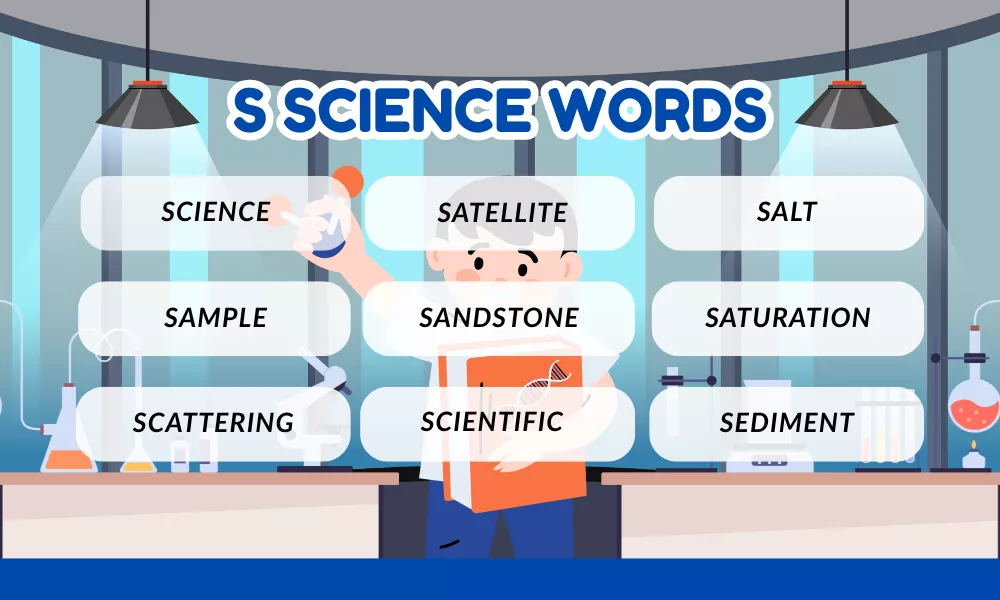
- Species – A group of living organisms that can reproduce with each other.
- Solution – A mixture where one substance dissolves in another.
- Symmetry – Balanced proportions or identical arrangement of parts.
- Structure – The arrangement of parts that form an object or organism.
- Synthesis – The process of combining elements or compounds to create something new.
- Stimulus – Any change in the environment that causes a response in an organism.
- System – A collection of interacting components forming a complex whole.
- Subatomic – Relating to particles smaller than atoms, such as electrons and protons.
- Spectrum – The range of wavelengths of light or other electromagnetic radiation.
- Satellite – An object that orbits a planet or celestial body.
- Solar System – The sun and all objects that orbit around it.
- Sediment – Small particles of rock or organic material that settle at the bottom of water bodies.
- Stability – The ability of a system or structure to remain balanced or unchanged.
- Solubility – The ability of a substance to dissolve in a liquid.
- Surface Tension – The elastic tendency of liquids that allows them to resist external force.
- Supernova – A powerful explosion of a star in space.
- Symbiosis – A close relationship between two different species living together.
- Simulation – A model used to study or imitate real-world processes.
- Scale Model – A smaller or larger representation of an object.
- Secretion – The production and release of substances by cells or glands.
- Signal Transmission – The transfer of information through waves or electrical impulses.
- Substrate – The material or surface on which organisms grow or reactions occur.
- Stationary – Not moving; remaining in one place.
- Stratosphere – The atmospheric layer above the troposphere.
- Scientific Method – A systematic process used to investigate and test scientific ideas.
Physics Science Words That Start With S
- Speed – The rate at which an object moves.
- Scalar – A physical quantity with magnitude but no direction.
- Sound Wave – A vibration that travels through a medium such as air.
- Spectrum – The range of electromagnetic radiation arranged by wavelength.
- Static Electricity – Electric charge that builds up on the surface of objects.
- Superconductor – A material that conducts electricity with no resistance at low temperatures.
- Solar Energy – Energy produced by the sun’s radiation.
- Spin – A fundamental property of particles related to angular momentum.
- Shock Wave – A strong wave created by sudden pressure changes.
- Spring Force – The force exerted by a stretched or compressed spring.
- Surface Tension – The cohesive force acting on the surface of liquids.
- Stationary Wave – A wave that remains in a constant position.
- Specific Heat – The amount of heat needed to change a substance’s temperature.
- Space-Time – The four-dimensional framework combining space and time.
- Spectroscopy – The study of light interaction with matter.
- Simple Harmonic Motion – Repetitive motion around an equilibrium point.
- Solid – A state of matter with fixed shape and volume.
- Speed of Light – The constant speed at which light travels in a vacuum.
- Spin Axis – The imaginary line around which an object rotates.
- Satellite Motion – The movement of an object orbiting a planet.
- Scattering – The deflection of particles or waves in different directions.
- Stress – Force applied per unit area within materials.
- Strain – The deformation caused by applied stress.
- Sonic Boom – A loud noise produced when an object travels faster than sound.
- Synchrotron – A type of particle accelerator used in physics research.
Chemistry Science Words That Start With S
| Words | Meaning |
|---|---|
| Solvent | A substance that dissolves another substance to form a solution. |
| Solute | The substance that is dissolved in a solvent. |
| Solution | A homogeneous mixture of two or more substances. |
| Salt | A compound formed by the reaction of an acid and a base. |
| Synthesis Reaction | A chemical reaction where substances combine to form a new compound. |
| Saturation | The point where no more solute can dissolve in a solvent. |
| Stoichiometry | The calculation of reactants and products in chemical reactions. |
| Substance | Matter with uniform chemical composition. |
| Solubility | The ability of a substance to dissolve in a solvent. |
| Spectroscopy | The study of matter using light interactions. |
| Standard Solution | A solution with a known concentration. |
| Surface Reaction | A chemical reaction occurring on a material’s surface. |
| Sublimation | The change of a solid directly into a gas. |
| Strong Acid | An acid that completely ionizes in water. |
| Strong Base | A base that fully dissociates in water. |
| Silicate | A mineral compound containing silicon and oxygen. |
| Sodium | A highly reactive alkali metal element. |
| Sulfur | A yellow nonmetal element used in many chemical compounds. |
| Stability Constant | A value showing the stability of chemical complexes. |
| Stereochemistry | The study of spatial arrangement of atoms in molecules. |
| Solvation | The process of surrounding solute particles with solvent molecules. |
| Suspension | A mixture where particles are dispersed but not dissolved. |
| Synthetic Compound | A substance made through chemical processes. |
| Standard Temperature | A reference temperature used in chemical measurements. |
| Solid State Chemistry | The study of solid materials and their properties. |
Biology Science Words That Start With S
- Species – A group of organisms that can reproduce with each other.
- Cell Structure – The arrangement of parts inside a biological cell.
- Symbiosis – A close relationship between two different organisms.
- Stimulus – A change in the environment that causes a reaction in organisms.
- Secretion – The release of substances by cells or glands.
- Skeleton – The framework of bones supporting the body.
- Spinal Cord – A part of the nervous system connecting the brain to the body.
- Sensory Organ – An organ that detects environmental changes.
- Sap – The fluid transported in plants carrying nutrients.
- Seed Germination – The process by which a seed begins to grow.
- Skin – The protective outer layer of the body.
- Spore – A reproductive cell capable of developing into a new organism.
- Stem Cell – A cell capable of developing into many different cell types.
- Symmetry – Balanced body structure in organisms.
- Saliva – A digestive fluid produced in the mouth.
- Synapse – The junction between two nerve cells.
- Sperm Cell – The male reproductive cell in animals.
- Skeletal Muscle – Muscle tissue attached to bones for movement.
- Survival – The ability of organisms to continue living in their environment.
- Succession – The gradual change in ecosystems over time.
- Stomata – Tiny openings on plant leaves used for gas exchange.
- Symbiotic Relationship – Interaction between two species living closely together.
- Synthesis in Plants – The formation of organic compounds during processes like photosynthesis.
- Sensory Neuron – A nerve cell that carries signals to the brain.
- Spinal Nerve – Nerves that emerge from the spinal cord and connect to the body.
Math Science Words That Start With S
- Sum – The result obtained when two or more numbers are added together.
- Subtraction – A mathematical operation used to find the difference between numbers.
- Square – A number multiplied by itself or a shape with four equal sides.
- Square Root – A value that, when multiplied by itself, gives the original number.
- Sequence – A list of numbers arranged in a specific order or pattern.
- Series – The sum of the terms of a sequence.
- Slope – A measure of how steep a line is on a graph.
- Set – A collection of distinct objects or numbers in mathematics.
- Symmetry – A property where one part of a figure mirrors another.
- Statistics – The study of collecting, analyzing, and interpreting data.
- Standard Deviation – A measure showing how spread out numbers are in a dataset.
- Scalar – A quantity that has magnitude but no direction.
- Simultaneous Equations – Two or more equations solved together.
- Segment – A part of a line between two endpoints.
- Scale – The ratio used to represent larger measurements in a smaller form.
- Solid Geometry – The study of three-dimensional shapes like cubes and spheres.
- Slope-Intercept Form – A way of writing linear equations in the form y = mx + b.
- Sample – A smaller group taken from a larger population for analysis.
- Scatter Plot – A graph showing the relationship between two sets of data.
- Subscript – A small number or symbol written below a line in mathematical notation.
- Significant Figures – Digits that carry meaningful precision in numbers.
- Sector – A portion of a circle bounded by two radii and an arc.
- Similarity – When two shapes have the same shape but different sizes.
- Symmetric Property – A property stating that if a = b, then b = a.
- System of Equations – A set of equations solved together to find common solutions.
Computer Science Words That Start With S
- Software – Programs and applications that run on a computer system.
- Server – A computer that provides resources or services to other computers.
- Source Code – The human-readable instructions written by programmers.
- Syntax – The rules that define how code must be written in a programming language.
- Script – A small program used to automate tasks.
- Storage – The place where data is saved on digital devices.
- Search Algorithm – A method used to locate specific data in a dataset.
- Security – Measures used to protect computer systems and data.
- System Software – Software that manages hardware and basic system operations.
- Simulation – A digital model used to imitate real-world systems.
- Stack – A data structure where elements are added or removed in a last-in, first-out order.
- Stream Processing – Real-time processing of continuous data streams.
- Scanner – A device that converts physical documents into digital data.
- Spreadsheet – Software used for organizing and analyzing data in tables.
- Session – A period during which a user interacts with a computer system.
- Shell – A command-line interface used to interact with an operating system.
- Subnet – A smaller division of a computer network.
- Synchronization – Keeping data consistent across systems or devices.
- Script Language – A programming language used mainly for automation.
- Semantic Analysis – The process of interpreting the meaning of code during compilation.
- Signal Processing – Techniques used to analyze digital signals.
- Serverless Computing – A cloud computing model where servers are managed by the provider.
- Secure Socket Layer (SSL) – A protocol used to secure internet communications.
- Software Engineering – The discipline of designing and maintaining software systems.
- Scalability – The ability of a system to handle increasing workloads.
Earth And Space Science Vocabulary With S
- Solar System – The sun and all celestial bodies that orbit it.
- Star – A massive luminous sphere of plasma producing energy through nuclear reactions.
- Satellite – An object that orbits a planet or other celestial body.
- Sediment – Small particles of rock or organic matter deposited by water or wind.
- Seismology – The scientific study of earthquakes and seismic waves.
- Seismic Wave – Energy waves produced by earthquakes traveling through Earth.
- Stratosphere – The atmospheric layer above the troposphere containing the ozone layer.
- Subduction – The process where one tectonic plate moves beneath another.
- Supernova – A powerful explosion marking the death of a star.
- Solar Eclipse – When the moon blocks the sun’s light from reaching Earth.
- Space-Time – The four-dimensional structure combining space and time.
- Solar Wind – A stream of charged particles released from the sun.
- Sandstone – A sedimentary rock formed from compacted sand.
- Sea Level – The average height of the ocean’s surface.
- Storm Surge – A rise in sea level caused by strong storms.
- Snowfall – The precipitation of ice crystals from clouds.
- Strata – Layers of sedimentary rock or soil.
- Seafloor Spreading – The process of new ocean crust forming at mid-ocean ridges.
- Solar Radiation – Energy emitted by the sun.
- Space Exploration – The study and exploration of outer space using spacecraft.
- Sunspot – A temporary dark spot on the sun’s surface caused by magnetic activity.
- Sublimation – The process where ice turns directly into water vapor.
- Satellite Orbit – The path a satellite follows around a planet.
- Season – One of the four periods of the year caused by Earth’s tilt and orbit.
- Stellar Evolution – The life cycle of stars.
Engineering And Applied Science Terms With S
- Structure – A system of connected parts designed to support loads.
- Stress – The force applied per unit area within materials.
- Strain – The deformation resulting from applied stress.
- Strength – The ability of a material to withstand applied forces.
- Soldering – A process used to join metal parts using melted filler metal.
- Sensor – A device that detects and responds to environmental changes.
- Signal – Information transmitted through electrical or mechanical means.
- Simulation – The modeling of real-world systems to study their behavior.
- System Design – The process of defining the architecture of a system.
- Servo Mechanism – An automatic device used for precise control of motion.
- Structural Analysis – The study of how structures respond to loads.
- Safety Factor – A design margin used to ensure reliability and safety.
- Subassembly – A smaller component that forms part of a larger system.
- Stress Testing – Evaluating systems under extreme conditions.
- Standardization – The establishment of technical standards for products.
- Surface Engineering – Techniques used to improve surface properties of materials.
- Signal Processing – Analysis and modification of signals in engineering systems.
- Solid Mechanics – The study of solid materials and their behavior under force.
- System Integration – Combining different subsystems into a single functioning system.
- Structural Load – The weight or force carried by a structure.
- Sustainable Engineering – Engineering practices focused on environmental sustainability.
- Shock Absorber – A device designed to absorb and dampen shock impulses.
- Smart Materials – Materials that change properties in response to stimuli.
- Scalability – The ability of a system to handle increased demand.
- Structural Stability – The ability of a structure to remain safe and balanced.
General Scientific Words Starting With S
- Science – The systematic study of the natural world through observation and experiments.
- Scientific Method – A structured process used to investigate scientific questions.
- Substance – Any material with a defined chemical composition.
- System – A group of interconnected components working together.
- Structure – The arrangement of parts within an object or organism.
- Spectrum – The full range of electromagnetic radiation.
- Solubility – The ability of a substance to dissolve in another.
- Surface – The outer layer or boundary of an object.
- Stability – The ability of a system to remain unchanged under conditions.
- Sample – A portion of a material used for analysis.
- Signal – Information transmitted through waves or electrical impulses.
- Scale – A system used for measurement or comparison.
- Synthesis – The combination of elements or compounds to form something new.
- Simulation – A model that imitates real-life scientific processes.
- Structure Function – The relationship between structure and function in systems.
- Specimen – A sample used for scientific study or testing.
- State of Matter – The physical form of matter such as solid, liquid, or gas.
- Stimulus – Any factor that causes a response in an organism or system.
- Symmetry – Balanced arrangement of parts in an object or system.
- Sensor – A device used to detect changes in the environment.
- Subatomic Particle – A particle smaller than an atom.
- Space – The vast region beyond Earth containing celestial bodies.
- Solar Energy – Energy derived from the sun.
- Standard Unit – A fixed measurement used in science.
- Scientific Theory – A well-tested explanation of natural phenomena.
How To Learn & Remember S Science Vocabulary Easily
- Group Words by Scientific Field
Instead of memorizing random terms, organize “S” science words by subject such as physics, biology, chemistry, or astronomy. Grouping related words like species, symbiosis, and stem cell together helps your brain build stronger connections and improves long-term memory. - Use Real-World Examples
Try linking scientific terms to everyday experiences. For example, connect solar energy with sunlight powering solar panels or sediment with sand settling at the bottom of water. Real-life connections make complex terms easier to understand and remember. - Create Simple Word Associations
Associating a word with an image, story, or similar-sounding term can strengthen recall. For instance, remembering sublimation as “solid skipping straight to gas” helps you visualize the concept quickly. - Practice With Flashcards or Quiz Apps
Flashcards are one of the most effective ways to learn scientific vocabulary. Write the term on one side and the definition on the other. Reviewing them regularly helps reinforce the meaning and improves memory retention. - Use the Words in Sentences
Try writing short sentences or explanations using the vocabulary. For example: “A supernova is a powerful explosion of a star.” Actively using words helps transfer them from short-term memory to long-term understanding. - Review Through Visual Learning
Many scientific concepts are easier to remember through diagrams, charts, and videos. Seeing a diagram of the solar system or the structure of a cell can make vocabulary clearer and more memorable.
FAQs
Conclusion
Science words that start with the letter “S” cover a remarkable range of ideas across multiple scientific disciplines. From mathematics and computer science to biology, chemistry, engineering, and space science, these terms help explain how the world works. Learning and understanding these words not only expands scientific vocabulary but also improves critical thinking and comprehension of scientific concepts. Whether you are a student, teacher, or science enthusiast, exploring science vocabulary beginning with “S” can deepen your knowledge and spark curiosity about the natural world.