Science Words That Start With I – List of Scientific Terms and Meanings
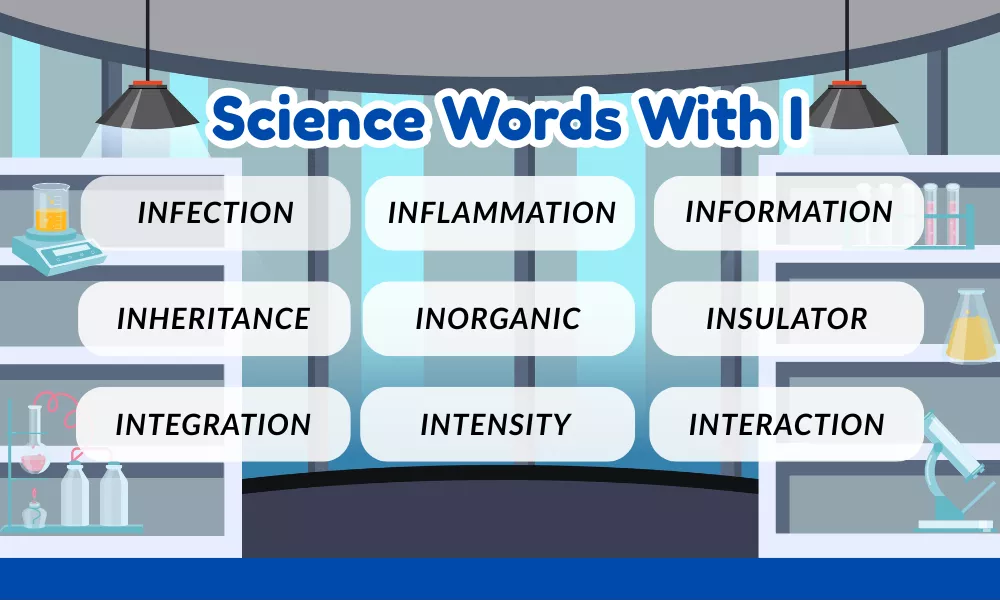
Science words that start with the letter “I” open up a fascinating gateway into discovery, innovation, and understanding. From everyday concepts like insulator and inertia to advanced fields like immunology and immunotherapy, these words represent key ideas across biology, chemistry, physics, earth science, and technology. Whether you’re a student, teacher, or simply curious about science, learning these terms can spark interest, improve comprehension, and make scientific topics easier to understand. This collection of “I” words is designed to be simple, useful, and inspiring for learners at all levels.
Importance of Science Words Starting With I
Science words that start with “I” are important because they explain many core scientific ideas and processes. Terms like inertia, isotope, and ion are foundational in physics and chemistry, while words like immunity and infection are essential in biology and health science. Learning these words not only strengthens scientific literacy but also improves academic vocabulary.
Science Words With I For Beginners
- Ice – Frozen water, a solid form of H₂O.
- Idea – A thought or suggestion used in scientific thinking.
- Image – A visual picture, often from a microscope or telescope.
- Impact – The effect or force of one object hitting another.
- Insect – A small animal with six legs and a body in three parts.
- Iron – A strong metal element (Fe).
- Illness – A state of poor health.
- Intake – The amount of food, air, or substances taken in.
- Irritate – To cause discomfort or inflammation.
- Instrument – A tool used in experiments.
- Igloo – A dome-shaped shelter made of ice (related to cold-region studies).
- Island – Land surrounded by water.
- Iodine – A chemical element used in medicine.
- Immune – Protected from a disease.
- Increase – To grow or become larger.
- Indicator – A substance that shows changes (like pH paper).
- Inside – The inner part of something.
- Interaction – When things affect each other.
- Inhale – To breathe in.
- Injury – Physical harm to the body.
- Investigate – To study or examine carefully.
- Invisible – Not able to be seen.
- Icy – Covered with ice.
- Identify – To recognize something.
- Invent – To create something new.
Core Science Terms With Letter I
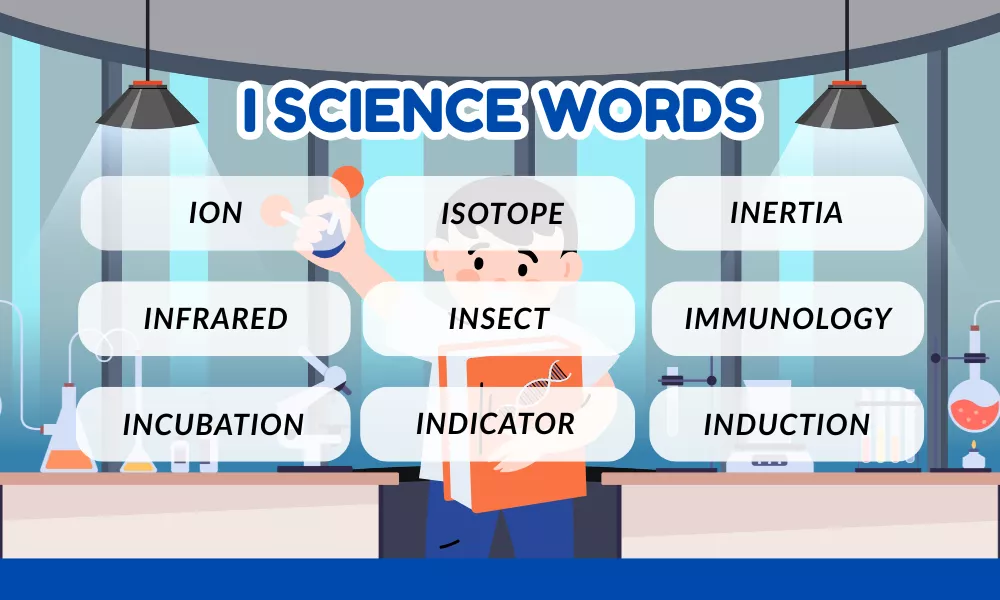
- Inertia – Resistance to change in motion.
- Ion – A charged particle.
- Isotope – Atoms of the same element with different neutrons.
- Insulator – Material that resists heat or electricity flow.
- Immunity – Protection from disease.
- Irradiation – Exposure to radiation.
- Incubation – Development period (like for eggs or diseases).
- Implosion – Collapse inward.
- Intensity – Strength of energy or force.
- Interface – Boundary between two systems.
- Induction – Producing electricity or reasoning from data.
- Infection – Invasion by harmful microbes.
- Inflammation – Body’s response to injury or infection.
- Inheritance – Passing traits genetically.
- Input – Energy or information put in.
- Innovation – New scientific idea or method.
- Integration – Combining parts into a whole.
- Instinct – Natural behavior.
- Irritant – Substance causing irritation.
- Implant – Device placed in the body.
- Index – Measurement scale.
- Inference – Conclusion from evidence.
- Infrared – Type of heat radiation.
- Iceberg – Large floating ice mass.
- Interference – Overlapping waves affecting each other.
Physics Science Words That Start With I
- Inertia – Object’s resistance to motion change.
- Impulse – Force applied over time.
- Induction – Producing electric current magnetically.
- Insulator – Stops electricity flow.
- Interference – Wave interaction effect.
- Intensity – Power per area.
- Inclination – Tilt angle.
- Impact – Collision force.
- Infrared – Electromagnetic radiation.
- Ionization – Creating ions.
- Incidence – Incoming ray direction.
- Idealization – Simplified model.
- Inelastic – Collision losing energy.
- Isolated system – No energy exchange.
- Illumination – Light falling on surface.
- Image formation – Creation of optical image.
- Impedance – Resistance in AC circuits.
- Index of refraction – Light bending measure.
- Inversion – Flipping image.
- Interaction – Forces between objects.
- Internal energy – Energy inside system.
- Interstellar – Between stars.
- Ionosphere – Charged upper atmosphere layer.
- Irreversibility – Process not reversible.
- Isotropy – Same properties in all directions.
Chemistry Science Words That Start With I
| Words | Description |
|---|---|
| Ion | Charged atom. |
| Isotope | Same element, different mass. |
| Ionic bond | Bond via electron transfer. |
| Indicator | Shows pH change. |
| Inert | Chemically unreactive. |
| Iodine | Element (I). |
| Ionization | Forming ions. |
| Immiscible | Liquids that don’t mix. |
| Impurity | Unwanted substance. |
| Ionic compound | Compound of ions. |
| Intermolecular forces | Forces between molecules. |
| Ion exchange | Swapping ions. |
| Ignition | Starting combustion. |
| Inhibitor | Slows reactions. |
| Industrial chemistry | Large-scale chemistry. |
| Isomer | Same formula, different structure. |
| Ionic radius | Size of an ion. |
| Inorganic | Not carbon-based. |
| Ionic solution | Contains ions. |
| Ion pair | Oppositely charged ions. |
| Insoluble | Cannot dissolve. |
| Intercalation | Inserting molecules. |
| Ion-selective electrode | Measures ions. |
| Iodometry | Titration method. |
| Isoelectric point | Neutral charge pH. |
Biology Science Words That Start With I
- Immunity – Disease protection.
- Infection – Microbe invasion.
- Inheritance – Genetic trait transfer.
- Insulin – Hormone controlling sugar.
- Intestine – Digestive organ.
- Invertebrate – Animal without backbone.
- Iris – Colored eye part.
- Incisor – Cutting tooth.
- Instinct – Natural behavior.
- Immune system – Body defense network.
- Inflammation – Response to harm.
- Incubation – Development period.
- Implantation – Embryo attachment.
- Inhalation – Breathing in.
- Ileum – Small intestine part.
- Integument – Skin covering.
- Irritability – Response to stimuli.
- Interneuron – Connector neuron.
- Invasive species – Harmful non-native species.
- Infancy – Early life stage.
- Isolation – Separation of species.
- Intake – Consuming food.
- Immunology – Study of immunity.
- Inhibitory neuron – Slows signals.
- In vitro – Outside a living body.
Math Science Words That Start With I
- Integer – Whole number (positive, negative, or zero).
- Inequality – A math statement showing values are not equal.
- Interval – A range of numbers.
- Intersection – Common elements between sets.
- Infinite – Without end.
- Irrational number – Number that can’t be written as a fraction.
- Identity – An equation true for all values.
- Inverse – Opposite effect (like subtraction for addition).
- Index (indices) – Exponent or power.
- Integral – Result of integration.
- Interpolation – Estimating between known values.
- Iteration – Repeating steps.
- Isosceles triangle – Triangle with two equal sides.
- Inflection point – Where a curve changes direction.
- Inequation – Another term for inequality.
- Imaginary number – Number involving √-1.
- Independent variable – Input variable.
- Indeterminate – No fixed value.
- Integer sequence – Ordered whole numbers.
- Icosagon – 20-sided polygon.
- Incircle – Circle inside a polygon.
- Inequality sign – Symbols like < or >.
- Iteration method – Repeated solving technique.
- Intercept – Where a graph crosses axes.
- Inradius – Radius of an incircle.
Computer Science Words That Start With I
- Input – Data entered into a computer.
- Interface – Point where users interact with systems.
- Internet – Global computer network.
- IP address – Unique device identifier online.
- Iteration – Repeating code steps.
- Indexing – Organizing data for quick search.
- Instruction – Command for a computer.
- Integrated circuit – Microchip.
- Infrastructure – System framework.
- Instance – Single object of a class.
- Inheritance – Class sharing features.
- Initialization – Setting starting values.
- Interpreter – Executes code line by line.
- IoT (Internet of Things) – Connected smart devices.
- Icon – Small graphical symbol.
- Identifier – Name for variable/function.
- Iteration loop – Repeating code structure.
- Information system – Data management system.
- Image processing – Editing/analyzing images digitally.
- Intrusion detection – Security monitoring.
- Index file – Data lookup file.
- Instruction set – CPU commands.
- IT (Information Technology) – Tech systems field.
- Interactive system – Responds to user actions.
- Integration – Combining systems/software.
Earth And Space Science Vocabulary With I
- Igneous rock – Rock from cooled magma.
- Iceberg – Floating ice mass.
- Ice age – Long cold climate period.
- Insolation – Incoming solar radiation.
- Inclination – Tilt of Earth or orbit.
- Ionosphere – Charged upper atmosphere layer.
- Impact crater – Hole from collision.
- Inner core – Earth’s solid center.
- Ice cap – Large glacier area.
- Island arc – Curved volcanic island chain.
- Interglacial – Warm period between ice ages.
- Irrigation – Supplying water to land.
- Isobar – Line of equal pressure.
- Inlet – Waterway into land.
- Ice sheet – Thick glacier mass.
- Illumination – Light on planets/moon.
- Interstellar – Between stars.
- Impact event – Meteor collision.
- Ice core – Cylindrical ice sample.
- Isostasy – Earth crust balance.
- Inclined orbit – Tilted orbit path.
- Inversion – Temperature layer flip.
- Ice crystal – Frozen water particle.
- Interplanetary – Between planets.
- Ice shelf – Floating glacier edge.
Engineering And Applied Science Terms With I
- Infrastructure – Basic system framework.
- Innovation – New idea or method.
- Integration – Combining components.
- Instrumentation – Measurement tools.
- Insulator – Blocks heat/electricity.
- Interface – Connecting systems.
- Implementation – Putting design into action.
- Industrialization – Growth of industries.
- Inspection – Careful checking.
- Iteration – Repeated improvement.
- Input signal – Entering signal.
- Induction motor – Electric motor type.
- Injection molding – Plastic shaping method.
- Ignition system – Starts engines.
- Integrated design – Unified planning.
- Impact testing – Material strength test.
- Insulation – Preventing heat/electric flow.
- Intake system – Engine air entry.
- Industrial robot – Automated machine.
- Impedance – Electrical resistance measure.
- Installation – Equipment setup.
- Inverter – Converts DC to AC power.
- Indicator system – Monitoring display.
- Innovation cycle – Idea-to-product process.
- Infrastructure engineering – Large system design.
General Scientific Words Starting With I
- Investigation – Careful study.
- Inference – Logical conclusion.
- Interaction – Mutual effect.
- Innovation – New scientific idea.
- Indicator – Shows change.
- Isolation – Separation.
- Intensity – Strength level.
- Irritation – Mild inflammation.
- Ingestion – Taking in food/substance.
- Inhalation – Breathing in.
- Incubation – Development period.
- Immunity – Disease protection.
- Infection – Germ invasion.
- Identification – Recognizing something.
- Inhibitor – Slows a process.
- Irradiation – Radiation exposure.
- Interface – Shared boundary.
- Innovation – New solution.
- Input – Information added.
- Insight – Deep understanding.
- Integration – Combining parts.
- Investigator – Science researcher.
- Index – Measurement scale.
- Inspection – Detailed checking.
- Inquiry – Asking questions to learn.
How To Learn & Remember I Science Vocabulary Easily
- Identify the Common Prefixes
Many I science words begin with prefixes such as “inter” (between), “intra” (within), or “iso” (equal). Understanding prefixes helps you quickly guess meanings of words like interaction, intracellular, and isotope. - Create Image Associations
Connect each word with a mental picture. For example, imagine two atoms connected for interaction, or identical twins for isotope. Visual images make words easier to recall. - Use the “I-Word Comparison Technique”
Compare similar words such as ion vs isotope or infection vs immunity. Comparing differences helps prevent confusion and strengthens memory. - Speak the Word in a Scientific Sentence
Practice using each vocabulary word in a simple science sentence, such as: “An ion carries an electric charge.” Speaking improves understanding and long-term retention. - Make Mini Topic Lists
Group I-words by topics like Biology (immunity, insulin), Physics (inertia, intensity), and Chemistry (ion, isotope). Organized learning improves recall. - Apply the 24-Hour Review Rule
Review the new I science vocabulary within 24 hours after learning it. Quick revision significantly increases long-term memory retention.
FAQs
Conclusion
Science words that start with the letter “I” are more than just vocabulary but they are keys to understanding important scientific ideas across physics, chemistry, biology, earth science, math, and technology. Words like inertia, isotope, immunity, and ion help explain how our world works, from tiny atoms to living systems and even outer space. By learning and practicing these words regularly, students can improve both their scientific knowledge and English vocabulary skills. Whether you are a student, teacher, or curious learner, mastering “I” science vocabulary builds confidence, boosts academic success, and sparks curiosity about science.