Science Words That Start With E – Science Vocabulary With Meanings

Exploring science words that start with “E” opens the door to some of the most essential and exciting concepts in the scientific world. From ecosystems that reveal how life interacts, to electrons that explain the behavior of atoms, to evolution that uncovers the story of life itself, these “E” terms form the backbone of many scientific ideas. They help students, researchers, and everyday learners understand how the natural world works, communicate complex topics clearly, and build a stronger scientific vocabulary.
Importance of Science Words Starting With E
Science words beginning with E are important because they represent many core ideas that shape modern science. These terms help learners describe natural processes, understand scientific principles, and communicate discoveries effectively. From explaining energy flow in ecosystems to understanding atomic electrons, “E” words make complex topics easier to grasp. Building a strong vocabulary with these terms also improves academic writing, boosts scientific literacy, and supports clearer thinking across all branches of science.
Science Words With E For Beginners
- Earth – The planet we live on.
- Energy – The ability to do work or cause change.
- Ecosystem – A community of living things interacting with their environment.
- Evaporation – When liquid water turns into water vapor.
- Experiment – A test done to learn something new.
- Environment – Everything that surrounds a living thing.
- Electricity – A form of energy that powers many devices.
- Element – A pure substance made of one kind of atom.
- Evidence – Information that supports a scientific idea.
- Erosion – Wearing away of rock or soil by wind or water.
- Egg – A structure produced by animals to grow a new organism.
- Earthquake – Shaking of the ground caused by movement of Earth’s crust.
- Extinct – A species that no longer exists.
- Environmentalist – A person who works to protect nature.
- Eardrum – A part of the ear that vibrates to help us hear.
- Elastic – Able to return to its original shape after being stretched.
- Elevation – Height above sea level.
- Equator – An imaginary line dividing Earth into north and south.
- Estimate – A close guess based on information.
- Earth Science – The study of Earth and its features.
- Eclipse – When one space object blocks light from another.
- Ethics – Rules about what is right and wrong in science.
- Edible – Safe to eat.
- Exhale – To breathe out.
- Environment – The surroundings where plants and animals live.
Core Science Terms With Letter E
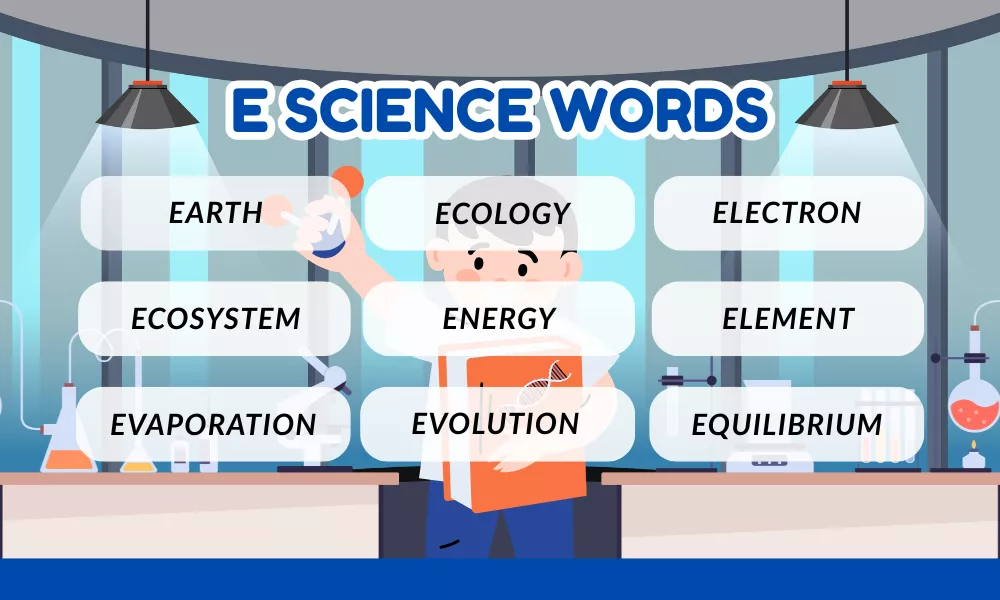
- Electron – A tiny negatively charged particle in atoms.
- Ecosystem – Interactions between living and nonliving things.
- Evolution – The process of species changing over time.
- Energy – Capacity for doing work.
- Entropy – Measure of disorder in a system.
- Enzyme – A protein that speeds up chemical reactions.
- Equilibrium – A balanced, stable state.
- Eukaryote – Organisms with cells containing a nucleus.
- Embryo – An early stage of organism development.
- Erosion – Wearing away of land.
- Ecology – Study of how organisms interact with their environment.
- Elasticity – How materials return to original shape after force.
- Exothermic – A reaction that releases heat.
- Endothermic – A reaction that absorbs heat.
- Evaporation – Liquid to gas change.
- Eclipse – Blocking of light by a celestial object.
- Electromagnet – A magnet made using electric current.
- Epidermis – The outer layer of skin.
- Eutrophication – Excess nutrients in water causing algae growth.
- Experimental Variable – The factor being tested.
- Ecosphere – Global sum of all ecosystems.
- Exosphere – The outermost layer of Earth’s atmosphere.
- Extinction – Permanent disappearance of a species.
- Ecotone – Transition zone between two ecosystems.
- Egestion – Removal of undigested food from the body.
Physics Science Words That Start With E
- Energy – Ability to do work.
- Electricity – Flow of electric charge.
- Electron – Negatively charged atomic particle.
- Electromagnetic Waves – Waves that carry energy through space (light, radio).
- Equilibrium – Balanced forces.
- Elasticity – Ability to return to original shape.
- Eddy Currents – Circular currents caused by changing magnetic fields.
- Emission – Release of light or energy.
- Entropy – Disorder of a system.
- Electric Field – Region around a charge where force acts.
- Electrostatics – Study of stationary electric charges.
- E=mc² (Energy-Mass Relation) – Einstein’s equation linking mass and energy.
- Eclipse – Blocking of light by a celestial body.
- Electromagnet – Magnet powered by electricity.
- Elongation – Extension caused by a force.
- Escape Velocity – Speed needed to leave a planet’s gravity.
- Equinox – Day and night of equal length.
- Ejection – Release of matter from an object (like stars).
- Exothermic – Release of heat energy.
- Endothermic – Absorption of heat energy.
- Electric Circuit – Path for electric current.
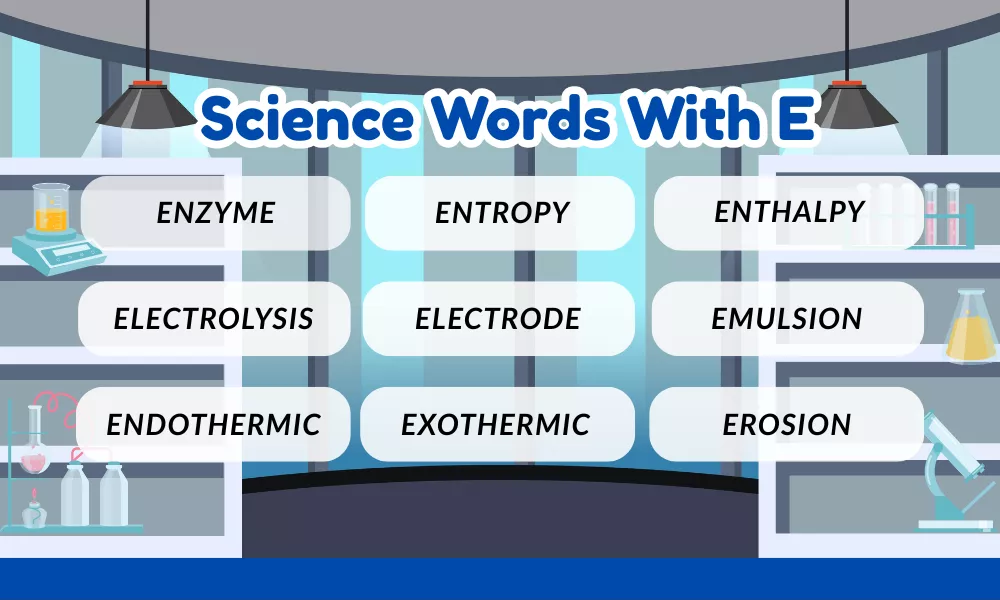
- Electrolysis – Using electricity to break chemical bonds.
- Elastic Potential Energy – Stored energy in stretched objects.
- Earthquake Waves (Seismic Waves) – Waves produced by Earth’s movement.
- Electromotive Force (EMF) – Energy per charge supplied by a source.
Chemistry Science Words That Start With E
| Word | Description |
|---|---|
| Element | Pure substance made of one type of atom. |
| Electrons | Negatively charged particles around the nucleus. |
| Electrolyte | Substance that conducts electricity when dissolved. |
| Evaporation | Liquid changing to gas. |
| Endothermic | Reaction that absorbs heat. |
| Exothermic | Reaction that releases heat. |
| Enzyme | Catalyst that speeds up reactions in living things. |
| Ester | Organic compound with a fruity smell. |
| Equilibrium | Balance in reversible reactions. |
| Emulsion | Mixture of two liquids that don’t usually mix. |
| Electronegativity | Atom’s ability to attract electrons. |
| Effervescence | Bubbles forming in a liquid (gas release). |
| Electron Cloud | Region where electrons are likely to be found. |
| Electroplating | Using electricity to coat metal. |
| Electrolysis | Breaking compounds with electric current. |
| Ethanol | A type of alcohol used in fuel and beverages. |
| Ethene | Hydrocarbon gas used in making plastics. |
| Equimolar | Equal number of moles of substances. |
| Eutrophication | Nutrient buildup causing excessive algae. |
| Enthalpy | Heat content of a system. |
| Entropy | Randomness or disorder of particles. |
| Enrichment | Increasing concentration of a substance. |
| Extraction | Removing a substance from a mixture. |
| Elution | Washing out substances from chromatography. |
| Electrophoresis | Technique for separating charged particles. |
Biology Science Words That Start With E
- Ecosystem – Interacting living and nonliving things.
- Evolution – Gradual change in species over time.
- Enzyme – Protein that speeds up biochemical reactions.
- Eukaryote – Organism with a nucleus in its cells.
- Embryo – Early stage of development.
- Epidermis – Outer layer of skin or plant surface.
- Ecology – Study of organisms and their environment.
- Endocrine System – Glands that produce hormones.
- Erythrocyte – Red blood cell.
- Esophagus – Tube that carries food to the stomach.
- Excretion – Removal of waste from the body.
- Egg Cell – Female reproductive cell.
- Endoskeleton – Internal skeleton.
- Exoskeleton – Outer covering of some animals.
- Estuary – Where rivers meet the sea; rich in life.
- Ecosphere – All Earth’s ecosystems combined.
- Epiphyte – Plant that grows on another plant.
- Ectotherm – Cold-blooded animal.
- Endotherm – Warm-blooded animal.
- Encephalitis – Inflammation of the brain.
- Extinction – When a species dies out.
- Egestion – Removal of undigested materials.
- Ethology – Study of animal behavior.
- Ejaculation – Release of sperm from the male body (biological term).
- Estrogen – Female sex hormone.
Math Science Words That Start With E
- Equation – A statement showing two expressions are equal.
- Exponent – A number that tells how many times to multiply a base.
- Estimate – A close, reasonable guess.
- Even Number – A number divisible by 2.
- Equivalent – Having the same value.
- Evaluate – To find the value of an expression.
- Expression – A mathematical phrase using numbers and symbols.
- Elimination Method – Solving equations by removing a variable.
- Euler’s Number (e) – A special mathematical constant (~2.718).
- Edge – The line where two faces of a solid meet.
- Endpoint – The end of a line segment or ray.
- Ellipse – An oval-shaped curve.
- Error – Difference between measured and true value.
- Event – An outcome in probability.
- Expected Value – The predicted average outcome.
- Exploration – Testing or searching through patterns.
- Equidistant – Same distance apart.
- Expansion – Multiplying out an expression.
- Extremes – The smallest and largest values.
- Eigenvalue – A special value in matrix operations.
- Eigenvector – A vector changed only by scale in a matrix.
- Evolutionary Algorithm – Math-based optimization using iteration.
- Error Margin – Allowable amount of inaccuracy.
- Equality – When things are the same in value.
- Expected Frequency – Predicted value in statistics.
Computer Science Words That Start With E
- Encryption – Protecting data by converting it into unreadable code.
- Execution – Running a program or command.
- Ethernet – A system for connecting computers in a network.
- Email – Electronic message sent over the internet.
- Embedded System – A small computer inside a device.
- Emulator – Software that imitates another system.
- Exception – An error that interrupts a program.
- Endpoint – A URL where an API receives requests.
- E-commerce – Buying and selling goods online.
- Extension – Add-on that improves software.
- Export – Saving or sending data out of a system.
- Edge Computing – Processing data closer to where it’s created.
- Event Listener – A function that waits for user actions.
- Entity – A data object in databases.
- Enumeration (Enum) – A set of predefined values.
- Encryption Key – Secret code used to decrypt messages.
- Executable File (.exe) – A file that runs a program.
- End-user – The person who uses software.
- Error Message – Notice that something has gone wrong.
- Escrow (Digital) – Secured digital holding system.
- Environment Variable – Settings that affect programs.
- Event-driven Programming – Coding based on user actions.
- E-learning – Education through digital tools.
- Ethernet Cable – Wire used for network connections.
- External Storage – USB drives, SD cards, and other external devices.
Earth And Space Science Vocabulary With E
- Earthquake – Sudden shaking of Earth’s crust.
- Eclipse – When one space object blocks another.
- Erosion – Wearing away of land by wind or water.
- Evaporation – Water changing from liquid to gas.
- Ecosystem – Community of living and nonliving things.
- Equator – Imaginary line dividing Earth into hemispheres.
- Exosphere – Outermost layer of the atmosphere.
- Estuary – Area where river meets the sea.
- Earth’s Crust – The outer solid layer of Earth.
- Epicenter – Point on Earth’s surface above an earthquake.
- Endangered Species – Species at risk of extinction.
- Equinox – Day and night are equal.
- Ejecta – Material thrown out during a volcanic eruption.
- Erupt – When a volcano explodes.
- Extraterrestrial – Relating to life or objects beyond Earth.
- Epoch – A long period of geological time.
- Eon – The longest time division in geology.
- Exposure – Amount of sunlight or radiation hitting Earth.
- Earth’s Mantle – Layer beneath Earth’s crust.
- Earth’s Core – Central region of Earth.
- Environment – Surroundings of living things.
- Eddy – Circular movement of water or air.
- Earthworks – Structures created from soil (archaeology/geology).
- Ecosphere – All ecosystems on Earth.
- Earthshine – Sunlight reflected off Earth that illuminates the Moon.
Engineering And Applied Science Terms With E
- Efficiency – How well a system uses energy or resources.
- Engine – Machine that converts energy into motion.
- Elasticity – Ability of a material to stretch and return.
- Electronics – Study and use of circuits and devices.
- Engineering Design – Process of creating solutions to problems.
- Energy Transfer – Movement of energy from one object to another.
- Ergonomics – Designing tools to fit human use.
- Experimentation – Testing ideas to improve technology.
- Exoskeleton (Tech) – Wearable suit that boosts human strength.
- Exhaust System – System removing waste gases from engines.
- Emissions – Gases released from machines or factories.
- Electrical Circuit – Path for electricity to flow.
- Encoder – Device converting data to coded signals.
- Expansion Joint – Part allowing structures to expand safely.
- Electrochemical Cell – Device producing electricity from chemical reactions.
- Extrusion – Shaping material by forcing it through an opening. End
- Effector – Tool attached to a robot arm.
- Environmental Engineering – Field focused on protecting nature.
- Engineered Materials – Materials created for specific uses.
- Eddy Currents – Circular electric currents in conductors.
- Equilibrium – A system in mechanical balance.
- Ejector Pump – Pump that uses pressure to move fluids.
- Electrode – Conductive part of an electrical system.
- Elastic Deformation – Temporary change in shape under force.
- Energy Efficiency Rating – Score showing how well devices save energy.
General Scientific Words Starting With E
- Energy – Power to cause change or motion.
- Ecosystem – Community of organisms interacting.
- Experiment – A test to discover something.
- Evidence – Data that supports a conclusion.
- Element – A pure chemical substance.
- Electron – A subatomic particle with negative charge.
- Erosion – Wearing away of land.
- Evolution – Long-term change in species.
- Equilibrium – Balance in systems.
- Epidemic – Rapid spread of disease in a region.
- Enzyme – Protein that speeds up reactions.
- Endothermic – Reaction that absorbs heat.
- Exothermic – Reaction that releases heat.
- Ecosphere – All Earth’s ecosystems.
- Environmental Science – Study of humans and nature.
- Eukaryote – An organism whose cells have nuclei.
- Embryo – Early developmental stage.
- Excretion – Removal of waste.
- Ecosystem Services – Benefits nature provides.
- Ecology – Study of relationships among living things.
- Ejecta – Material expelled by explosions (volcanoes, impacts).
- Evaporation – Water turning into vapor.
- Ethics in Science – Rules for fair and safe research.
- Exposure – Contact with sunlight, chemicals, or radiation.
- Extinction – Disappearance of a species.
How To Learn & Remember E Science Vocabulary Easily
- Create “E” Word Clusters
Group similar “E” science words together (e.g., energy, electron, element, ecosystem). Learning them in clusters helps your brain build connections, making recall faster and easier. - Use the Everyday Association Method
Link each word with a daily-life example.
Energy → electricity powering your phone
Erosion → soil washing away after rain
Real-life connections strengthen long-term memory. - Build Mini Flash Stories
Make a short story using several “E” words: “An electron moved through an electric wire carrying energy.” Stories help you remember vocabulary more naturally than memorizing definitions. - Write and Speak the Words Daily
Write each new word in a sentence and say it aloud at least three times. Speaking activates auditory memory, while writing strengthens visual memory. - Use the “Explain to Someone” Technique
Try explaining a new word (like evaporation or evolution) to a friend, sibling, or even yourself. Teaching forces deeper understanding, which improves retention. - Practice Quick Daily Revision (2-Minute Rule)
Spend just two minutes every day reviewing previously learned “E” vocabulary. Frequent short reviews are far more effective than long, occasional study sessions.
FAQs
Conclusion
Exploring science words that start with E opens the door to a powerful collection of terms used across biology, chemistry, physics, math, computer science, Earth science, and engineering. These vocabulary words help students communicate scientific ideas clearly, understand complex processes, and strengthen overall scientific literacy. Whether you’re learning basics like energy and ecosystem or diving into specialized terms like eigenvalue and electrophoresis, mastering “E” science vocabulary builds a strong foundation for academic success. By using memory techniques, studying in small batches, and connecting each word to real-world examples, anyone can quickly learn and remember these essential E-terms.