
Science Words That Start With D | List With Meanings for Learning

Science is a language of discovery, and many of its most powerful terms begin with the letter D. From DNA and density to dark matter and diffusion, these words help explain how our world works at everything from the microscopic to the cosmic level. Learning science words that start with D not only builds a stronger vocabulary but also makes it easier to understand scientific ideas in school, media, and everyday life. Whether you’re a student, writer, or curious learner, exploring these “D” terms opens the door to clearer communication and deeper scientific awareness.
Importance of Science Words Starting With D
Science words starting with D are important because they describe many core concepts in biology, chemistry, physics, and environmental science. Terms like data, diagnosis, diversity, and dynamics are frequently used in research, education, and real-world problem-solving. Knowing these words helps you read scientific texts more confidently, communicate ideas accurately, and stay informed about topics like health, technology, and the environment. In short, mastering these terms strengthens both your scientific literacy and your overall communication skills.
Science Words With D For Beginners
- Data – Facts or information collected for study.
- DNA – The molecule that carries genetic information.
- Density – How much mass is in a certain volume.
- Disease – An illness that affects the body.
- Digest – To break down food in the body.
- Drought – A long period without rain.
- Decompose – To break down into simpler parts.
- Drop – A small amount of liquid.
- Daylight – Natural light from the sun.
- Darkness – Absence of light.
- Dust – Tiny dry particles in the air.
- Damp – Slightly wet.
- Drift – To move slowly (like clouds or continents).
- Damage – Harm or injury to something.
- Detect – To discover or identify something.
- Develop – To grow or change over time.
- Direction – The path something moves.
- Dissolve – When a substance mixes into a liquid.
- Depth – How deep something is.
- Diameter – Distance across a circle.
- Dew – Tiny drops of water on surfaces in the morning.
- Decay – Gradual breakdown of material.
- Danger – Risk of harm.
- Disaster – A sudden harmful event (like an earthquake).
- Dune – A hill of sand formed by wind.
Core Science Terms With Letter D
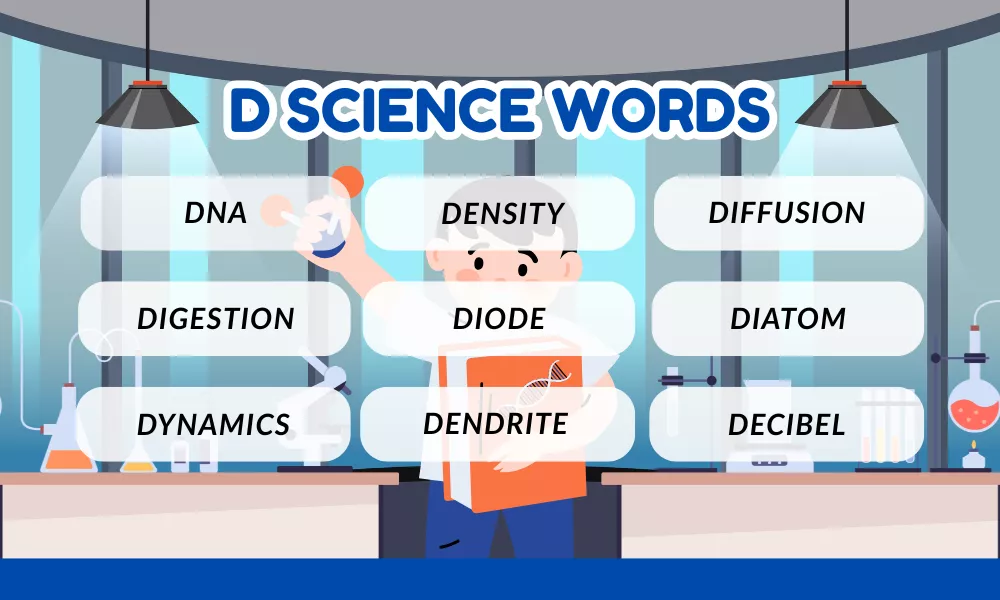
- Diffusion – Movement of particles from high to low concentration.
- Dynamics – Study of forces and motion.
- Dehydration – Loss of water from the body or material.
- Distillation – Separating liquids by boiling points.
- Decomposition – Breaking down of substances.
- Diagnosis – Identifying a disease.
- Diversity – Variety of living things.
- Detection – Discovering the presence of something.
- Displacement – Object’s change in position.
- Duct – Tube for carrying fluid or air.
- Domain – A classification category in biology.
- Dipole – Molecule with two opposite charges.
- Deflection – Change in direction of motion.
- Deposition – Process of material settling.
- Deformation – Change in shape due to force.
- Dormant – Inactive but alive.
- Dosage – Amount of medicine taken.
- Dilution – Making a solution weaker.
- Deviation – Difference from normal.
- Detergent – Substance that cleans.
- Dissection – Cutting apart to study.
- Decay (radioactive) – Breakdown of unstable atoms.
- Detritus – Dead organic matter.
- Diatom – Type of microscopic algae.
- Drift (genetic) – Change in gene frequency by chance.
Physics Science Words That Start With D
- Displacement – Distance moved in a direction.
- Drag – Air or fluid resistance.
- Dynamics – Study of forces and motion.
- Diffraction – Bending of waves.
- Dispersion – Splitting of light into colors.
- Doppler Effect – Change in wave frequency due to motion.
- Direct Current (DC) – One-direction electric flow.
- Dielectric – Insulating material.
- Dipole – Pair of equal opposite charges.
- Density – Mass per volume.
- Decibel – Unit for sound intensity.
- Deflection – Bending of a path.
- Drift Velocity – Speed of electrons in a conductor.
- Dark Matter – Invisible matter in space.
- Dark Energy – Force causing universe expansion.
- Diameter – Line through circle center.
- Dimension – Measurable size.
- Divergence – Spreading out from a point.
- Damping – Reduction of vibration.
- Diffusion (wave) – Spreading of waves.
- Deformation – Shape change due to force.
- Detector – Device that measures signals.
- Dynamics Equations – Motion formulas.
- Dipole Moment – Measure of charge separation.
- Double Refraction – Light splitting in crystals.
Chemistry Science Words That Start With D
| Word | Description |
|---|---|
| Dilution | Lowering concentration of a solution. |
| Distillation | Separation by boiling. |
| Dissolution | Dissolving a substance. |
| Decomposition | Chemical breakdown. |
| Dipole | Molecule with charge separation. |
| Detergent | Cleaning chemical. |
| Dimer | Two bonded molecules. |
| Displacement Reaction | One element replaces another. |
| Density | Mass per volume. |
| Ductile | Can be stretched into wire. |
| Dehydrate | Remove water. |
| Delocalization | Spread of electrons. |
| Dissociate | Split into ions. |
| Derivative | Compound from another compound. |
| Desiccant | Drying agent. |
| Deposition | Gas to solid change. |
| Double Bond | Two shared electron pairs. |
| Donor | Gives electrons. |
| Dynamic Equilibrium | Balance in reactions. |
| Dilute Solution | Low solute amount. |
| Detonation | Explosive reaction. |
| Dative Bond | One atom provides electrons. |
| Dextrorotatory | Rotates light right. |
| Denature | Change protein structure. |
| Desublimation | Gas to solid conversion. |
Biology Science Words That Start With D
- DNA – Genetic blueprint.
- Digestion – Breaking down food.
- Disease – Disorder in the body.
- Decomposer – Organism that breaks down waste.
- Dormant – Inactive state.
- Development – Growth process.
- Diffusion – Movement across membranes.
- Diversity – Variety of species.
- Domain – Highest classification level.
- Dendrite – Nerve cell branch.
- Diaphragm – Breathing muscle.
- Dissection – Studying by cutting.
- Defense Mechanism – Protection method.
- Diabetes – Blood sugar disorder.
- Dorsal – Back side of organism.
- Diploid – Two chromosome sets.
- Diurnal – Active during the day.
- Detritivore – Eats dead matter.
- Diagnosis – Disease identification.
- Droplet Transmission – Spread by droplets.
- Dehydration – Water loss.
- Dominant Trait – Stronger gene trait.
- Denaturation – Protein shape change.
- Diatom – Tiny algae.
- Differentiation – Cells becoming specialized.
Math Science Words That Start With D
- Data – Collected facts or numbers for analysis.
- Decimal – Number based on ten (e.g., 0.5).
- Denominator – Bottom number in a fraction.
- Difference – Result of subtraction.
- Digit – Any number from 0–9.
- Diameter – Line across a circle through its center.
- Dimension – Measurable size (length, width, height).
- Division – Splitting into equal parts.
- Divisor – Number that divides another.
- Domain – Set of input values of a function.
- Degree – Unit for measuring angles.
- Derivative – Rate of change in calculus.
- Distribution – How data is spread out.
- Deviation – Difference from a standard value.
- Deduction – Logical conclusion from facts.
- Determinant – Value from a matrix.
- Discrete – Separate, distinct values.
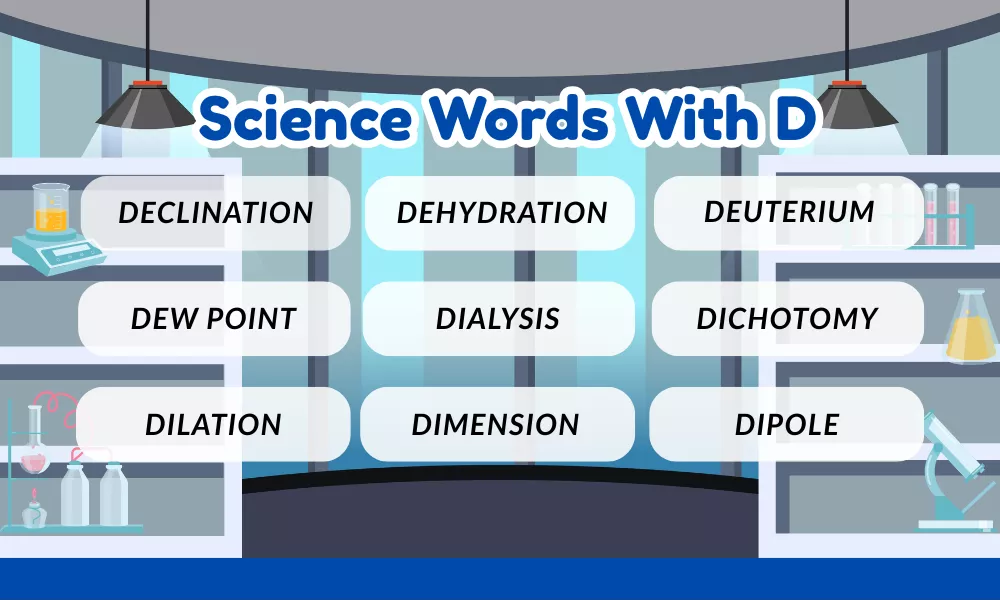
- Dilation – Resizing a shape proportionally.
- Diagonal – Line between opposite corners.
- Density (statistical) – Data concentration.
- Decomposition – Breaking into parts.
- Direct Variation – Relationship where values grow together.
- Disproof – Showing something is false.
- Distance – Space between points.
- Double – Multiply by two.
Computer Science Words That Start With D
- Database – Organized data collection.
- Debugging – Finding and fixing errors.
- Download – Receiving data from the internet.
- Data Structure – Way to organize data.
- Directory – Folder for files.
- Disk – Storage device.
- Driver – Software controlling hardware.
- Digital – Electronic data format.
- Domain – Website address name.
- Daemon – Background process.
- Deployment – Releasing software.
- DDoS – Attack flooding servers.
- Data Mining – Finding patterns in data.
- Deep Learning – Advanced AI method.
- Diskette – Small storage disk.
- Docking – Connecting devices.
- Default – Preset setting.
- Dynamic Typing – Type checked at runtime.
- Distributed System – Networked computers working together.
- DNS – Converts names to IP addresses.
- DevOps – Dev + IT operations practice.
- Digitize – Convert to digital form.
- Decryption – Unlocking coded data.
- Dataset – Collection of data.
- Dashboard – Visual data display.
Earth And Space Science Vocabulary With D
- Delta – Landform at a river’s mouth.
- Drought – Long period without rain.
- Drift – Slow movement (like continents).
- Deposition – Settling of sediments.
- Dust Storm – Strong wind carrying dust.
- Dune – Hill of wind-blown sand.
- Daylight – Sunlight during the day.
- Dark Matter – Invisible cosmic matter.
- Dark Energy – Force driving universe expansion.
- Density (planetary) – Mass per volume of planets.
- Declination – Angle of a star.
- Deep Sea – Very deep ocean area.
- Dew Point – Temperature when dew forms.
- Drizzle – Light rain.
- Dike – Wall to prevent flooding.
- Desert – Dry region with little rain.
- Drainage – Water flow system.
- Deformation – Rock shape change.
- Divergence – Plates moving apart.
- Dust – Fine earth particles.
- Debris – Rock or space fragments.
- Dorsal Ridge – Underwater mountain chain.
- Downpour – Heavy rain.
- Depression (weather) – Low-pressure system.
- Day-Night Cycle – Earth’s rotation effect.
Engineering And Applied Science Terms With D
- Design – Planning structures or systems.
- Dynamics – Study of motion and force.
- Drafting – Technical drawing.
- Device – Tool or machine.
- Drive – Mechanism that moves parts.
- Durability – Strength over time.
- Digital Signal – Electronic signal form.
- Die Casting – Metal shaping process.
- Ductility – Ability to stretch.
- Drilling – Cutting holes.
- Diameter – Width measurement.
- Damping – Reducing vibration.
- Deployment – Using technology in real world.
- Diagnostics – System problem testing.
- Distributed Load – Spread-out force.
- Direct Current – One-way electricity flow.
- Design Cycle – Engineering planning steps.
- Data Logger – Records measurements.
- Dynamo – Electricity generator.
- Drive Shaft – Transfers rotation.
- Digital Twin – Virtual model of a system.
- Differential – Gear system.
- Deflection – Bending under force.
- Dielectric – Insulating material.
- Drone – Unmanned vehicle.
General Scientific Words Starting With D
- Discovery – Finding new knowledge.
- Data – Information collected.
- Density – Mass per volume.
- Diffusion – Particle spreading.
- Development – Growth or change.
- Diagnosis – Identifying disease.
- Diversity – Variety of life.
- Decomposition – Breaking down.
- Detection – Identifying presence.
- Domain – Category or area.
- Displacement – Change in position.
- Dehydration – Loss of water.
- Deviation – Difference from norm.
- Dormant – Inactive state.
- Dipole – Two opposite charges.
- Dynamic – Changing or active.
- Deposition – Settling process.
- Deflection – Direction change.
- Duct – Passageway for fluid/air.
- Detritus – Organic waste.
- Dilution – Weakening concentration.
- Derivative – From another source.
- Dissolution – Dissolving process.
- Diatom – Microscopic algae.
- Denaturation – Protein structure change.
How To Learn & Remember D Science Vocabulary Easily
- Group Words by Science Branch Learn
D words by category like biology (DNA, diffusion), physics (density, displacement), chemistry (dilution, decomposition). Grouping helps your brain store related meanings together. - Use the “Definition + Example” Rule
Don’t just memorize definitions. Pair each word with a real-life example, like density → “oil floats on water because it has lower density.” - Create Word Associations
Connect new D words to familiar ideas. For example, link diffusion to the smell of perfume spreading in a room. - Visualize the Concept
Draw simple diagrams or imagine processes like decomposition or dark matter. Visual memory is stronger than plain text recall. - Practice with Short Sentences
Write one simple sentence for each word. Using words like data, diagnosis, or diversity in context makes them stick longer. - Review with Mini Quizzes
Test yourself weekly using flashcards or quick quizzes. Repetition over time is one of the most effective ways to lock vocabulary into long-term memory.
FAQs
Conclusion
Science words that start with D form the foundation of understanding many important scientific concepts across biology, chemistry, physics, mathematics, and technology. From beginner-friendly terms like data and density to advanced concepts like dark matter and diffusion, mastering these words strengthens scientific literacy and boosts academic confidence. By using smart learning techniques you can easily learn and remember D science vocabulary and apply it effectively in studies, exams, and everyday discussions.