Science Words That Start With C – Easy List With Meanings for Students
Science begins with curiosity, and exploring science words that start with the letter C is a great way to expand both knowledge and vocabulary. From cells that form the foundation of life to carbon that shapes the chemistry of our world, and from circuits powering technology to the vast cosmos beyond Earth, each C-word reveals an important scientific concept. Whether you’re a student, teacher, writer, or lifelong learner, building a strong science vocabulary helps you understand complex ideas, communicate clearly, and develop confidence in academic and everyday discussions.
Importance of Science Words Starting With C
Understanding science words that start with C plays an important role in building a strong academic foundation. Many key scientific concepts are frequently used in textbooks, classrooms, and real-world discussions. Learning these terms helps students grasp scientific topics more easily, improves reading comprehension, and supports better performance in exams and assignments. In addition, a strong science vocabulary enhances communication skills, allowing learners to explain ideas clearly and confidently. Mastering C-words in science is a small step that leads to deeper understanding and greater interest in the world around us.
Science Words With C For Beginners
- Cell – The smallest unit of life in living organisms.
- Cloud – A visible mass of water droplets in the sky.
- Cold – A low temperature condition.
- Chemical – A substance used or formed in a chemical process.
- Change – A process where something becomes different.
- Cycle – A series of events that repeat over time.
- Carbon – An element essential for life.
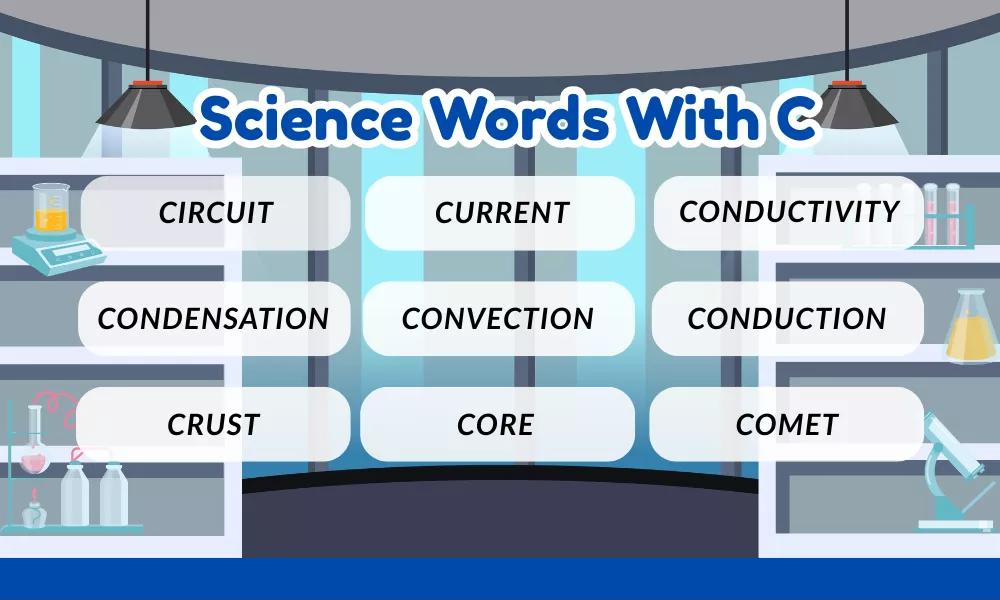
- Current – The flow of electricity or water.
- Climate – The long-term weather pattern of a place.
- Crystal – A solid with a regular geometric structure.
- Circuit – A path through which electricity flows.
- Condensation – Gas changing into liquid.
- Combustion – Burning process that releases heat.
- Collision – When two objects hit each other.
- Continent – A large landmass on Earth.
- Cavity – A hole, often in a tooth.
- Coral – Marine organisms that form reefs.
- Caterpillar – The larval stage of a butterfly.
- Compound – A substance made from two or more elements.
- Centrifuge – A machine that separates substances by spinning.
- Conductor – A material that allows heat or electricity to pass.
- Capillary – A tiny blood vessel.
- Core – The central part of something, like Earth’s core.
- Chromosome – Structures that carry genetic information.
- Culture – Growing microorganisms in a lab.
Core Science Terms With Letter C
- Cause – The reason something happens.
- Control – A standard used for comparison in experiments.
- Conclusion – The final result of an investigation.
- Constant – A factor that does not change.
- Chart – A visual way to display data.
- Classification – Grouping based on similarities.
- Comparison – Finding similarities and differences.
- Calibration – Adjusting equipment for accuracy.
- Calculation – Mathematical problem-solving.
- Correlation – Relationship between two variables.
- Criteria – Standards for judging results.
- Context – Conditions surrounding an experiment.
- Concept – An idea or principle.
- Component – A part of a system.
- Condition – Environmental or experimental state.
- Collection – Gathering data or samples.
- Classification Key – Tool for identifying organisms.
- Confidence – Level of certainty in results.
- Control Group – Group not exposed to the tested variable.
- Causation – Direct cause-and-effect relationship.
- Consistency – Reliability of results.
- Cycle Testing – Repeated testing process.
- Criterion Variable – Measured outcome.
- Cross-check – Verifying accuracy.
- Collaboration – Working together in research.
Physics Science Words That Start With C
- Current – Flow of electric charge.
- Charge – Electrical property of matter.
- Capacitance – Ability to store electric charge.
- Capacitor – Device that stores electrical energy.
- Circuit – Closed path for electricity.
- Conductor – Material that allows electricity flow.
- Collision – Interaction between moving objects.
- Compression – Decrease in volume under pressure.
- Centripetal Force – Force toward the center of circular motion.
- Circular Motion – Movement in a circle.
- Coefficient of Friction – Measure of friction between surfaces.
- Convection – Heat transfer through fluid movement.
- Conduction – Heat transfer through direct contact.
- Critical Angle – Angle where total internal reflection occurs.
- Coulomb – Unit of electric charge.
- Coulomb’s Law – Law describing electric force between charges.
- Center of Mass – Average position of mass in an object.
- Compression Wave – Wave where particles move back and forth.
- Cosmic Rays – High-energy radiation from space.
- Crystal Lattice – Regular atomic arrangement in solids.
- Cooling – Loss of heat energy.
- Constant Velocity – Motion at steady speed and direction.
- Conservation of Energy – Energy cannot be created or destroyed.
- Critical Temperature – Temperature where material changes state.
- Curvature – Bending of space or objects.
Chemistry Science Words That Start With C
| Word | Description |
|---|---|
| Compound | Substance made of two or more elements. |
| Catalyst | Substance that speeds up reactions. |
| Concentration | Amount of substance in a solution. |
| Chemical Reaction | Process forming new substances. |
| Carbon | Element essential for organic life. |
| Covalent Bond | Sharing of electrons between atoms. |
| Cation | Positively charged ion. |
| Chromatography | Method for separating mixtures. |
| Crystal | Solid with ordered atomic structure. |
| Combustion | Reaction with oxygen producing heat. |
| Corrosion | Gradual destruction of metals. |
| Colloid | Mixture with tiny dispersed particles. |
| Calorimetry | Measurement of heat changes. |
| Chemical Formula | Representation of a compound. |
| Chemical Bond | Force holding atoms together. |
| Condenser | Apparatus that cools vapor to liquid. |
| Conjugate Acid | Acid formed after base gains proton. |
| Crystallization | Formation of solid crystals. |
| Chemical Equilibrium | Balanced reaction state. |
| Combining Capacity | Ability of elements to bond. |
| Corrosive | Substance that damages materials. |
| Chlorine | Reactive chemical element. |
| Carbon Cycle | Movement of carbon through nature. |
| Complex Ion | Ion with central atom and ligands. |
| Chemical Energy | Energy stored in chemical bonds. |
Biology Science Words That Start With C
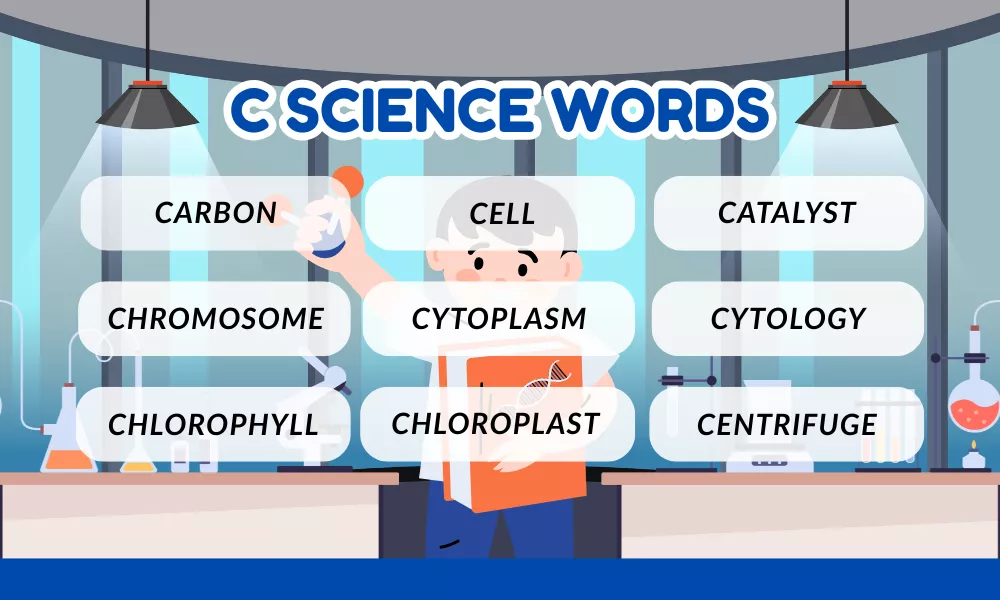
- Cell – Basic unit of life.
- Chromosome – DNA-carrying structure.
- Cytoplasm – Fluid inside a cell.
- Cell Membrane – Protective cell boundary.
- Chlorophyll – Pigment used in photosynthesis.
- Chloroplast – Organelle for photosynthesis.
- Circulation – Movement of blood in the body.
- Capillary – Smallest blood vessel.
- Carnivore – Animal that eats meat.
- Consumer – Organism that eats other organisms.
- Camouflage – Adaptation for hiding.
- Cell Division – Process of cell reproduction.
- Cancer – Uncontrolled cell growth.
- Cilia – Hair-like cell structures for movement.
- Cocoon – Protective covering during transformation.
- Colony – Group of organisms living together.
- Cold-blooded – Body temperature depends on environment.
- Cortex – Outer layer of an organ.
- Conservation – Protection of natural resources.
- Commensalism – One organism benefits, other unaffected.
- Cross-pollination – Transfer of pollen between plants.
- Cloning – Producing identical organisms.
- Cytology – Study of cells.
- Cardiovascular System – Heart and blood vessels.
- Carbohydrate – Energy-providing biological molecule.
Math Science Words That Start With C
- Calculation – The process of solving mathematical problems.
- Coefficient – A number multiplied by a variable.
- Constant – A value that does not change.
- Circle – A round shape with all points equal distance from the center.
- Circumference – The distance around a circle.
- Chord – A line segment joining two points on a circle.
- Coordinate – A number that shows position on a graph.
- Cartesian Plane – A graph with x and y axes.
- Cube – A solid with six equal square faces.
- Cubic – Related to the third power or volume.
- Column – Vertical arrangement of numbers or data.
- Combination – Selection of items where order doesn’t matter.
- Commutative Property – Changing order doesn’t change the result (a + b = b + a).
- Complement – Two angles that add up to 90°.
- Congruent – Shapes that are equal in size and shape.
- Conic Section – Shapes like circle, ellipse, parabola, hyperbola.
- Correlation – Relationship between two variables.
- Curve – A smoothly bending line.
- Counting – Determining the number of items.
- Central Angle – Angle formed at the center of a circle.
- Cosecant – A trigonometric function (1/sin).
- Cosine – Ratio of adjacent side to hypotenuse.
- Cross Multiplication – Method to solve proportions.
- Cancellation – Removing common factors.
- Cumulative – Increasing by adding values together.
Computer Science Words That Start With C
- Code – Instructions written for a computer.
- Compiler – Software that converts code into machine language.
- CPU (Central Processing Unit) – The brain of a computer.
- Cache – High-speed memory for quick data access.
- Cloud Computing – Using internet-based servers for storage and processing.
- Cybersecurity – Protection of systems from digital attacks.
- Command – Instruction given to a computer.
- Cursor – Indicator showing where input will appear.
- Client – Computer that requests services from a server.
- Cookie – Small file storing user data on websites.
- Compression – Reducing file size.
- Container – Lightweight software package with dependencies.
- Cryptography – Securing information using encryption.
- Cluster – Group of connected computers working together.
- Class – Blueprint for objects in programming.
- Callback – Function called after an event occurs.
- Character Encoding – System for representing text digitally.
- Control Flow – Order in which program instructions run.
- Configuration – System setup or settings.
- Cross-platform – Software that runs on multiple systems.
- Connection – Communication link between devices.
- Content Management System (CMS) – Software for managing websites.
- Command Line – Text-based interface.
- Concurrency – Multiple tasks running at once.
- Cyberattack – Attempt to damage or access systems illegally.
Earth And Space Science Vocabulary With C
- Climate – Long-term weather patterns.
- Crust – Earth’s outer layer.
- Core – Earth’s central region.
- Continental Drift – Movement of Earth’s continents.
- Carbon Cycle – Movement of carbon through Earth systems.
- Cloud – Collection of water droplets in the atmosphere.
- Canyon – Deep valley with steep sides.
- Current (Ocean Current) – Continuous ocean water movement.
- Cyclone – Large rotating storm system.
- Comet – Icy object orbiting the Sun.
- Constellation – Group of stars forming patterns.
- Cosmos – The universe as a whole.
- Crater – Bowl-shaped depression on a surface. Convection
- Current – Heat-driven fluid movement inside Earth.
- Continental Shelf – Shallow underwater land near continents.
- Climate Change – Long-term shift in global temperatures.
- Cumulus Cloud – Puffy white cloud type.
- Cirrus Cloud – Thin, high-altitude cloud.
- Carbon Dioxide – Greenhouse gas in the atmosphere.
- Celestial Body – Natural object in space.
- Corona – Outer layer of the Sun’s atmosphere.
- Cosmic Radiation – High-energy particles from space.
- Cryosphere – Earth’s frozen water regions.
- Conservation – Protection of natural resources.
- Collision (Planetary) – Impact between space objects.
Engineering And Applied Science Terms With C
- Circuit – Path for electrical flow.
- Calibration – Adjusting equipment for accuracy.
- CAD (Computer-Aided Design) – Software for designing structures or products.
- Composite – Material made from multiple components.
- Control System – System that manages device operations.
- Cooling System – Mechanism to remove heat.
- Compressor – Device that increases gas pressure.
- Conveyor – System for moving materials.
- Coupling – Device connecting two parts.
- Cantilever – Beam supported at one end.
- Casting – Shaping material using molds.
- Cutting Tool – Tool used to shape materials.
- Construction – Building structures or systems.
- Corrosion Protection – Preventing material damage.
- Controller – Device that regulates operations.
- Current Load – Amount of electrical current used.
- Component – Individual part of a system.
- Cycle Time – Time to complete a process.
- Compression Test – Measuring material strength.
- CNC (Computer Numerical Control) – Automated machine control.
- Cable Management – Organizing electrical wiring.
- Chassis – Structural frame of a machine.
- Check Valve – Valve allowing one-way flow.
- Condition Monitoring – Checking equipment health.
- Control Panel – Interface for operating systems.
General Scientific Words Starting With C
- Concept – An idea or principle.
- Cause – Reason something happens.
- Control – Standard for comparison in experiments.
- Conclusion – Final result of research.
- Classification – Grouping based on similarities.
- Comparison – Finding similarities and differences.
- Collection – Gathering data or samples.
- Chart – Visual data representation.
- Criteria – Standards for evaluation.
- Condition – State or environment.
- Consistency – Reliability of results.
- Correlation – Relationship between variables.
- Calibration – Ensuring measurement accuracy.
- Causation – Direct cause-effect relationship.
- Collaboration – Working together in research.
- Component – Part of a system.
- Cycle – Repeating process.
- Change – Transformation over time.
- Context – Surrounding conditions.
- Calculation – Mathematical analysis.
- Cross-check – Verifying accuracy.
- Compilation – Collecting information.
- Citation – Referencing sources.
- Confidence Level – Certainty in results.
- Communication – Sharing scientific information.
How To Learn & Remember C Science Vocabulary Easily
- Group Words by Science Branch
Instead of memorizing randomly, group C words by subject such as: Biology (Cell, Cytoplasm), Chemistry (Compound, Catalyst), Physics (Current, Circuit). Your brain remembers patterns better than isolated terms. - Create Visual Associations
Turn each word into a mental picture. For example: Cell → a tiny room with workers inside and Circuit → a glowing loop of wire Visual memory is stronger than text memory. - Use the “C-Word Sentence” Method
Create one sentence using multiple C science words: “The cell uses chemical energy in a cycle to maintain circulation.” This connects meanings naturally and boosts recall. - Teach the Word Out Loud
Explaining a word forces your brain to organize information. If you can teach “Carbon Cycle” or “Conductor”, you truly understand it. - Use Short Daily Reviews (5–10 Minutes)
Review 5–10 C science words daily instead of cramming. Short, repeated exposure strengthens long-term memory far more effectively.
FAQs
Conclusion
Learning science vocabulary that starts with the letter C becomes simple and effective when you use smart strategies like categorization, visualization, daily practice, and real-life connections. Instead of memorizing long lists, understanding the meaning and context of each term helps build strong scientific knowledge and long-term retention. Whether you are a student, teacher, or beginner exploring science, these techniques will improve your vocabulary, boost confidence, and make learning more enjoyable. With consistent practice and the right learning methods, mastering C science words can become an easy and rewarding experience.