Science Words That Start With A – Scientific Terms & Vocabulary Guide
Science becomes easier and more engaging when you understand its core vocabulary. Science words that start with the letter “A” introduce learners to many foundational ideas used across disciplines such as physics, chemistry, biology, astronomy, and environmental science. From common terms like atom, acceleration, and absorption to more specialized concepts like anaerobic, aperture, and asteroid, these words help explain how natural processes, experiments, and discoveries work. Learning science vocabulary alphabetically not only improves scientific understanding but also strengthens English language skills, allowing students and curious minds to communicate complex ideas with clarity and confidence.
Importance of Science Words Starting With A
Science words starting with A form the foundation of many essential scientific concepts and principles. These terms help learners understand basic ideas related to matter, motion, energy, life processes, and space. Building familiarity with “A” science words improves comprehension of textbooks, experiments, and scientific discussions while also enhancing academic vocabulary. Whether for students, teachers, or science enthusiasts, mastering these words supports clearer thinking, better communication, and a stronger grasp of how science explains the world around us.
Science Words With A For Beginners
- Atom – The smallest unit of matter that retains the properties of an element.
- Air – The mixture of gases surrounding Earth, essential for life.
- Animal – A living organism that feeds on organic matter and can usually move.
- Astronomy – The study of stars, planets, and space.
- Acid – A substance with a sour taste that can react with metals and bases.
- Acceleration – The rate at which speed or direction changes.
- Adaptation – A feature that helps an organism survive in its environment.
- Atmosphere – The layer of gases surrounding a planet.
- Absorb – To take in a substance or energy.
- Apex – The highest point of something.
- Aquatic – Living or growing in water.
- Algae – Simple plant-like organisms found mostly in water.
- Anatomy – Study of body structure.
- Altitude – Height above sea level.
- Antenna – Sensory organ used by insects and some animals.
- Asteroid – A rocky object orbiting the sun.
- Artery – A blood vessel carrying blood away from the heart.
- Aurora – Natural light display in the sky near polar regions.
- Autotroph – An organism that makes its own food.
- Axle – A rod that helps wheels rotate.
- Antibody – A protein that helps fight infections.
- Aquifer – Underground layer storing groundwater.
- Arid – Very dry climate or region.
- Axis – Imaginary line around which an object rotates.
- Asexual – Reproduction involving only one parent.
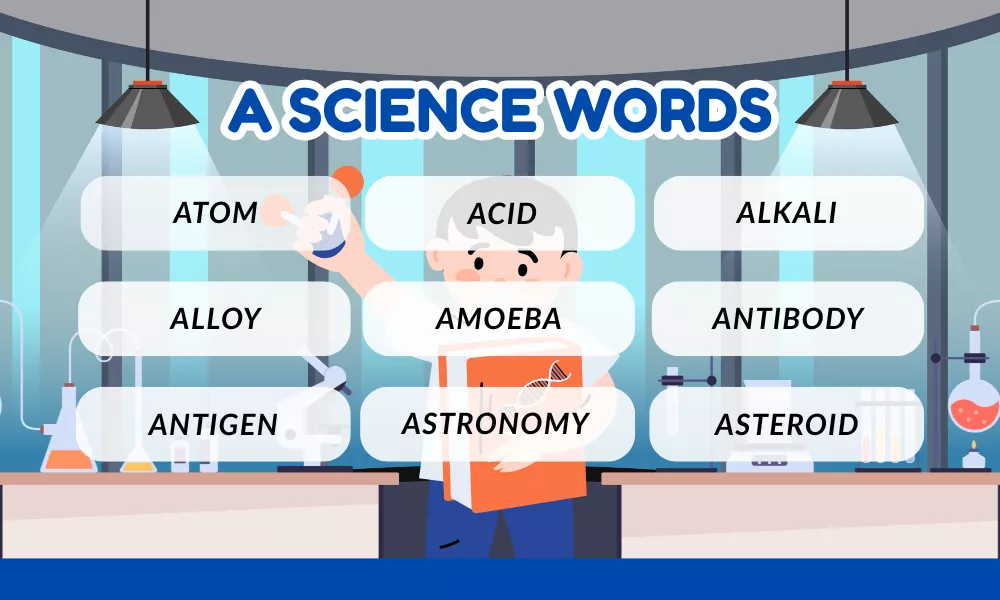
Core Science Terms With Letter A
- Acceleration – Change in velocity over time.
- Atom – Basic building block of matter.
- Acid – Substance that releases hydrogen ions in solution.
- Adaptation – Evolutionary trait aiding survival.
- Atmosphere – Gas layer surrounding Earth.
- Absorption – Process of taking in substances or energy.
- Amino Acid – Building block of proteins.
- Allele – Variant form of a gene.
- Antigen – Substance triggering immune response.
- Anaerobic – Occurring without oxygen.
- Aqueous – Solution where water is the solvent.
- Astronomy – Study of celestial bodies.
- Astrophysics – Physics applied to space objects.
- Abiotic – Non-living environmental factors.
- Autotroph – Organism that produces its own food.
- Axon – Nerve cell extension carrying signals.
- Antibiotic – Drug that kills or slows bacteria.
- Adaptation – Adjustment to environment over generations.
- Aerosol – Tiny particles suspended in air.
- Acclimatization – Adjustment to new climate conditions.
- Anatomy – Study of organism structures.
- Asexual Reproduction – Reproduction without fertilization.
- Abiogenesis – Theory of life arising from non-living matter.
- Alloy – Mixture of metals.
- Amplitude – Height or strength of a wave.
Physics Science Words That Start With A
- Acceleration – Rate of velocity change.
- Amplitude – Maximum wave displacement.
- Angular Velocity – Rate of rotation.
- Axis – Line about which rotation occurs.
- Ampere – Unit of electric current.
- Alternating Current – Electric current reversing direction periodically.
- Action Force – Force exerted on an object in interaction.
- Atmospheric Pressure – Pressure exerted by air.
- Atomic Energy – Energy released from atomic reactions.
- Acceleration Due to Gravity – Rate objects speed up falling toward Earth.
- Absolute Zero – Lowest possible temperature.
- Aperture – Opening through which light passes.
- Angular Momentum – Momentum related to rotation.
- Absorption Spectrum – Wavelengths absorbed by a substance.
- Anode – Positive electrode in devices.
- Aerodynamics – Study of air motion around objects.
- Atomic Mass – Mass of an atom.
- Attenuation – Reduction of wave strength.
- Acoustic – Related to sound waves.
- Arc – Electric discharge between electrodes.
- Atomic Number – Number of protons in nucleus.
- Acceleration Vector – Directional measure of acceleration.
- Antimatter – Matter composed of antiparticles.
- Aether (historical) – Old concept of space medium.
- Angular Acceleration – Rate of change of angular velocity.
Chemistry Science Words That Start With A
| Words | Description |
|---|---|
| Atom | Smallest chemical unit of matter. |
| Acid | Substance donating hydrogen ions. |
| Alkali | Base soluble in water. |
| Alloy | Mixture of metals. |
| Aqueous | Dissolved in water. |
| Anion | Negatively charged ion. |
| Atomic Number | Number of protons in atom. |
| Atomic Mass | Mass of an atom. |
| Acidity | Measure of acid strength. |
| Alkane | Hydrocarbon with single bonds. |
| Alkene | Hydrocarbon with double bond. |
| Alkyne | Hydrocarbon with triple bond. |
| Amine | Organic compound derived from ammonia. |
| Amide | Organic compound with nitrogen group. |
| Alcohol | Organic compound with hydroxyl group. |
| Adsorption | Surface attachment of molecules. |
| Activation Energy | Energy needed to start reaction. |
| Aromatic Compound | Stable ring-structured compound. |
| Azeotrope | Mixture with constant boiling point. |
| Anhydrous | Substance without water. |
| Acetone | Common solvent chemical. |
| Allotrope | Different forms of same element. |
| Alkalinity | Ability to neutralize acids. |
| Acetate | Salt or ester of acetic acid. |
| Amphoteric | Can act as acid or base. |
Biology Science Words That Start With A
- Anatomy – Study of body structure.
- Adaptation – Trait aiding survival.
- Allele – Variant form of gene.
- Autotroph – Organism making its own food.
- Asexual Reproduction – Reproduction without mating.
- Artery – Blood vessel carrying blood from heart.
- Antibody – Protein fighting infection.
- Antigen – Substance triggering immune response.
- Axon – Nerve fiber transmitting signals.
- Algae – Simple aquatic organisms.
- Amphibian – Animal living in water and land.
- Amino Acid – Building blocks of proteins.
- Anaerobic – Living without oxygen.
- Aerobic – Requiring oxygen.
- Appendix – Small organ attached to intestine.
- Albinism – Genetic lack of pigment.
- Abiotic – Non-living environmental factor.
- Aorta – Main artery from heart.
- Autopsy – Examination after death.
- Antibiotic – Medicine against bacteria.
- Asexual – Reproducing without fertilization.
- Adaptation Evolution – Change aiding species survival.
- Arboreal – Living in trees.
- Annelid – Segmented worms group.
- Antagonist Muscle – Muscle opposing another muscle.
Math Science Words That Start With A
- Addition – The process of combining numbers to get a total.
- Angle – The space between two intersecting lines measured in degrees.
- Area – The amount of surface covered by a shape.
- Algebra – Branch of math using symbols and equations.
- Algorithm – Step-by-step method for solving problems.
- Arithmetic – Basic math involving numbers and operations.
- Approximation – A value close to the exact answer.
- Axis – Reference line in graphs or geometry.
- Array – Arrangement of numbers or objects in rows and columns.
- Acute Angle – Angle measuring less than 90 degrees.
- Average – The central value of a data set.
- Asymptote – Line a graph approaches but never touches.
- Absolute Value – Distance of a number from zero.
- Arc – Portion of a circle’s circumference.
- Adjacent Angle – Angles sharing a common side and vertex.
- Analytical Geometry – Study of geometry using coordinates.
- Angle Bisector – Line dividing an angle into two equal parts.
- Abscissa – Horizontal coordinate in graphing.
- Algebraic Expression – Mathematical phrase using numbers and variables.
- Arithmetic Mean – Sum divided by number of values.
- Axis of Symmetry – Line dividing shape into mirror halves.
- Ascending Order – Arrangement from smallest to largest.
- Acute Triangle – Triangle with all angles less than 90°.
- Argument – Input value of a function.
- Approximate Value – Estimated numerical result.
Computer Science Words That Start With A
- Algorithm – Procedure for solving computational problems.
- Application – Software designed for user tasks.
- Artificial Intelligence (AI) – Machines simulating human intelligence.
- Array – Data structure storing elements in order.
- Access Control – Security method managing permissions.
- API (Application Programming Interface) – Tool enabling software communication.
- Automation – Technology performing tasks automatically.
- Assembler – Program converting assembly code to machine code.
- Analytics – Study of data patterns.
- Address Bus – Hardware pathway transferring memory addresses.
- Algorithm Efficiency – Measure of algorithm performance.
- Augmented Reality – Digital elements added to real-world view.
- Authentication – Process verifying user identity.
- Application Layer – Top layer of network communication models.
- Access Time – Time needed to retrieve data.
- AI Model – Trained system performing intelligent tasks.
- Autonomous System – Self-operating computing or network system.
- Antivirus – Software protecting against malware.
- API Endpoint – Specific access point for services.
- Abstraction – Hiding complex details in programming.
- Adaptive System – System that changes behavior automatically.
- Algorithmic Bias – Bias arising from data or algorithm design.
- Active Directory – Microsoft directory service.
- Application Server – Server running application programs.
- Access Log – Record of system access events.
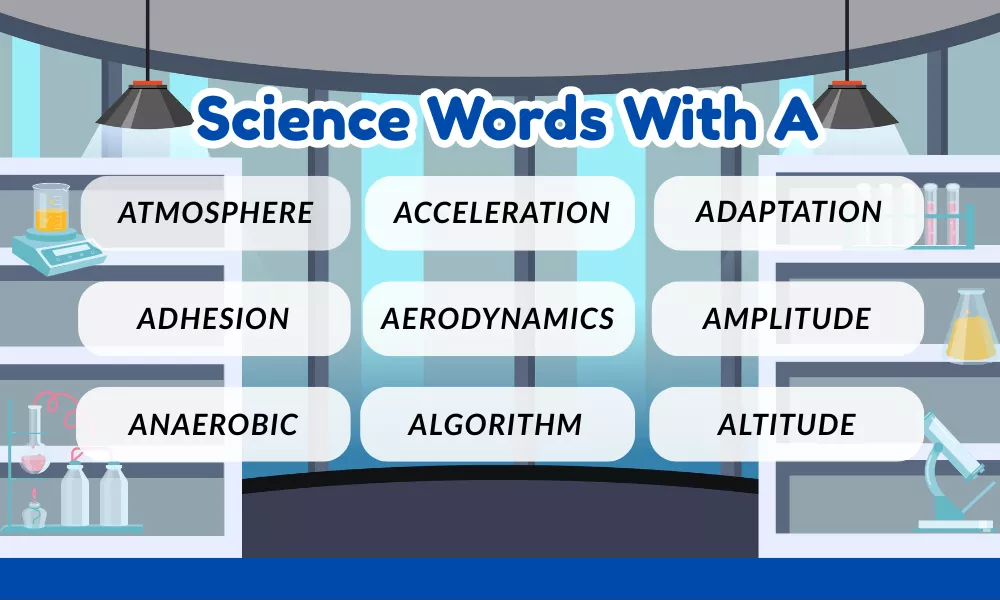
Earth And Space Science Vocabulary With A
- Atmosphere – Gas layer surrounding Earth.
- Asteroid – Rocky object orbiting the Sun.
- Aurora – Polar light display caused by solar particles.
- Astrology – Study linking celestial bodies to events (not scientific).
- Astronomy – Study of space objects.
- Astrophysics – Physics applied to celestial bodies.
- Abyssal Plain – Deep ocean floor region.
- Arid – Extremely dry climate.
- Aquifer – Underground water storage layer.
- Avalanche – Rapid snow slide down slopes.
- Aftershock – Smaller earthquake following main one.
- Asthenosphere – Soft upper mantle layer beneath crust.
- Axis – Imaginary Earth rotation line.
- Aphelion – Point farthest from the Sun in orbit.
- Alluvium – Sediment deposited by rivers.
- Aerosol – Tiny airborne particles.
- Archipelago – Group of islands.
- Atmospheric Pressure – Pressure from air weight.
- Accretion – Growth by accumulation of material.
- Anticline – Upward fold in rock layers.
- Astrobiology – Study of life in the universe.
- Artesian Well – Well where water rises naturally.
- Astrometeorology – Study of space weather effects.
- Astrogeology – Geology of planets and moons.
- Astrolabe – Ancient astronomical instrument.
Engineering And Applied Science Terms With A
- Automation – Use of machines to perform tasks automatically.
- Actuator – Device converting energy into motion.
- Aerodynamics – Study of airflow around objects.
- Algorithm – Method used in engineering calculations.
- Assembly Line – Production system using sequential processes.
- Architecture (Engineering) – Design of structures or systems.
- Amplifier – Device increasing signal strength.
- Alternator – Machine producing alternating current.
- Adapter – Device allowing compatibility between components.
- AutoCAD – Computer-aided design software.
- Antenna – Device transmitting or receiving signals.
- Alloy – Engineered mixture of metals.
- Aeronautics – Science of aircraft design and flight.
- Alignment – Correct positioning of components.
- Autonomous Vehicle – Self-driving transport system.
- Axial Load – Force applied along an axis.
- Anodizing – Process creating protective metal coating.
- Airfoil – Shape used in wings for lift.
- Adaptive Control – System adjusting to changing conditions.
- Arc Welding – Welding using electric arc heat.
- Accelerometer – Sensor measuring acceleration.
- Automation Control – Systems regulating automatic processes.
- Auxiliary System – Supporting system in machines.
- Actuation System – System generating motion.
- Acoustic Engineering – Engineering related to sound control.
General Scientific Words Starting With A
- Atom – Basic unit of matter.
- Acceleration – Rate of speed change.
- Acid – Substance with low pH.
- Adaptation – Survival trait in organisms.
- Atmosphere – Gas layer around Earth.
- Absorption – Taking in substances or energy.
- Amino Acid – Protein building block.
- Allele – Gene variation.
- Antibody – Immune system protein.
- Antigen – Substance causing immune response.
- Anaerobic – Occurring without oxygen.
- Autotroph – Organism producing its own food.
- Aerosol – Particles suspended in air.
- Aquatic – Related to water environments.
- Artery – Vessel carrying blood from heart.
- Axon – Nerve cell extension.
- Astronomy – Study of celestial bodies.
- Alloy – Mixture of metals.
- Acoustic – Related to sound.
- Aperture – Opening allowing light passage.
- Asexual – Reproduction without fertilization.
- Abiotic – Nonliving environmental factor.
- Altitude – Height above sea level.
- Antibiotic – Drug fighting bacteria.
- Adaptability – Ability to adjust to change.
How To Learn & Remember A Science Vocabulary Easily
- Learn Words Through Real-Life Examples
Connect science terms to everyday experiences. For example, think of acceleration when a car speeds up or absorption when a sponge soaks up water. Real-life connections make words easier to remember. - Use Visual Learning Techniques
Diagrams, charts, flashcards, and labeled images help the brain remember complex terms faster. Visual memory often works better than text alone. - Break Words Into Meaningful Parts
Many scientific terms come from Greek or Latin roots. Learning prefixes and suffixes (like bio = life or astro = star) helps you understand and remember many words at once. - Practice Using Words in Sentences
Try writing or speaking sentences using new science words. Active usage strengthens memory more than simply reading definitions. - Study in Small Daily Sessions
Learning a few words daily is more effective than memorizing long lists at once. Short, regular practice improves long-term retention. - Play Science Vocabulary Games or Quizzes
Word games, quizzes, or flashcard apps make learning interactive and fun, helping vocabulary stick in memory without feeling like hard study.
FAQs
Conclusion
Learning science vocabulary that starts with the letter A builds a strong foundation for understanding scientific subjects across physics, chemistry, biology, mathematics, engineering, and space science. From simple beginner terms to advanced scientific concepts, these words help learners communicate ideas clearly and understand scientific processes more effectively. By practicing regularly and applying learning techniques like visualization and real-life association, students and science enthusiasts can steadily expand their vocabulary and confidence in science. Mastering science words alphabetically is a smart and organized way to develop both scientific knowledge and language skills.